
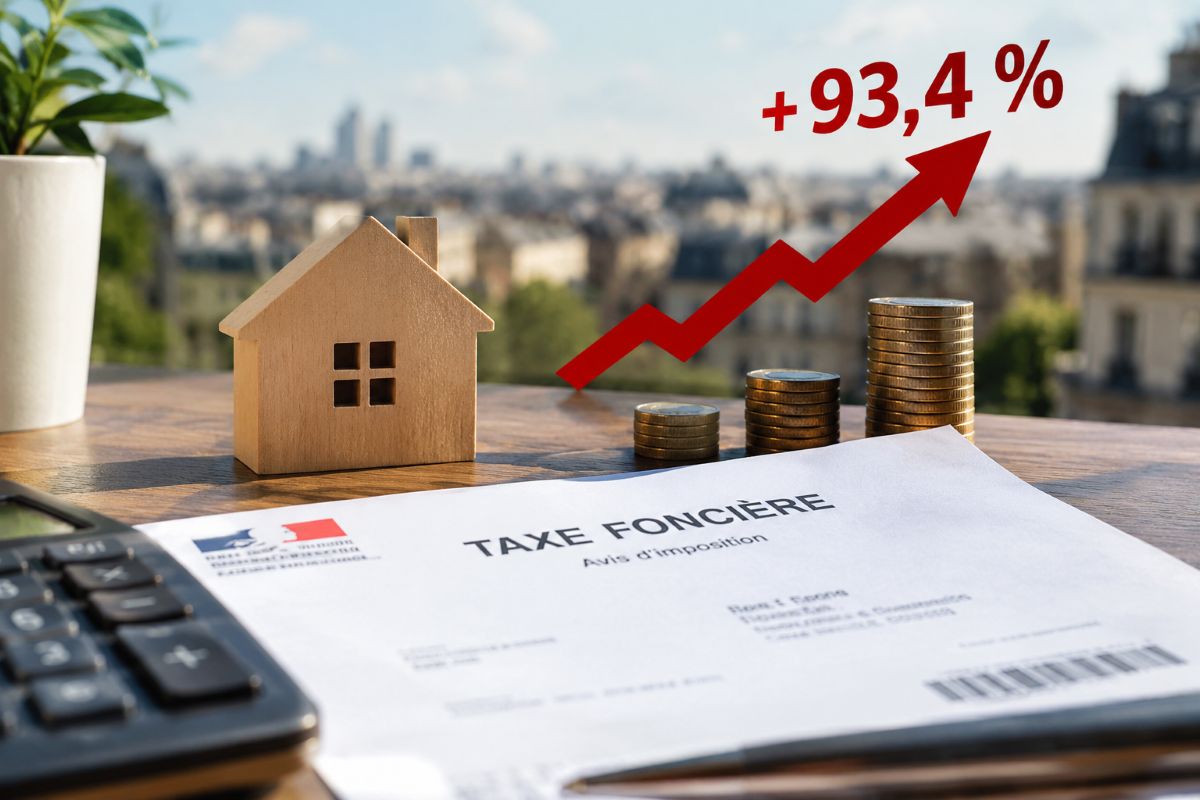
Your property tax has almost doubled in twenty years! According to the UNPI, it jumped by 93.4% between 2005 and 2025, or two and a half times inflation. And the differences are dizzying depending on the city.
Publi-Information 


The bill has almost doubled in twenty years. Between 2005 and 2025, the property tax increased by 93.4% in France, or two and a half times inflation over the same period. An increase which can be explained both by the tax decisions of local authorities and by the revaluation of rental values serving as a basis for calculating the tax, according to the National Union of Real Estate Owners (UNPI).
Paris: an increase of 261% in twenty years
However, not all cities have experienced the same evolution. Among the 50 most populous French municipalities, and unsurprisingly, is Paris, whose property tax has seen the largest increase of large French cities, with an increase of 261% in twenty years, a surge which is explained in particular by a significant increase in the municipal rate, which was previously particularly low. Despite this increase, the capital maintains one of the lowest property tax rates among major French citiesa paradox reminding us that the rate applied is not sufficient, on its own, to determine the amount paid by owners.
In 2026, the increase remains more contained. In the 200 largest French cities, the property tax has increased on average by 1.7% compared to 2025. The UNPI attributes this moderate development in particular to the context of the municipal elections.
More than 1,400 euros in Grenoble, almost 1,200 euros in Bordeaux
In property tax mattersthe bill varies greatly from one city to another. In France, the average amount paid per accommodation reaches 635 eurosexcluding household waste collection tax (TEOM). In the 50 largest French cities, this average rises to 976 euros. Several municipalities far exceed this level:
– Grenoble: 1,487 euros;
– Bordeaux: 1,173 euros;
– Marseille: 943 euros;
– Paris: 900 euros;
– Lyon: 772 euros.
These amounts do not include the household waste collection tax. Once this is integrated, the average tax reaches 1,179 euros in the 50 largest cities.
“Landlords pay increasingly higher charges“
For Sylvain Grataloup, the president of the UNPI, this development raises the question of the distribution of local taxation. “Landlords are paying increasingly higher charges and it’s no longer fair“, he believes. The organization calls for a overhaul of local taxation and property tax. In particular, it defends the principle of “local user contribution“, which would concern all residents, whether they are owners or tenants.
Behind this proposal, the UNPI calls into question a system in which property tax rests on the ownerswhile services financed by communities benefit all residents. A development which would, however, require an in-depth review of current local financing mechanisms.
Revision of rental values still pending
Another file could weigh on the real estate taxation in the coming years: the revision of cadastral rental values. In November 2025, a project planned in particular to automatically take into account certain so-called “comfort” elements in the calculation of tax bases. However, fFaced with criticism, the government suspended the reform and chose to consider a more territorialized approach, taking into account the opinions of departments and even municipalities.
According to the UNPI, letters have since been sent to local authorities to suggest that they apply this reform. Some municipal councils have started to speak out on the subject.
The debate therefore remains open. After twenty years of increases, changes in rental values could further modify the amount of property tax paid by certain owners. It remains to be seen under what terms and with what effects on future invoices.