
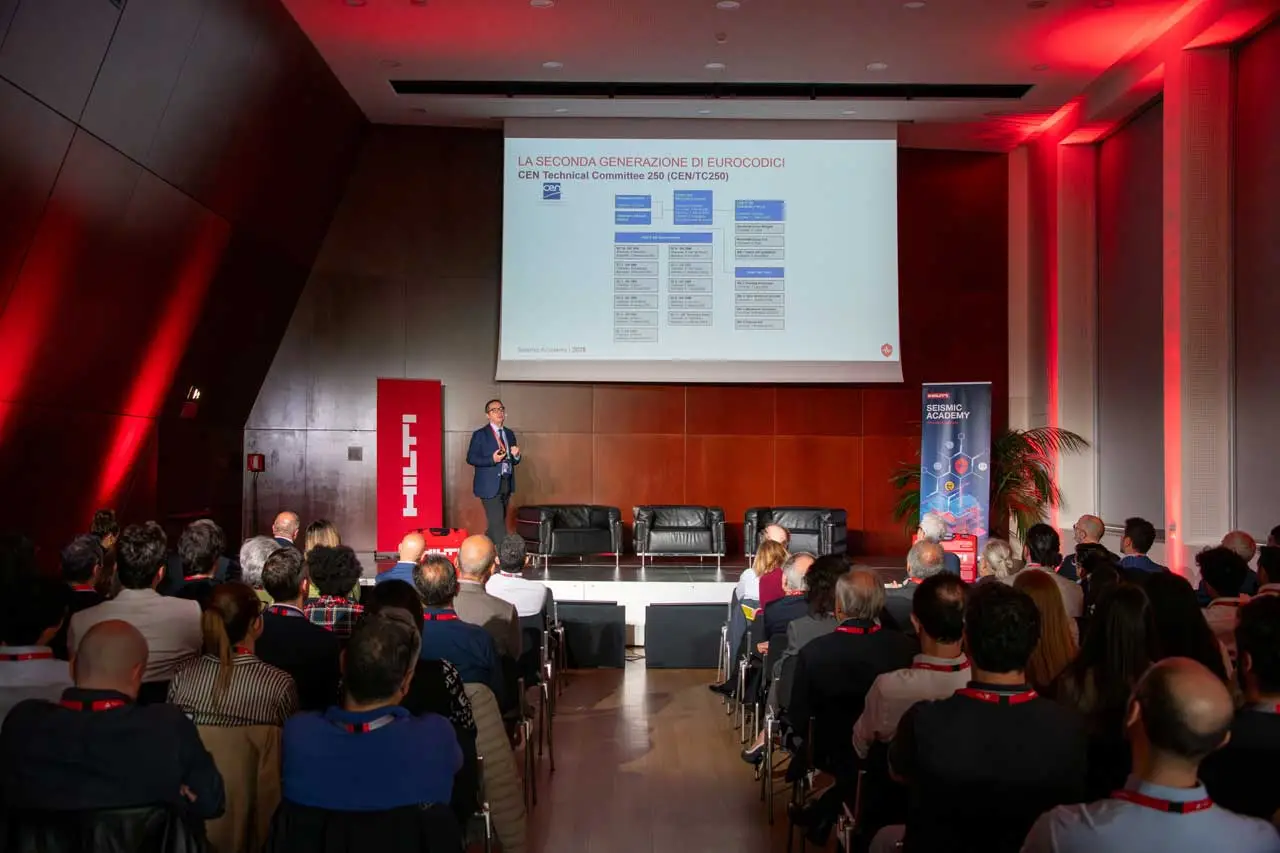
The transition to second generation Eurocodes: is the sector ready?
EdilTechnician: “Engineer, the roadmap drawn up by Prof. Landolfo sets the definitive withdrawal of the first generation of the Eurocodes for 2028, opening a crucial phase of coordination between National Annexes and our NTCs. From the point of view of a leading company like Hilti, which experiences the pulse of the market and professionals on a daily basis, how do you assess the state of readiness of the Italian engineering sector in the face of this imminent regulatory “switch” and what could be the main bottlenecks in the transition?”
Engineer Baccarini: “The arrival of the second generation of the Eurocodes will certainly represent a moment of strong discontinuity for the sector, both for engineers and for companies operating in the construction world. In fact, professionals will find themselves dealing with new design approaches, updated formulas, new coefficients and, in some cases, with a significant revision of the verification methodologies compared to the first generation of regulations.
Some of the new Eurocodes have already been published some time ago; however, even as a company that communicates daily with designers and engineering firms, we have so far recorded a relatively limited number of requests for further information. I believe that this is also an indication of the awareness of professionals regarding implementation times and the fact that some application aspects remained poorly defined until the publication of the National Annexes.
Overall, I believe that the Italian engineering sector has the skills to effectively deal with this transition. However, it will be essential to accompany the market with continuous training and updating activities. In this sense, professional associations, universities, technical associations and companies in the sector will have a key role in making the transition as smooth as possible.
From Hilti’s point of view, this journey began several years ago. In fact, regulatory evolution directly impacts design tools, calculation software, verification methodologies and technical documentation that we use and make available to our customers. This is why we are working in advance to guarantee operational continuity and technical support to designers during all phases of the regulatory “switch”.
Personally I believe that one of the main bottlenecks could be a publication of the National Annexes too close to the definitive withdrawal of the first generation of the Eurocodes. In such a scenario, design studios may find themselves having to quickly incorporate new regulatory requirements into internal software and tools. It is clearly a limit hypothesis, but it highlights how important it will be to ensure a gradual and well-coordinated transition phase.”
Eurocode 8, resilience and structural connections: what changes for fixings and anchors
EdilTechnician: “The evolution of Eurocode 8 towards a more resilient and displacement-based seismic design (Performance-Based Design) will inevitably also influence the calculation and verification of fastening systems and structural reinforcements, areas in which Hilti research has always been at the forefront. How will these EC8 innovations guide the development of your future anchoring systems and what technical challenges do you see for the calculation of structural connections?”
Engineer Baccarini: “The evolution of the EC8 introduces very relevant changes not only for the world of structural connections, but also for the design and fixing of non-structural elements, areas which today take on an increasingly central role in the overall seismic safety of buildings.
As regards anchors, many of the innovations concern above all the evaluation of the seismic actions that reach the connection and the way in which these are considered in the design phase. This does not mean, however, that substantial changes are missing: the seismic design of fastening systems is in fact more integrated into the new EC8-1-1, with direct implications on the choice of anchors and on checks based on structural ductility and seismic action class.
For companies like Hilti, this regulatory evolution represents a further stimulus to the development of increasingly advanced anchoring systems and design tools, capable of supporting design approaches oriented towards the performance and resilience of structures. This is an evolution that will require companies to have a strong alignment between legislation, experimentation and design tools, with the aim of guaranteeing professionals increasingly reliable solutions consistent with new design approaches.”
Training, software and technical support: how to accompany designers
EdilTechnician: “Prof. Landolfo underlined how this regulatory revolution will require a continuous updating of skills and a strong alignment between research and professional practice. What are the strategies and concrete initiatives that Hilti – for example through the extension of the Hilti Academy training offer or the evolution of calculation software such as PROFIS Engineering – intends to implement to support Italian structural designers in this training and technical adaptation path?”
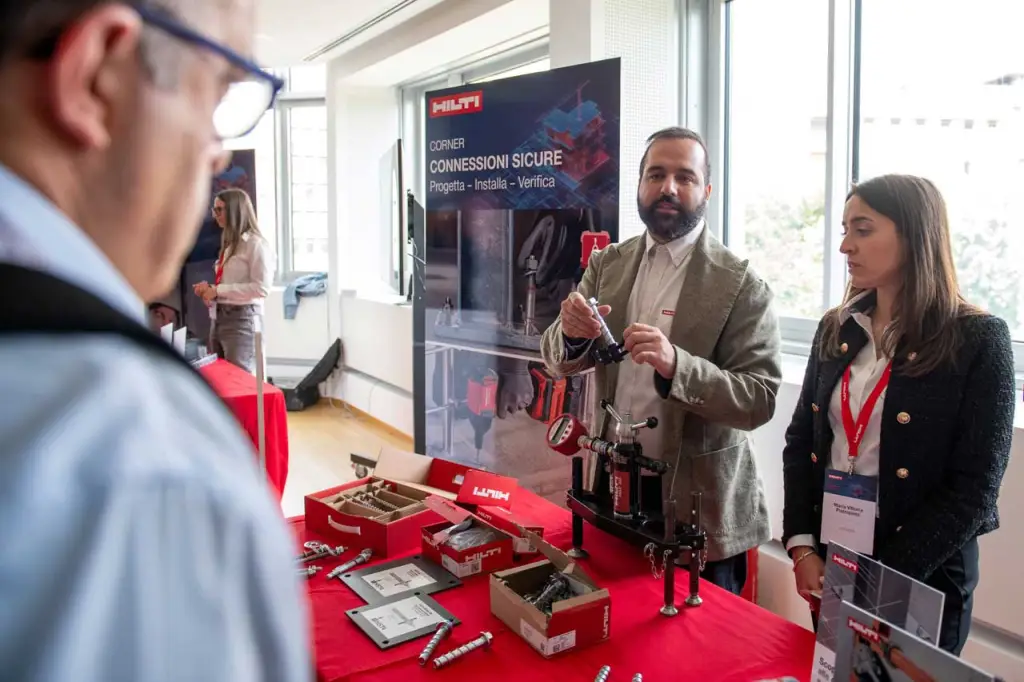
Engineer Baccarini: “One of the first steps will certainly be the updating of our internal and external calculation software, such as PROFIS Engineering, in parallel with the continuous training of our Field Engineers. It is essential that our specialists are prepared in advance on regulatory developments, so as to be able to support the designers with constantly updated technical skills.
Subsequently, our team of Field Engineers will directly support the design studios through dedicated technical meetings, application insights and moments of discussion on the main innovations introduced by the second generation of the Eurocodes and, subsequently, by the future NTCs. To reach an even broader audience, we will also continue to invest in technical webinars, specialized content published on Engineering Center and support tools such as the ASK section, which allows designers to ask questions directly to our experts. For Hilti this approach is now consolidated, as the world of structural connections and support systems is constantly evolving and requires constant updating of skills.
Already in the last two editions of the Seismic Academy we have dedicated an important space to the in-depth analysis of the new Eurocodes, precisely because we believe it is essential to accompany the market in such a significant regulatory transition. It is a commitment that we intend to further strengthen in the coming years, also in view of the evolution of the Technical Standards for Construction, which will represent a further important step for the entire sector.”
Not just Eurocodes: design quality, BIM and risk management
The Seismic Academy 2026 discussion was not limited to the regulatory transition. During the day, other central themes for the future of construction were also addressed: from the quality of the design to the feasibility of the works, up to the use of BIM in complex projects and the management of large-scale seismic risk.
In the round table with the contribution of AssoRUP and Conforma, the evolution of the role of the RUP emerged, increasingly closer to that of a public project manager, called to integrate engineering, legal-administrative and management skills. The comparison also highlighted the importance of preventive and independent verification to improve the quality of projects, in a context in which design non-conformities can generate delays, disputes and additional costs.
The case study dedicated to the redevelopment of the Artemio Franchi Stadium in Florence has shown the complexity of interventions on the existing heritage, where it is necessary to integrate innovation, protection of historical structures and seismic improvement. The intervention brought the structure’s safety index from 35% up to around 80%, demonstrating how even complex historic buildings can be adapted to contemporary standards through an integrated approach.
The round table with Aecom, Lombardini 22 and Politecnica instead placed emphasis on the technical governance of complex works and the gap between planning and execution. Projects that are formally correct from a regulatory point of view are not always fully workable: hence the importance of coordination along the entire supply chain and of the early involvement of designers, companies, suppliers and customers.
EXYTE’s experience in managing highly technologically complex projects has highlighted the role of BIM as an enabling element for continuous integration between design, construction and commissioning, especially in areas such as data centers and clean rooms. The digital model thus becomes an operational tool for coordination between disciplines and stakeholders, also useful for managing times, costs, critical issues and work progress.
Finally, the UniCredit model for the prevention and management of large-scale seismic risk has shown how the approach to safety can no longer be limited to the single building, but must extend to the entire real estate portfolio. Starting from the obligations introduced by Legislative Decree 81/2008 and strengthened by the 2018 NTC, the group has developed a strategy on over 2,700 properties, defining intervention priorities based on danger, vulnerability and exposure.
The perspective that emerged from the Seismic Academy 2026 is clear: the second generation of Eurocodes not only introduces new requirements, but requires a different level of integration between legislation, research, digital tools and professional practice. For designers, the path towards 2028 will therefore also be a test of technical and organizational updating, in which continuous training, design quality and collaboration along the supply chain will play a central role.
For further information
hilti.it