
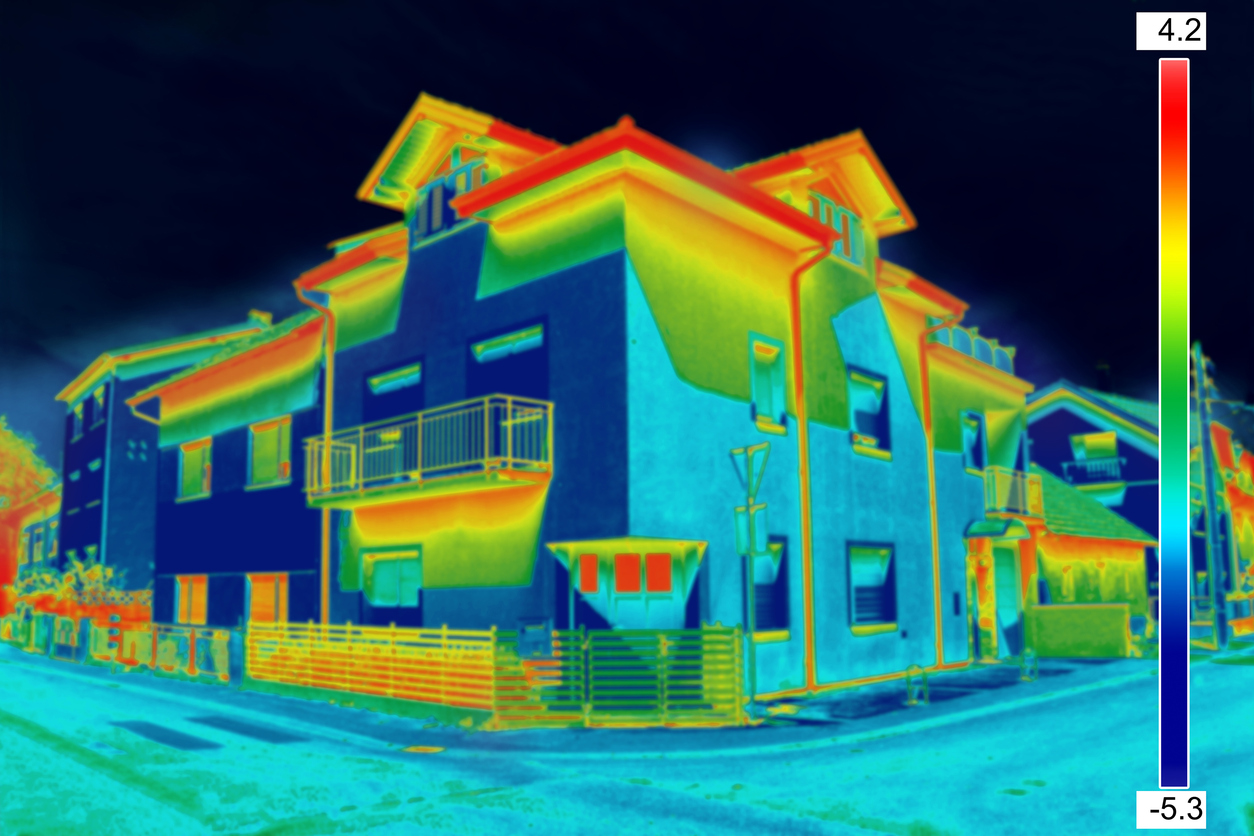
The new Minimum Requirements Decree (DM 28 October 2025), which updates the framework of minimum energy performance requirements for buildings, has introduced, as we know, important innovations for energy design. These include a new definition of thermal bridge, contained in article 10 of the decree, which modifies point 32 of Annex A to Legislative Decree 192/2005.
This is a modification that offers the opportunity to delve deeper into one of the most delicate aspects of building envelope design: the correct identification of thermal bridges, the understanding of the physical phenomena that characterize them and the evaluation of their consequences.
Thermal bridge: the old and new regulatory definitions
The Ministerial Decree of 28 October 2025 intervenes on the definition contained in Annex A of Legislative Decree 192/2005, replacing the previous point 32. The previous definition of thermal bridge was the following:
32. thermal bridge is the discontinuity of thermal insulation that can occur at the joints of structural elements (floors and vertical walls or vertical walls between them).
The new definition, introduced by the Ministerial Decree of 28 October 2025, is instead the following:
32. thermal bridge: more or less extensive area of the building envelope characterized by thermal dispersion due to construction, structural or geometric discontinuities and the use of materials with different thermal conductivity values, in compliance with what is defined by the UNI EN ISO 10211 standard.
The comparison highlights a change in the approach of the two formulations. The previous definition identified the thermal bridge with a discontinuity in the insulation, referring to the connections between structural elements. The new formulation instead broadens the description of the phenomenon, recalling the constructive, structural and geometric discontinuities, as well as the use of materials with different thermal conductivity values.
Precisely the relationship between this definition and the physical phenomenon constitutes the starting point of the reflections developed by the author.
What really is a thermal bridge and when does it form?
To understand the meaning of the thermal bridge it is necessary to start from the behavior of the heat flow through the building envelope. As Pesaresi explains, we can define a thermal bridge as the part of the envelope of a building in which a disturbance of the heat flow and the trend of the isotherms occurs, with a consequent modification of the internal surface temperature and heat flow rate.
In a homogeneous flat wall, the heat flow normally passes through the building element in a direction perpendicular to the internal and external surfaces, while the isotherms are parallel to the faces of the wall. When a disturbance occurs, the flow instead takes on a two-dimensional or three-dimensional pattern, modifying the temperature distribution.
This phenomenon can occur in different situations, for example:
- Interpenetration of materials with different thermal conductivity, as in the case of a concrete pillar inserted into a wall.
- Variations in thickness of construction elements, such as in radiator niches under windows.
- Angles between construction elements, internal or external, in which the geometry modifies the trend of the heat flow.
These examples show how the thermal bridge cannot be traced back exclusively to the interruption of the insulation, but must be analyzed considering the overall behavior of the construction node.
The consequences of thermal bridges: dispersions and internal comfort
The presence of a thermal bridge can produce two main consequences. The first concerns the modification of the internal surface temperature, which can favor the formation of surface condensation and increase the risk of mold development, with repercussions on the quality and healthiness of the environments.
The second concerns the modification of the thermal capacity, which can determine an increase in energy dispersions through the envelope and therefore in the energy needs of the building.
Pesaresi underlines the importance of distinguishing these two aspects: the evaluation of energy dispersions, alone, does not necessarily allow us to exclude critical issues linked to internal surface temperatures. It therefore becomes essential for the designer to consider both consequences of the phenomenon, avoiding interpreting the thermal bridge exclusively as a source of energy dispersion.
A thermal bridge does not necessarily coincide with a discontinuity in the insulation
One of the most interesting aspects of the author’s in-depth analysis concerns the clarification of some concepts often used as equivalent. Through an example relating to a wall characterized by a different stratigraphy, but by the same overall thermal resistance, Pesaresi shows how the thermal flow can still undergo a disturbance.
The variation in thermal resistance alone therefore does not constitute a sufficient criterion to define the presence of a thermal bridge. Similarly, a thermal bridge can be present even when the thermal insulation has no interruptions.
A further clarification concerns the concept of correct thermal bridge. The author recalls the previous definition introduced by Legislative Decree 192/2005, according to which a thermal bridge was considered correct when the thermal transmittance of the fictitious wall did not exceed that of the current wall by more than 15%. According to Pesaresi, this criterion is not sufficient to guarantee that the thermal bridge is actually correct from a thermohygrometric point of view. Even in the presence of very close transmittance values, in fact, the thermal flow can undergo such a disturbance as to modify the internal surface temperatures. The correction of a thermal bridge must therefore also be evaluated with respect to surface temperatures and the risk of mold formation, as well as in relation to energy losses.
The new regulatory definition and implications for design
While acknowledging the attempt to overcome the previous formulation, the author highlights some aspects which, in his opinion, continue to lend themselves to interpretations that do not fully adhere to the physical nature of the phenomenon. In particular, he observes that the reference to thermal dispersion risks focusing attention on only one of the consequences of the thermal bridge, leaving the modification of internal surface temperatures in the background, which is crucial for thermo-hygrometric comfort and for the prevention of mould.
The distinction takes on particular importance in design practice, where the linear thermal transmittance coefficient ψ is used to quantify the contribution of thermal bridges to the dispersions of the casing, without however exhausting the description of the physical phenomenon. The regulatory update therefore represents an opportunity to recall the importance of design that pays attention not only to energy performance, but also to the thermo-hygrometric behavior of construction nodes and the quality of internal environments.
For further information: Sergio Pesaresi’s volume
As anticipated, this article takes up the contents of the chapter “New definition of thermal bridge” of the volume Understand the minimum requirements for designing the ecological transitionby Sergio Pesaresi, published by Maggioli Editore. The book offers a comparative and commented reading of the Ministerial Decree of 26 June 2015 and of the Ministerial Decree of 28 October 2025, delving into the innovations relating to the minimum energy performance requirements of buildings and providing operational indications for the Technical Project Report and the Energy Performance Certificate (APE).