
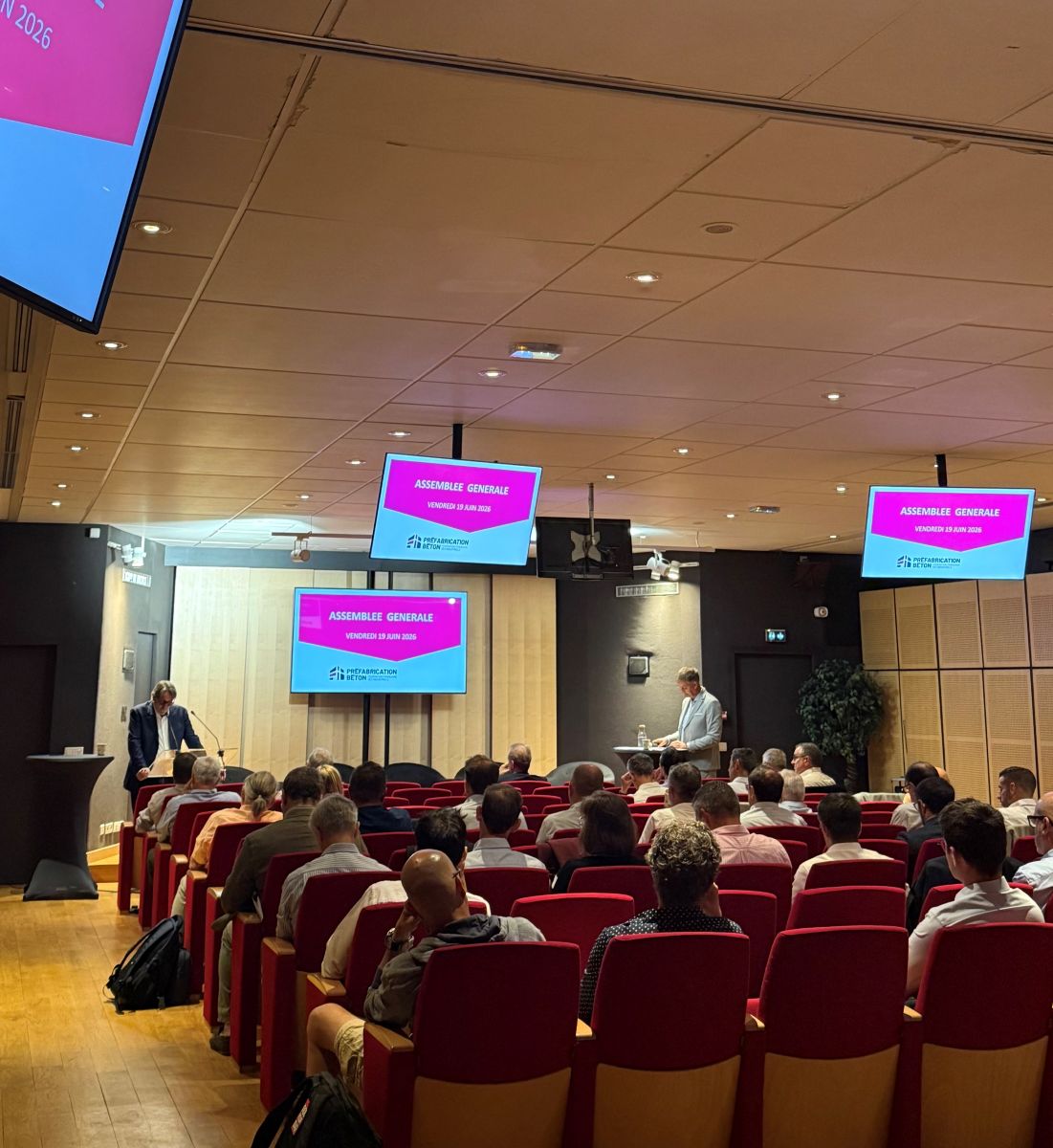
Gathered in Paris for their general assembly, prefabrication concrete manufacturers highlighted their constructive advantages, while placing water conservation at the top of their priorities.

The water crisis is now emerging as one of the major challenges in construction. This is the message that the French Federation of Concrete Prefabrication Industrialists (FIB) during its 2026 general meeting organized on June 19 in Paris.
For this first general assembly since the change of name of the organization – which became at the beginning of 2026 the French Federation of Concrete Prefabrication Industrialists –, the sector has demonstrated its desire to improve to recognize the specificities of the off-site construction methode, while demonstrating its ability to respond to the environmental issues that are already shaking up the territories.
The FIB claims the singularity of concrete prefabrication
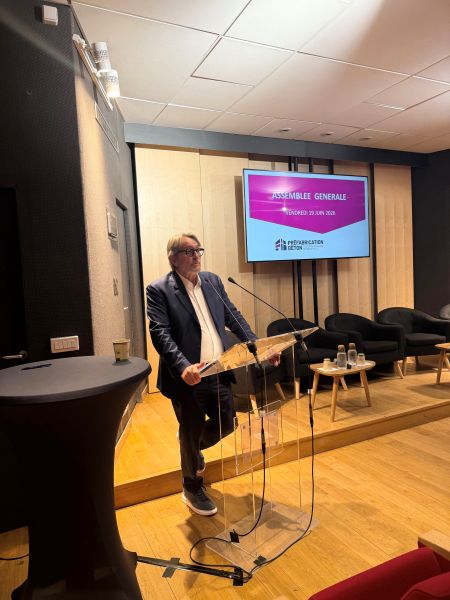
Through this repositioning, the federation clearly intends distinguish concrete prefabrication from other uses of the material. The objective is to accelerate the use of industrialized solutions produced locally for buildings, infrastructure and civil engineering works, a strategy supported by Jacques Platard, elected president of the federation last year.
The survey carried out among members also confirmed several priority areas of work: prevention and safety, ecological transition, strengthening links with training establishments, but also rapprochement with local authorities.
In this logic, the federation has launched an approach to raise awareness among elected officials around the message “Prefabrication Concrete, the plus that transforms your territory”an argument which highlights the gains obtained in terms of decarbonization, control of deadlines, reduction of construction site nuisances and acceptability by local residents.
A situation which continues to weigh on the sector
This offensive desire, however, comes in a particularly tense economic context. While the outlook for the end of 2025 gave hope for a gradual recovery in housing and a more measured slowdown in public works, the conflict in the Middle East came to reshuffle the cards. The rise in energy and raw material prices immediately affected production costs and dampened investment prospects. The European Central Bank’s recent decision to raise its key rate to 2.25% also fuels concerns about the market’s ability to restart.
The figures presented at the general meeting reflect this persistent fragility. THE concrete products intended for buildings show a decline by 2.5% in volume over the first four months of 2026, a trend which continues nearly forty consecutive months of decline in activity. On the public works side, volumes also fell by 3%. The profession now fears a postponement of certain public investments due to budgetary constraints or a redeployment of funding towards other priorities.
In this context, manufacturers are concerned about the growing pressure on cash flow across the entire construction value chain.
Water sobriety: the industry releases the figures
However, it is in the field of water that the federation has chosen to concentrate a large part of its work.
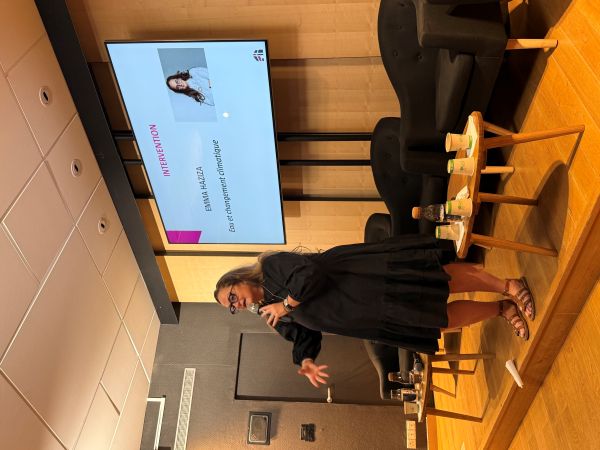
Guest of the event, hydrologist Emma Haziza recalled the scale of the challenges awaiting the territories, faced with an increasing alternation between prolonged droughts and episodes of extreme rain. © FIB
To objectify the issues, CERIB presented a study carried out at the request of the FIB with 148 industrial sites representative of the profession. The results show that the sector takes approximately 1.8 million m3 of water per year for all of its marketed production. On average, the manufacturing one ton of prefabricated products requires 105 liters of water, integrating concrete formulation, washing operations and various industrial processes.
Supply sources are divided between groundwater (55%), public networks (35%) and other resources excluding recycling (10%).
Above all, the study reveals an already underway dynamic of reducing consumption:
– 93% of industrial companies reuse recycled water in their concrete ;
– 68% have detailed mapping of their water flows;
– 67% have modified their processes to reduce their consumption;
– 65% now follow dedicated performance indicators.
In order to achieve the national objective of reducing taxes by 10% by 2030, set by the Water Sobriety PlanHowever, the sector considers it necessary to go further by generalizing closed circuits, the recovery of rainwater, the use of unconventional water and the optimization of industrial processes.
Several industrialists came to share their feedback: at PROPRESO, in Charente-Maritime, the work focused on the centralization of the water needs of eight concrete plants. The objective was to recover, treat and reuse all the water from the different processes in a closed circuit, while recycling the rainwater collected from the buildings. A2C Préfa has undertaken a similar transformation at its Sivry and Melun Ile-de-France sites, with the support of the Water Agency. Rainwater is now stored in buffer basins before being reinjected into washing operations. All water flows have been mapped and the infrastructure adapted.
Result: the two factories no longer discharge any waste into the natural environment and no longer draw water from local resources.
Adapting industry to tomorrow’s climate
The FIB also presented the first lessons from an experiment carried out with the General Directorate of Enterprises, ADEME and Bpifrance around adaptation to climate change. The manufacturers CAPREMIB and LG Industrie served as pilot companies to identify the climate vulnerabilities of their activities and build roadmaps adapted to their entire value chain. This approach is part of the third National Plan for Adaptation to Climate Change (PNACC-3), the implementation of which still remains complex for many industrial SMEs.
Continuing this work, the federation and Bpifrance now wish to strengthen their collaboration in order to facilitate access for concrete prefabrication manufacturers to financing mechanisms linked to ecological transition investments.