
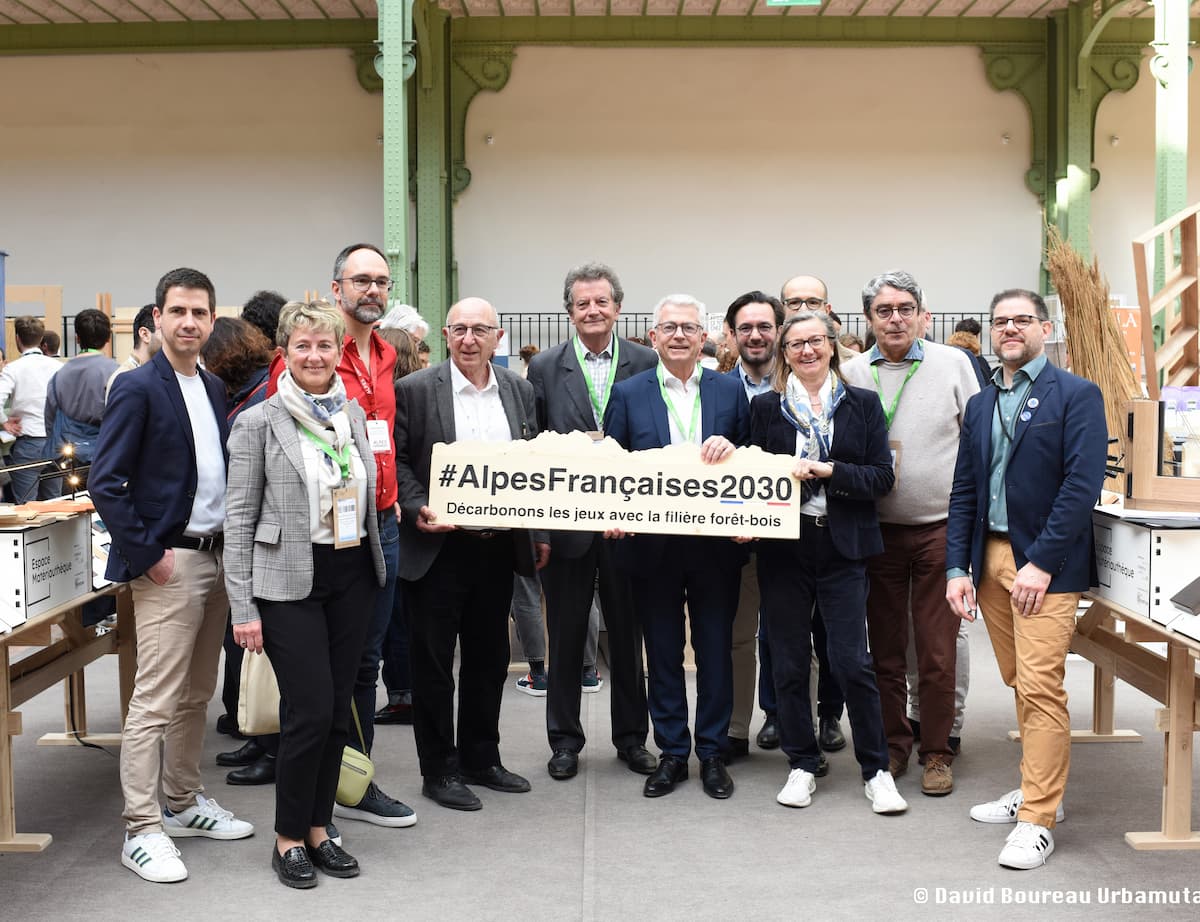
The France Bois 2030 mission, launched at the 15th International Bois Construction Forum, must support the Olympic installations and especially the successive legacy phase, but it is already faced with deadlines.

Put wood in the Games is an ancient story. In 1924 in Paris, the Olympic village of Colombes was in chalets. In Albertville in the Alps in 1992, the very young CNDB launched with the support of the Ministry of Agriculture was cutting its baby teeth on largely concrete installations. For Paris 2024as the award took place almost at the same time as COP21, it seemed logical to develop a low-carbon approach and, led by Luc Charmasson and Georges-Henri Florentin, lobbying was strong upstream at the program level, notably from the Athletes’ Village, and more measured as the promotion groups took control. THE volume of wood was gradually shrinking compared to the first forecasts, but France Wood 2024 could count on the outperformance of the portion of French wood. The hybrid from R+7 became concrete with FOB, which was already not so bad and required a lot of ATEX work (unfortunately case B) often grouped together.
Legacy Objective
THE launch of the France Bois 2030 missionto accompany the JOP 2030 in the French Alpses, did not give rise to a public assessment of the work of France Bois 2024. At least, the sector’s financiers have decided to renew the formula to try to do better.
In principle, 2030 is the big year that marks the carbon neutrality of 2050, and in this context, building very low carbon is obvious. The Olympic Committee itself has gradually evolved in this direction. Furthermore, the Alps are resinous, industrialized in terms of the wood construction sector and the two inter-professional associations which cover the Alps, FiBois Aura and FiBois Sudfully engaged. The main issue is less the holding of the Games than the prospect of a fundamental reconversion of this entire region faced with melting glaciers, landslides, lack of snow and the need to rethink white gold into green gold.
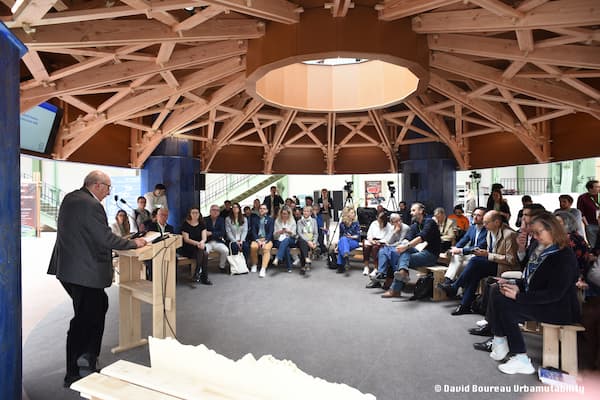
Gérard Gautier, president of the France Bois 2030 Mission, during the Quadrilogue at the International Wood Construction Forum at the Grand Palais last February. ©David Boureau urbamutability
A dedicated workshop that has been matured for a long time
France Wood 2030 was in the starting blocks on time. Since summer 2025, Olivier Gaujard, vice-president of FiBois Sud and linchpin of the mission in formation, prepared a dedicated workshop for the 15th edition of the Forum, centered on two subjects, the renovation of winter sports resorts and wooden bridges. In fact, the prospect of the Games leads to an extension of a highway coupled with the construction of wooden bridges on which the BE Arborescence works.
Appropriately, a new version of the French civil engineering reference work on wooden bridges is published and presented all over the world (New Zealand, Austria, etc.). This is a real bridge between the 2024 Games and those of 2030, since Georges-Henri Florentin had succeeded in having the elegant Dugny footbridge built, subsequently carried out by Exploration Architecture in collaboration with the European specialist Miebach, then innovative Simonin with the use of his RESIX glued dowel technique. A sort of ripple effect is observed with the Bondy footbridge inaugurated at the end of 2025 (Aldo Turchetti Architects, BI and AIA Ingénierie).
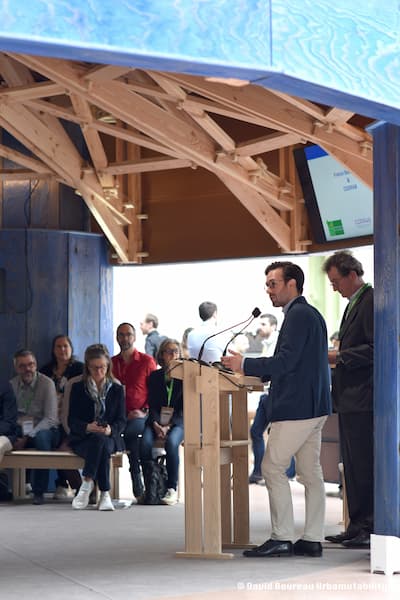
France Bois Forêt and Codifab support the France Bois 2030 initiative. © David Boureau urbamutability
JOPs that start in doubt
For the legacy component of rehabilitation of winter sports resorts, Roux Entreprise conveniently delivers an operation in Avoriaz in autumn 2025, while architecture students from Malaquais, with Pascal Gontier and Milena Karanesheva, are working on the reconversion of another small mid-altitude resort facing a snow deficit. While the programming for the B9 workshop on Friday, February 27 is solidifying, the vote on the framework law on the 2030 JOPs. Added to this are bickering within Solidéo. Aware of the opportunity of the dedicated workshop and the Forum at the Grand Palais, the actors of the mission tried to place an official launch there which came up against the validation of their visual identity, authorized at the last minute. The presentation of the mission under the Quadrilogue, at the Grand Palais, refers to a large meeting planned in Marseille in March, where the wood industry is present as a bloc to affirm its intention to take part in the economic developments of these winter games. Alas, the municipal elections are reshuffling the cards in Nice and calling into question part of the Solidéo concept.
A qualitative aim
This context emphasizes the imperative of deadlines and makes us forget the civic and social acceptability undermined in Italy this winter, faced with “games without snow”, without forgetting the outbreak of the Iranian war before the end of the Olympic Games, a mania since 2022.
France Bois 2030 prefers not to trumpet on wood or biosourced share objectives or part of French woodin a context that is still too uncertain. Which also makes it possible not to enter into controversies between the wood of France and the wood of the Alps. The objective is rather qualitative. Firstly through perfect interaction with Solidéo and optimal support for the construction industry players who will carry out the work, then through the choice to push subjects such as wooden bridgesthe renovation of stations, but also the use of work under marquees.
At the same time, the obvious prefabrication in wooden construction should constitute an asset in meeting deadlines, in a context different from that of the 2024 Olympic Games, less prosperous and with more extensive production capacities.
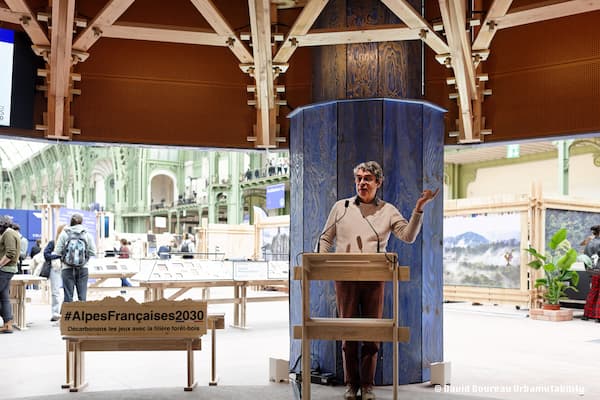
Olivier Gaujard, project manager of the mission and moderator of the B9 dedicated workshop at the Forum. © David Boureau urbamutability
France Bois 2030 is also 2030
With the help of the Forum’s sounding board, the France Wood 2030 mission has certainly enough to do to support the preparation of the JOP 2030. But it also constitutes a spearhead for the French construction industry to achieve emissive objectives by 2030 despite the guilty vagueness which is currently practiced on the objectives of the world of construction in the face of a general objective which reduces emissions to 270 Mt per year, while, in fact, the construction sector is the first emitter of French GHGs if we stop hiding our faces.
Jonas Tophoven / © David Boureau urbamutability