
Xerfi and the Montaigne Institute looked at the links between demography and housing. The Montaigne Institute speaks of a demographic archipelago. Xerfi predicts a sharp decline in housing construction from 2030.

Two institutes looked at the same timeinfluence of demographics on housing : Xerfi and the Institut Montaigne. Starting from thepredictable evolution of French demographics, sectorization of housing – young working people in large cities, families with children on the outskirts of large cities and elderly people in medium-sized towns – poses real problems and to which municipalities are poorly equipped to react.
The aging of the French population is inevitable
According to the study presented by Xerfi in Paris on March 17, 2026, the decline in the French population has long been understood, but has not produced any real political reaction. Like the demographic developments are relatively slow, demographic forecasts for the next 25 years are almost certain. And this is not particularly encouraging, nor without serious consequences for housing.
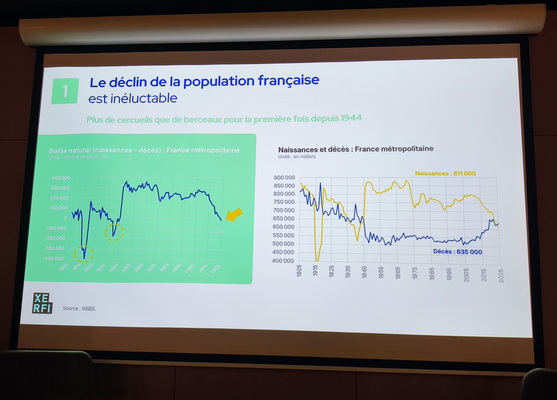
In 2025, the number of births and deaths in France will overlap: in the years to come, there will be more deaths than births. This should lead to a break and the start of the decline in the active population around 2040. This phenomenon could be slowed down, but not reversed, if a new reform further delays the retirement age. © Xerfi
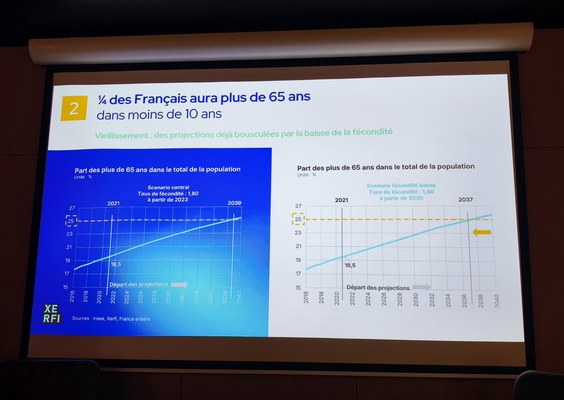
As a result of the drop in births, the population is aging and from 2037, the proportion of people over 65 will increase to 25% and will continue to rise thereafter. © Xerfi
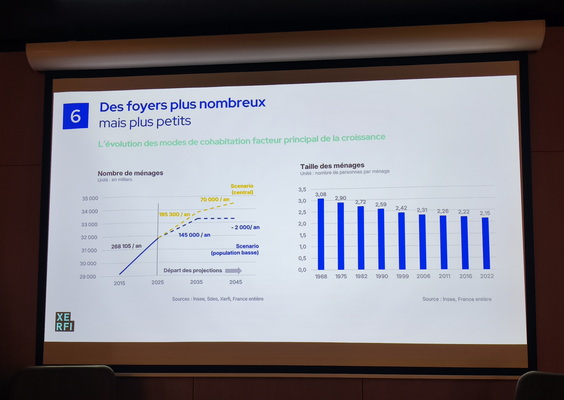
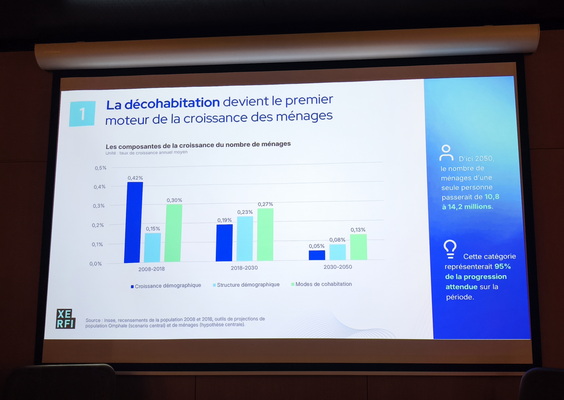
The number of households is expected to continue to grow until around 2045, but mainly because of de-housing. As of 2022, the average number of people per household was only 2.15 and this is expected to continue to slowly decline. And cohabitation will be the main factor in the growth in the number of households. © Xerfi
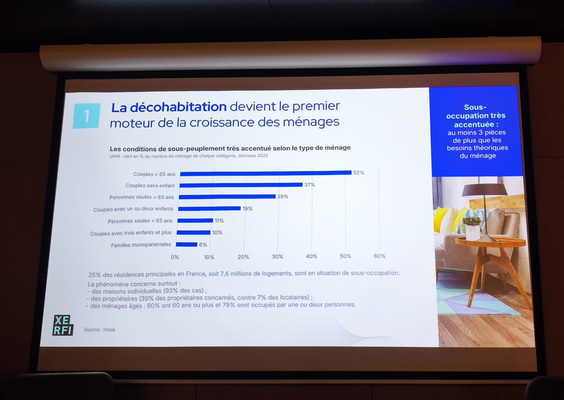
Another consequence of cohabitation according to Xerfi, under-occupancy of housing – defined as at least three rooms more than the theoretical needs of households – is increasing among elderly people, single and in couples, and among couples without children. According to Xerfi, as of now 25% of primary residences in France, or 7.6 million homes, are under-occupied. These are primarily individual houses in 93% of cases. Owners are significantly more concerned (39%) than tenants (7%). And these tend to be elderly households: 60% of sub-occupants are at least 60 years old and 70% of them are households of one or two people. © Xerfi
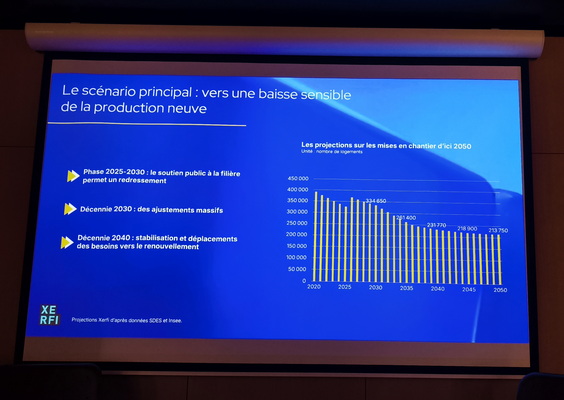
Faced with these developments, Xerfi forecasts a sharp drop in the construction of new housing, after the 2025-2030 period for which the public authorities have put in place various means of support. The 2030 decade should see a rapid and significant decline in the annual number of new housing units, then stability at slightly above 210,000 new housing units per year during the 2040 decade. © Xerfi
Faced with the aging of the population, new housing needs are emerging
The vast majority of elderly people want to end their lives at home. Which justifies the housing adaptation work and the interest of MaPrimeAdapt’. But this is not always possible and, to get around the EHPAD, whose image is not improving, new types of housing are appearing, as well as new types of financing. On the financing side, two fintech companies, Arrago and Mirabelle, as well as Certivia, a subsidiary of Caisse des Dépôts et Consignations, offer life mortgage loans. Arrago and Certivia offer a loan of at least €50,000, in exchange for the mortgage on the borrower’s real estate. These loans have no monthly repayment payments. The loan and its interest are repaid when the mortgage matures.
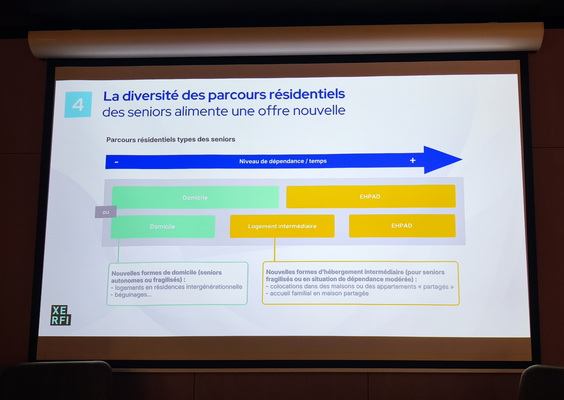
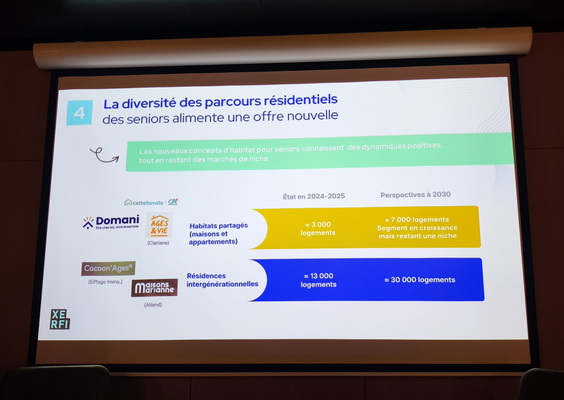
Xerfi indicates that new types of housing are appearing for seniors who are still independent – intergenerational residences or beguinages – but also for seniors who are already vulnerable, but not totally dependent: shared accommodation and shared houses. Some developers, such as Domani, AGES & VIE, have launched into shared housing, which should nevertheless remain a niche until around 2030. While others, such as Cocoon’Ages (Eiffage Immobilier) and Maisons Marianne (Atland) are promoting intergenerational residences with 30,000 housing units in perspective by 2030. © Xerfi
The new demographic archipelago: a challenge for Mayors
The study by the Institut Montaigne, carried out using data collected by Terre deData, focuses on the polarization of territories according to age and family structure. The Montaigne Institute explains that “large cities concentrate young workers, while medium-sized cities age more quickly; families with children are moving to the outskirts; single-parent families are making strong progress in several metropolises. This demographic archipelago is not a simple statistical observation: it reconfigures the demand for public services, modifies the balance of facilities (schools, early childhood, health) and redraws the planning decisions“Mayors, underlines the Montaigne Institute, are caught between two fires: responding urgently to the immediate effects of these flows, while seeking to influence the structural determinants which guide residential trajectories, first and foremost access to housing.
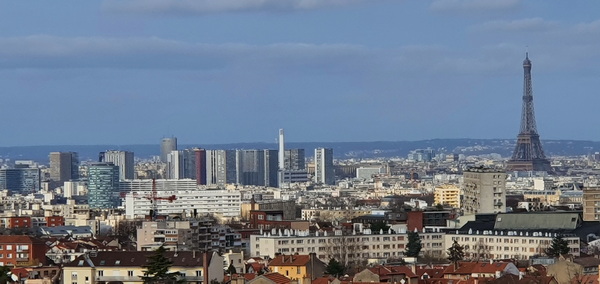
Between 2016 and 2022, the share of people under 25 and 25-54 years old continued to increase in large cities, while it declined in medium-sized cities, defined as those whose Cities Attraction Area (AAV) has between 50,000 and 200,000 inhabitants. The concentration of young workers in large cities is also due to the growing number of adults over 25 still living with their parents. This number is accelerating in the twelve largest French cities, with increases often exceeding 10% between 2016 and 2022. © PP
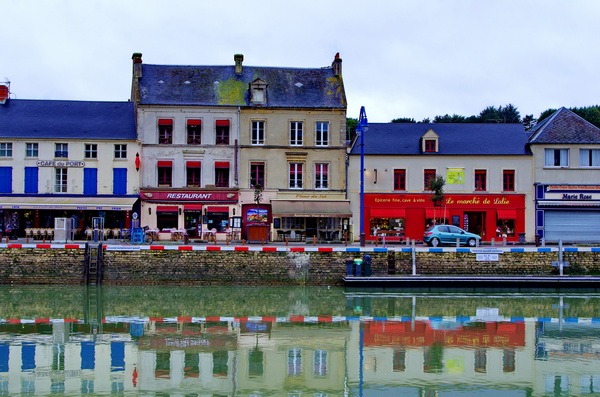
The increase in the number of people over 55 is almost twice as fast in medium-sized cities as in large cities, accentuating the contrast between dynamic metropolises and intermediate territories experiencing accelerated demographic aging. © PP

In large cities, the presence of families with at least one minor child is clearly declining in favor of the outskirts. In the twelve largest French cities, the number of families with at least one child declines sharply between 2016 and 2022. In Paris, it decreases almost three times faster than in the entire territory: – 6.6% compared to – 2.7%. ©PP
As a result, underlines the Montaigne Institute, thedemographic archipelago translates, at the municipal level, into a progressive homogenization of population profiles. Some cities are becoming predominantly family-oriented, others are aging rapidly, and still others mainly attract young working people without children. Municipalities must therefore face a double challenge: adapting public facilities – public services, school offerings, health – to these developments, but also trying to change their trajectory.
The adaptation strategy, downstream, is more visible and politically rewarding; the choice of upstream action, by acting on the structural determinants of residential attractiveness, is more uncertain, more costly and only produces its effects in the long term. Once the flows are initiated, indicates the Montaigne Institute, municipal action absorbs the consequences, more than it controls the causes, at the risk of reactive management of capacities (classes, crèches, equipment), rather than a planned trajectory.
In total, these answers relate to adjustment:
– adaptation of equipment to new demand;
– Consolidation of the social offer for specific urban profiles such as single-parent families;
– Compensation for the loss of diversity through intergenerational schemes.
It is essential, but by aligning with the present population, the offer of services and facilities contributes to consolidating the dominant profile of the municipality, reinforcing the mechanisms of demographic specialization. To react, in large cities in particular, a structuring lever is essential: access to housing. The recent evolution of prices highlights the difficulty in stopping the mechanism of generational and social selection that housing operates. Over the last decade, this selection has become tougher: the average price per m2 old apartments increased by around 35% in Lyon, Lille and Montpellier, by 53% in Marseille and up to 60% in Rennes. It only increased by 25% in Paris, but starting from an already very high level, which resulted in Paris prices per m2 approximately three times higher than the national average.
Unsuitable means
Municipalities have taken numerous initiatives which demonstrate a growing awareness of role of housing in the demographic structuring of cities. However, they come up against a major limit, as indicated by the Institut Montaigne: the heart of residential selection mechanisms remains locked by parameters whose processing is at the national level. If the mayor has certain levers, these remain partial, regulated and often insufficient alone to influence the social and generational composition of the city, particularly when the Local Urban Plan (PLU) is intercommunal. The mayor can, for example, request the application of a housing tax on vacant housing in certain cases, but he cannot reduce transfer taxes. He cannot order the requisition of vacant accommodation, but can regulate tourist furniture. So much so, concludes the Montaigne Institute, that mayors are judged on the capacity of their city to remain “mixed”, dynamic and habitable for all stages of the life cycle, even though the most decisive mechanisms are largely at play elsewhere. The risk is then that of fragmented management of symptoms: while each municipality will refine its local response, the Territorial specialization will continue to strengthen and silently redraw the social geography of the country.
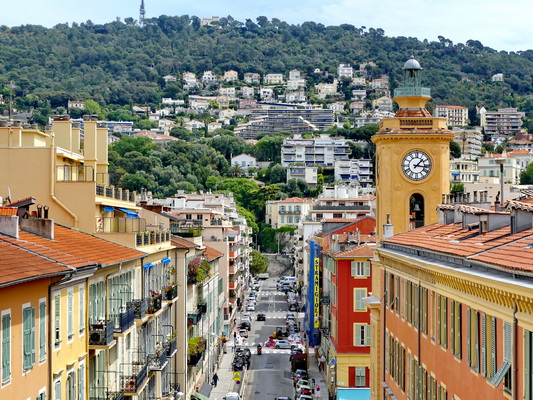
In April, after the municipal elections, a bill should arrive in the Senate, which will concern a decentralization of powers over housing. He could change things. © PP