
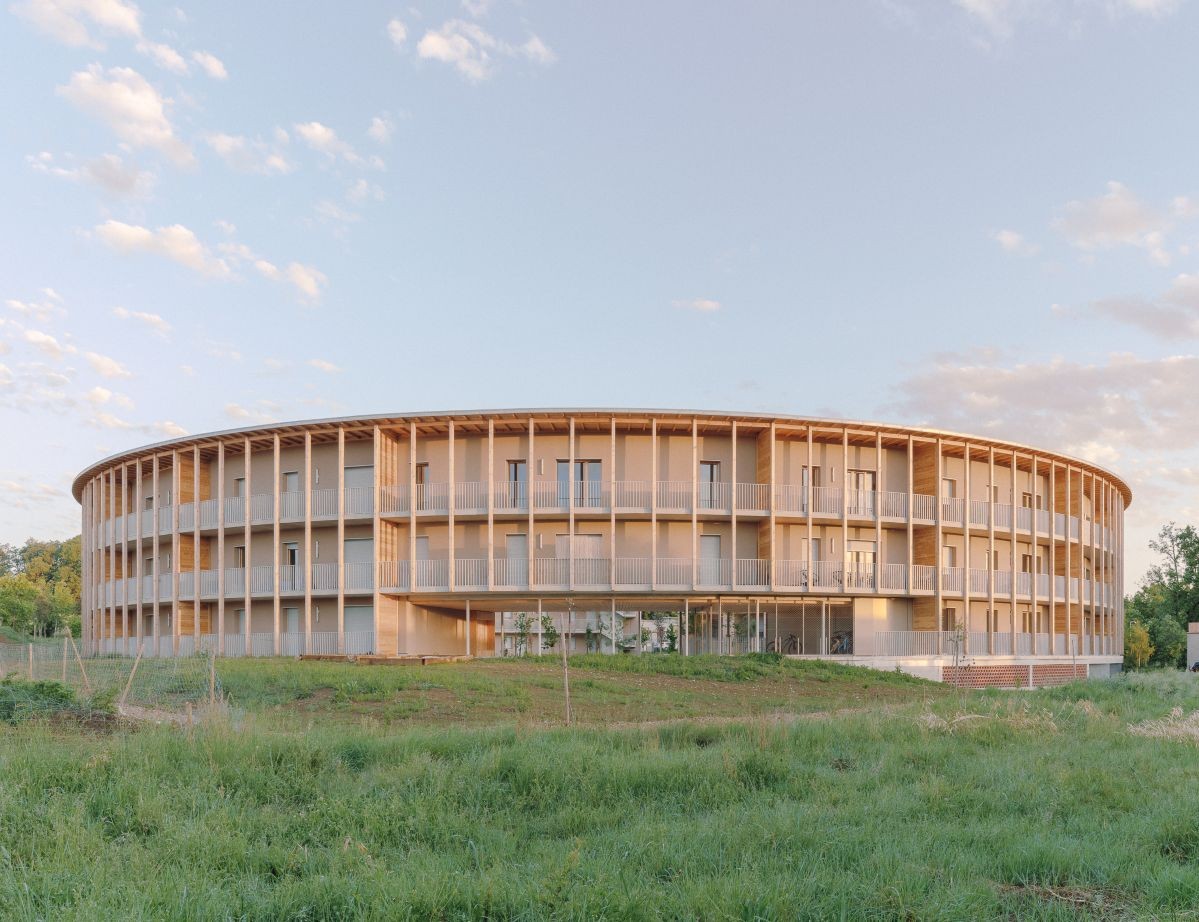
At the southern entrance to the ZAC Monges-Croix du Sud in Cornebarrieu (Toulouse), the circular residence designed by Atelier Régis Roudil becomes a beacon of current hybrid wood construction.
Publi-Information 


In the northwest suburbs of Toulouse, 10 km from the center, the commune of Cornebarrieu benefits from the disadvantages and advantages of the end of the airport runway on its soil. Deported towards the West on the other side of the river and the city center, the ZAC Monges-Croix du Sud dates back to 2011. Labeled Ecodistrict, it has given rise to prestigious architectural interventions, crowned by thethe cultural junction work of Philippe Madec (Associer)delivered in 2018. It was at the time of the launch of the happy and creative frugality movement, and it alone represents a sort of manifesto, in particular through its pioneering use of structural raw earth, natural ventilation but also an assumed use of concrete.
Since then, the name Cornebarrieu is often associated with this operation.
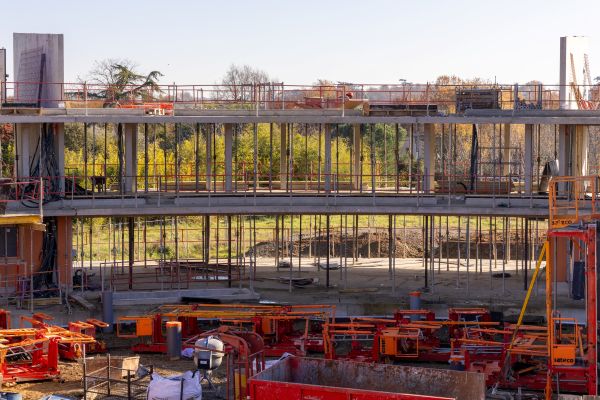
Despite its initial design and its architectural presence, Anéou de Terrà is made largely of a concrete structure. © Compass
Architectural competition
Atelier Régis Roudil, although the first agency to deliver a wooden construction operation by river transport in Paris, in 2021, and undoubtedly also one of the first to combine rammed earth, it operates more in the Rhone corridor and develops the use of secondary resinous species such as Aleppo pine or cypress. However, the prestige of Cornebarrieu pushed the agency to participate in a competition to mark the southern entrance to the ZAC, therefore the one which leads to Toulouse, even if it means winning and having to operate far from its bases. Perhaps the inconvenience caused pushed the agency to propose the unthinkable.
The fascination of the circle
The ZAC aims to triple the average densification of the Toulouse metropolitan area marked by urban sprawl in individual houses. The competition, in addition to the orientations towards eco-materials, therefore asks here to create 41 crossing housing units plus 5 individual housing units, while offering useful gardens.
The Workshop imagines, with Anéou de Terra, of install a circular building using up to the limits of the plot, and integrate the adjoining individual dwellings like an arc of the circle. At the time, the Vortex was built in Lausanne for student accommodation and with it the memory of the large circular Chinese buildings (the Tulou of Fujian) was reborn. Google creates its huge ring in California.
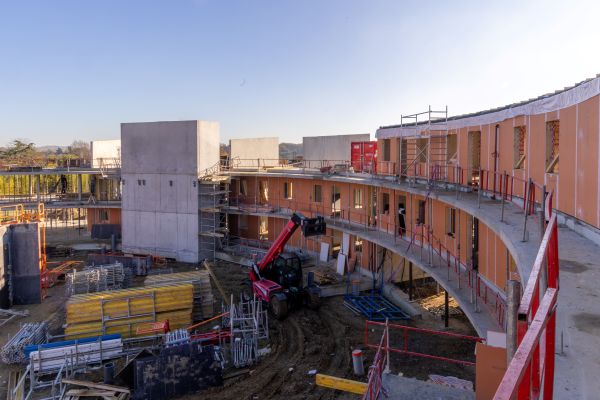
On the facade, the FOBs are carried out as progress is made and the MOBs on the top floor are prefabricated. © Compass
Cranes like circles
In this eco-district setting, the project is first designed largely in wood and the exterior is reflected with its filigree structuring. and the exterior wooden posts that support the advanced roofexterior side. However, several phases of cost compression are occurring at the initiative of the project owner, the lessor CDC Habitat.
When the wooden works finally fall to the Compass builderthe hybridization is notable. The walls and floors and even the posts are made of concrete. The concrete walls serve as bracing, while the floors are a simplification solution, including in terms of fire protection and acoustics. Yes, the circular shape invites you to place a crane in the middle and to assemble the structural work in a particularly repetitive and competitive way. Conversely, the wood is chosen for the curved facadesand even if the radius is bearable, it is necessary bend MOBs and FOBs. Which amounts to choosing particularly wide and recut low and high rails, then bending the panels in a rather unusual way.
Joinery and structure
There MOB of the top floor facades is prefabricatedbut the FOBs between concrete floors are installed as progress is made, without the engineer Paul Carsalade of Compas reporting any particular tolerance problems.
Compas takes care of both the wooden structure package and the exterior joinerywhich represents one of the specificities of this emerging player in the Toulouse area, based in Saint-Gaudens. The pine joinery comes from Aveyron. They are installed on site, while the management of the two batches is essential to adjust the non-curved joinery to the interior and exterior facades which are.
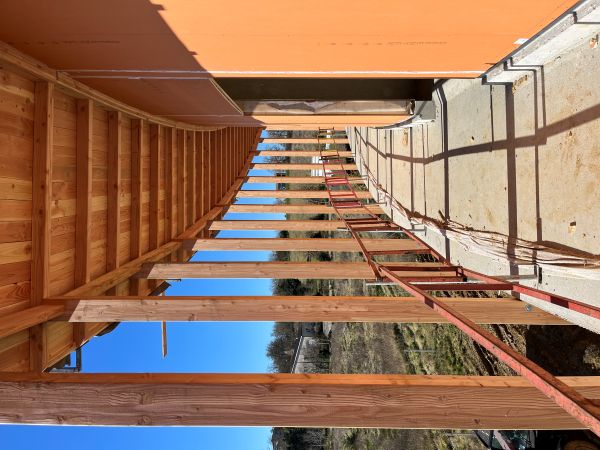
The exterior balconies give all their character to the work. The FOB facades are curved and match non-curved joinery. © Compass
Logistics hybridization
The troof and therefore the top floor are made of a wooden frame which supports a box roof worked in “cheese slices” with an exterior width of 2.50 m but a length of 10 m which the centering crane also allows to transport.
All the wood used on this site is French, specifies Paul Carsalade.
One of the notable buildings of the year in France
In the wake of the Aria cultural center of Philippe Madec and practices of the Atelier Régis Roudilwe could have imagined a structure with a reduced proportion of concrete, structural raw earth, who knows straw, natural ventilation. However, it was necessary to reduce the cost of construction to 2,500 euros/m2 approximately.
The building was delivered in February, just at the time of the conference during the 9th Parallel Workshop dedicated to lessors as part of the 15th International Wood Construction Forum. The official inauguration took place on May 6, 2026 and almost puts an end to this ZAC which is becoming a must for architectural walks, with around ten renowned agencies and a particular requirement, undoubtedly without equivalent elsewhere in France.
The first strawberries have been planted, it remains to be seen how this neighborhood will come to life.
Jonas Tophoven / © Bastien Treille