
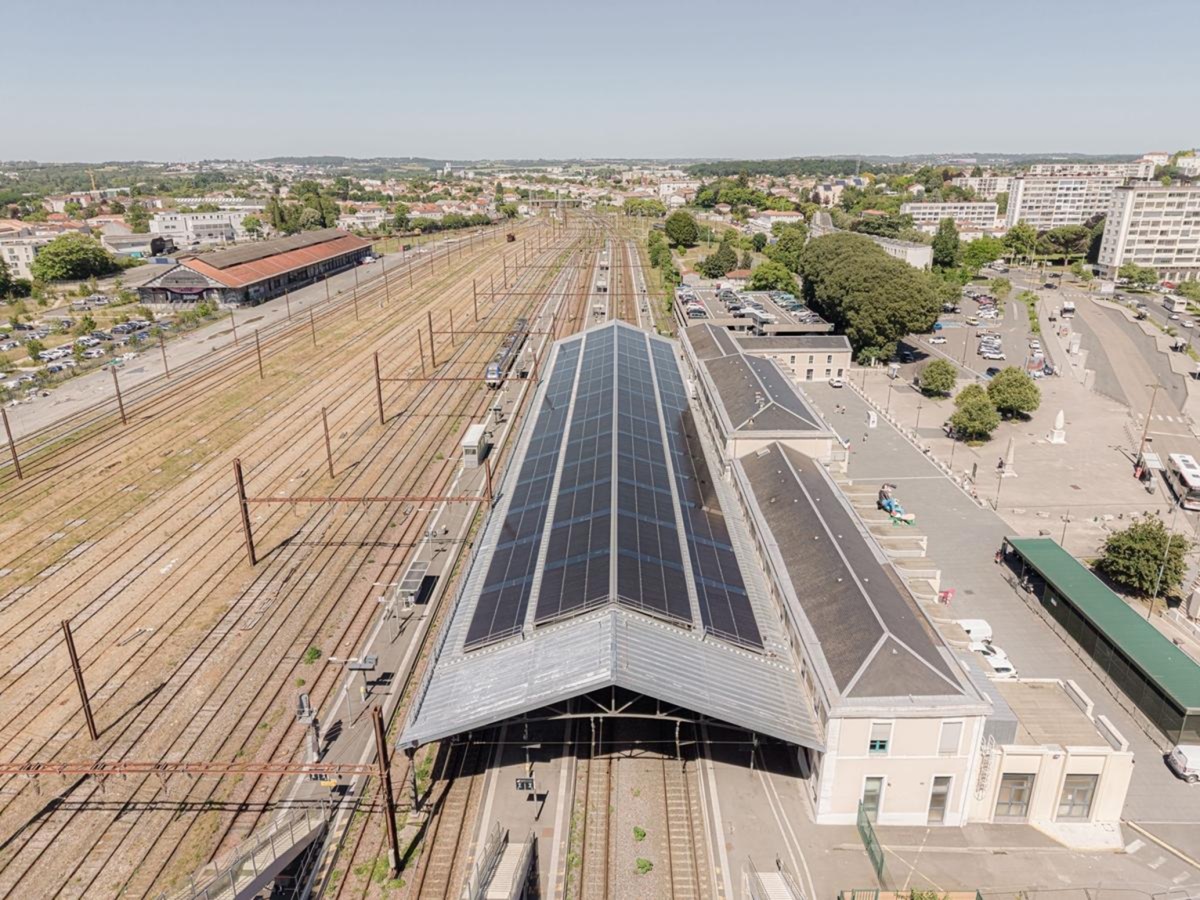
After seventeen months of work, Angoulême station unveils a completely renovated passenger hall, combining preservation of railway heritage and production of renewable energy.

With his glass roof completely restored and equipped with translucent photovoltaic panels, Angoulême station offers a unique achievement, which combines architectural preservation and renewable energy production and illustrates SNCF’s desire to adapt its historic infrastructure to contemporary environmental challenges.
A major renovation for a railway monument
There Angoulême station has just completed one of the largest renovation projects carried out in recent years on historic railway infrastructure. Inaugurated on May 28 in the presence of Jean Castex, Chairman and CEO of the SNCF group, Alain Resplandy-Bernard, CEO of SNCF Gares & Connexions, and Xavier Bonnefont, Mayor of Angoulême and President of Grand Angoulême, the new large passenger hall now constitutes a national benchmark.
The operation, which represents an investment of 17.4 million euros excluding taxes, required seventeen months of work and the complete recovery of more than 3,000 m2 roofing. Built in 1886 by the Paris-Orléans Railway Company, this vast metal structure 119 meters long, 26 meters wide and 11 meters high had gradually suffered the effects of time. The materials installed during previous renovations, in particular the polycarbonate sheets used in the 1980s, showed advanced signs of aging and no longer met current requirements for comfort and performance.
The restoration was carried out with particular attention paid to respecting the original architecture of the work because the objective was as much to restore its historical identity to the hall and prepare its adaptation to contemporary uses. The project was therefore carried out in collaboration with the architect of Bâtiments de France.
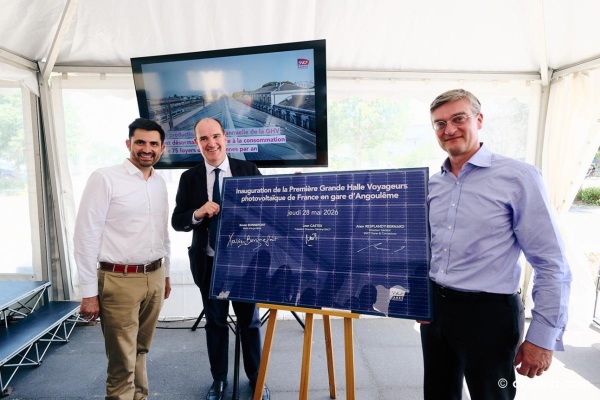
Xavier Bonnefont, mayor of Angoulême and president of the Greater Angoulême Agglomeration, Jean Castex, president and CEO of the SNCF group, and Alain Resplandy-Bernard, general director of SNCF Gares & Connexions during the inauguration. © SNCF Gares & Connexions
A solar power plant integrated into the heart of the glass roof
The uniqueness of the project lies in theintegration of translucent photovoltaic panels directly within the roof. In total, 840 modules – manufactured by the Strasbourg company Voltec Solar – were installed over nearly 1,900 m2 surface, making Charentaise station the first French station to have a solar canopy of this magnitude. Producing around 300,000 kWh per year, the installation develops a total power of 327.6 kW. This production makes it possible to cover nearly 40% of the electrical needs of the passenger building, or the equivalent of the annual consumption of around seventy-five housing units.
To achieve this result, the technical teams had to overcome several challenges. The historic framework has been partially preserved, while certain structural elements have been reinforced or replaced in order to support the new loads induced by photovoltaic equipment. Specific devices have also been integrated to facilitate future maintenance operations.
The work, which took place between October 2024 and May 2026, was carried out by:
– the Baudin Chateauneuf group – agent;
– Le Ny – wood and roofing;
– Altrad – scaffolding;
– And Lassarat – painting and stripping).
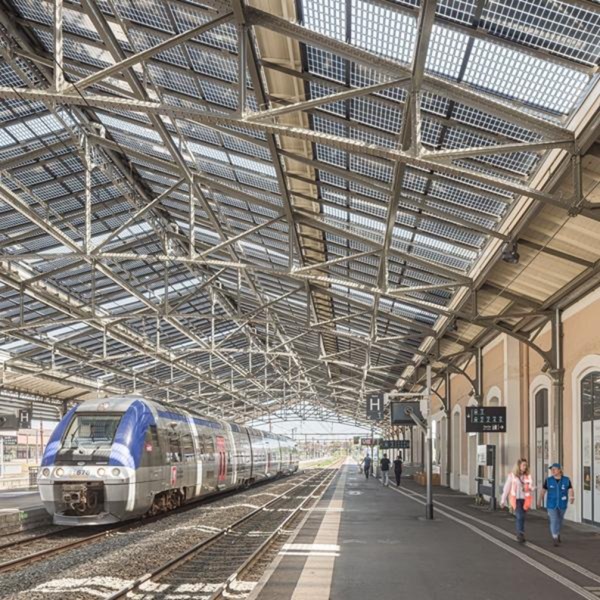
The whole was designed to preserve natural light under the hall. Transparent panels thus complete the solar system, guaranteeing a balance between energy production, visual comfort and architectural quality. © SNCF Gares & Connexions
Heritage, thermal comfort and ecological transition
The renovation also made it possible to restore the skylights which characterized the hall during its construction. Formerly used to evacuate fumes from steam locomotives, these architectural elements have today found an essential function by ensuring effective natural ventilation of the building. This combination of passive ventilation and solar protection significantly improves the comfort conditions under the glass roof since the first returns show a notable decrease in temperatures – a drop in temperature of 2 to 4 degrees was recorded – during episodes of high heat, thanks to theshading generated by photovoltaic panels.
Beyond its technical performances, the project constitutes a symbol of the evolution of railway infrastructures. Long considered only as places of transit, the stations are gradually becoming equipment capable of participating in the production of energy and the decarbonization of territories. “Despite the complexity of the subject, the project demonstrates the possibilities of adapting a 19th century work to contemporary issues and of reconciling heritage preservation and renewable energy production.“, underlines SNCF Gares & Connexions.
© SNCF Gares & Connexions