
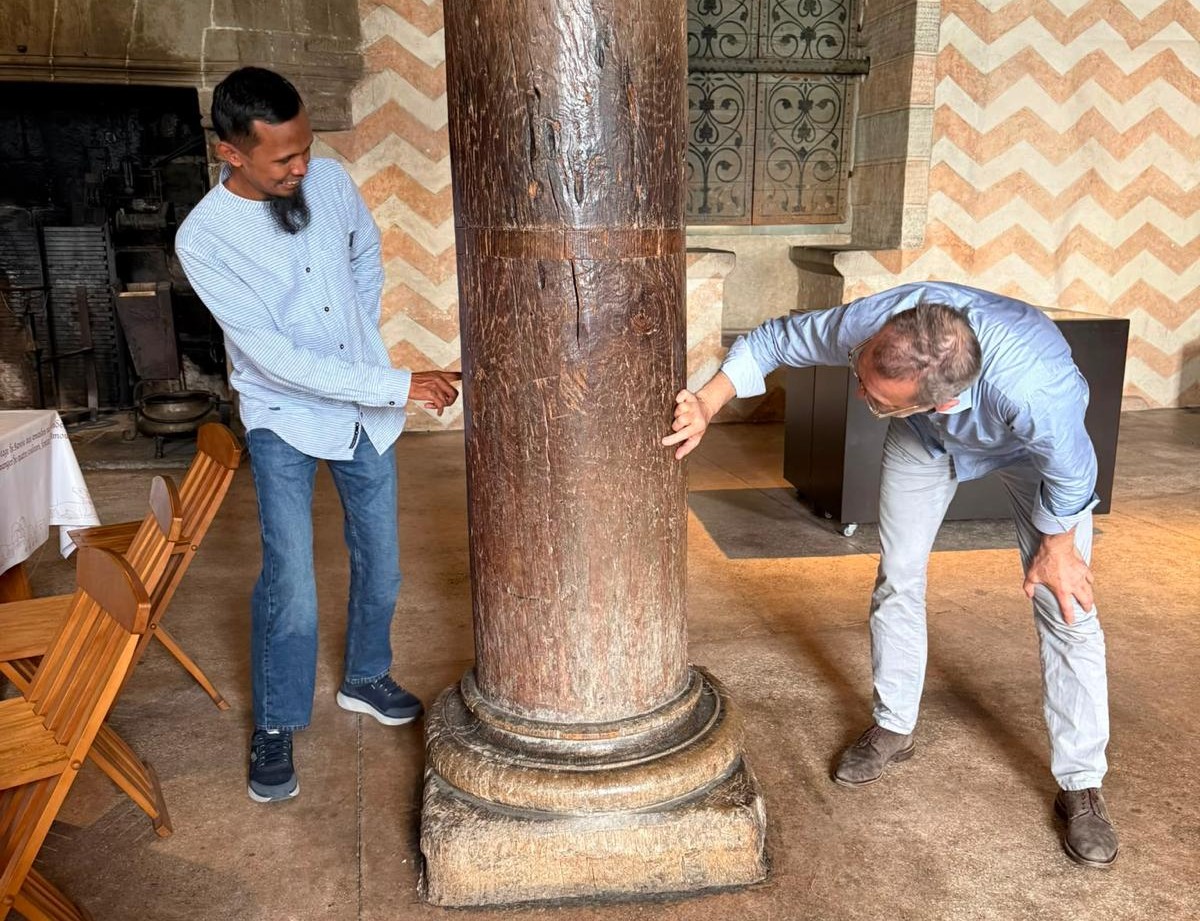
The wood manufacturer Pyrénées Charpente (Maître Cube) exchanges on June 18 in Lourdes with the BE Di2cb and CBS-CBT around the reuse of wood, renovation, diagnostics, tools and implementation methods.

If anyone still doubted that Jean-Luc Sandoz, the Jura inventor of Sylvatest and the boss of CBS-CBT, is the best-known Franco-Swiss in the world in the wood sectorthe agenda for the year 2026 can only reaffirm this. He scours the planet from Symposium to Conference to Salon to Training and we can forgive him for the carbon he burns because the technologies he promotes are in the process of change the global wood market in a good way.
Save lives
Since the launch of Sylvatest in its first version in 1990 with his doctoral thesis at EPFL, and the specific application to wooden posts, Luxpole, several decades ago, the objective has been to conserve the structures that can be preserved and to save lives. Operators who climb the poles are less likely to fall to their death because the mechanical performance is verified, the support galleries in Chile’s mines are well supported and the old wooden structuress are qualified and possibly reinforced on site as soon as possible.
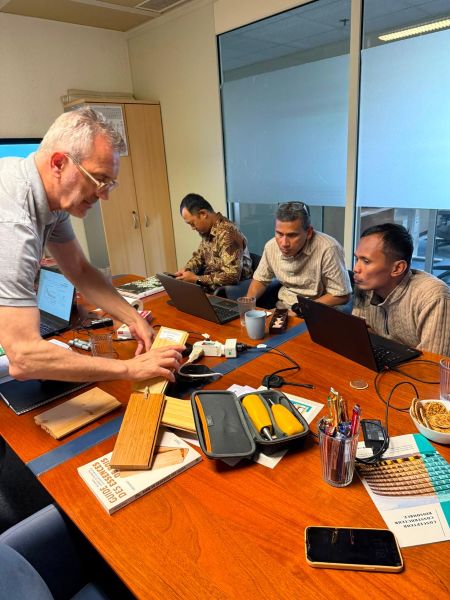
Training in handling the Sylvatest. © CBS-CBT
False lead
Jean-Luc Sandoz finally left engineering teaching at the highest level, because the subject of his thesis, the measurement of mechanical characteristics of wood by the non-destructive technology of ultrasound, seemed too useful to him and he wanted to put it into practice. And yet, the researcher was subsequently wrong. Faithful to his dogma “more engineering, less material”, he thought that this characterization would make it possible to classify each element of softwood in the factory according to its specific mechanical characteristics. It was too fast and too soon. About twenty years ago, he went so far as to install such a qualification line at a transformer, until the day it appeared that the market didn’t want it. This did not prevent him from developing refined construction systems himself as if wood were a kind of steel.
At the same time, the richer and more practical versions of Sylvatest test systemswith Sylvatest Quattro (4th generation) and Luxpole have gradually established themselves on the five continents.
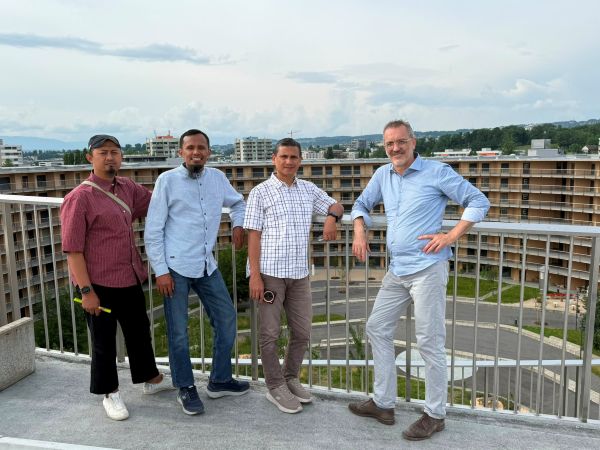
Training of Indonesian experts visiting the Vortex in Lausanne. © CBS-CBT
You have to find the way
Patents led to the factory production of constructive systems and soon to the development of implementation, thanks to which the European wooden construction has acquired references that have stimulated the wood construction market. But, once again, it seems that the inventor took a wrong turn. This is at least what the current rebound in its involvement suggests, after the partial cessation of the manufacturer’s activity, particularly in France. Because the historic heart of the Sandoz reactor, the non-destructive technologyis taking off all over the world, with complementary and different aims.
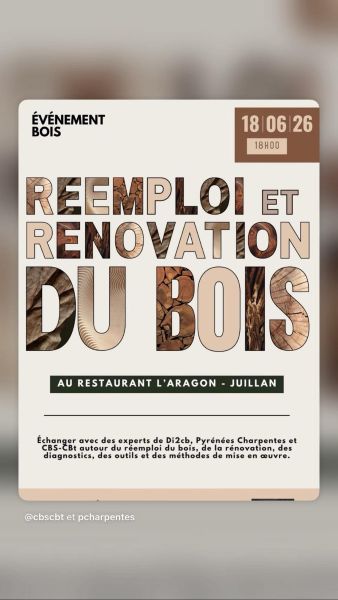
Poster of the Lourdes event. © CBS-CBT
Firstly, it is a question of providing a professional and handy tool for the immense emerging wood reuse market. Pyrénées Charpente has just shone at the last International Wood Construction Forum with a Bordeaux sports courtyard (Moonwalklocal) of which 25% of the structural material is reused. In Switzerland, the JPF group uses Sylvatest as part of the renovation of the floors of the Les Berges du Léman medico-social establishment, in order to preserve and possibly reinforce what can be. The examples are multiplying.
CBS-Lifteam delivered the Hilton hotel at the end of 2023, an oak post-beam structure on five levels of the former Paris general stores, with a capacity of 1,000 kg/m2, assessed by Sylvatestwhich made it possible to preserve wooden structures reinforced with resinso as to activate all the contact surfaces for the descent of the compressive forces in the posts on the five levels. Refurbished conservation is the holy grail for extending carbon storage.
Climate emancipation
Reusing is good. But by dint of explore the great world of woodJean-Luc Sandoz realizes that the main advantage of Sylvatest is from provide emerging countries in wood construction, particularly tropical countries, with a tool that will finally allow them to develop an independent market. Less pillage for export, more reasoned local use instead of all concrete. Indonesia and Malaysia are “hooked” and are ordering dozens of devices, served by a network of highly qualified engineers who understand the full benefit of this tool for concrete climate action.
The ecological and political perspectives are immense, like what is already happening in French Guiana, where CBS-CBT has been operating for more than thirty years in close collaboration with local players, and where the Sylvatest becomes a qualification tool for thousands of speciesbut also valorization of the unique capabilities of construction timber which, like Angélique, are well worth a D 100, currently under development!
The great attenuator
Jean-Luc Sandoz set out head-on with the idea of sorting the spruce lumber between C18 and C35, in order to use the C35 wisely and without waste. Here he is providing emerging countries with a weapon to use D 100, that is to say, making concrete completely obsolete and limit harvesting of logs while developing local economies and improving the qualification of species. All while Luxpole defends the market share of wooden poles and the lives of users to reject the idea of switching to glass fiber poles, or worse, carbon fiber poles, ecological nonsense par excellence.
The man who continues, in each of his public appearances, to raise alarms with great pedagogy about the consequences of the climate catastrophe, is at 65 years old one of those who potentially contribute the most to the mitigation of Carbon risk. Its technological recipe is not the gas plant of pumping and carbon storage systems at 1,000 euros per tonne. It’s just the requalification of a development of the last millennium around wood, of a non-destructive measuring tool which becomes a global emancipation tool for woodwhatever it is, tropical, western, or in historical monuments that have become demonstrators of the sustainability of biosourced materials.
Jonas Tophoven / © CBS-CBT