
Glass is one of the oldest products manufactured by man since the origins of anthropic societies, but there is also a natural glass of volcanic origin, obsidian, an extrusive magmatic rock composed mainly of silica, formed due to the rapid cooling of volcanic lava, widely used in the Neolithic to make sharp blades and arrowheads.
From the origins of glass to industrial production
The historical origins date back to antiquity. Tradition indicates it as a chance discovery by Phoenician merchants, about 5000 years before the Christian era. But the process of glass formation, through blowing and rotation, began between 500 and 600 AD, remaining almost unchanged until the 19th century.
However, the real transformation of glass art occurred with the advent of the Industrial Revolution, following subsequent technological progress; the introduction of production automation has in fact made it possible to start serial production, at reduced costs, supplanting the ancient manual art, relegated today to a few artisanal productions.
The birth of expanded cellular glass
Expanded cellular glass, also known as glass foam, has more recent origins. The way to foam glass, transforming it from a siliceous powdery mass into a compact and light element, dates back to the early 1930s, by the Russian scientist Isaac Ilyich Kitaygorodskiy and the French engineer Bernard Long, who, working in the laboratories of the Saint Gobain company, formulated the composition of compact cellular glass, filing the patent in 1933.
In 1937, from the merger of the two American industries Pittsburgh Plate Company – the first company specialized in the production of flat glass, founded in 1883 by Captain John Baptiste Ford and John Pitcairn Jr. in Creighton, Pennsylvania – and the Corning Glass Works company – an industry founded in 1951 for the production of crockery, pyroceramic-based pans and pyrex baking trays – Pittsburgh Corning, a giant glass production industry, was born industrialist who, with the acquisition of the Saint Gobain patent, suitably perfected and adapted to a building application, started the production of expanded cellular glass in 1942, coining the brand Foamglas®, a name whose marketing had wide resonance in North America.
The fortune of cellular glass, in those years around the Second World War, was due to the scarcity of natural insulating resources, which gave the opportunity to expand its use, for example as a buoyancy block for underwater networks, by virtue of the characteristic of this material of not being altered in the presence of salt water.
Cellular glass arrived in Europe in the 1950s imported from the USA, but with limited use in the construction market, due to lack of knowledge of the product and its characteristics. With the opening of a first factory in Belgium in 1962, the cellular glass produced by Pittsburgh Corning will gain ground with a range of insulating panels, which will be widely used especially in Northern European countries, arriving later in Italy, in the Seventies.
Because cellular glass deserves to be known
Even today, despite having been present in Europe as a building product for more than 90 years, not all Italian technicians and construction workers know cellular glass; few know of its existence and those who have had mention of it or who believe they know it have hardly learned all its possible applications.
The writer, for example, met it for the first time 20 years ago, during the first CasaClima Basic course and, from that moment, it was love at first sight, especially after discovering its technical characteristics and its versatility in its many uses.
Expanded cellular glass is in fact a material that can have many applications, which make it not just a simple thermal insulating material, but a real construction system, which can also be used in difficult solutions, as a single product that replaces more complex systems, made up of various aggregate materials.
A material with a high percentage of recycled content
We mentioned at the beginning the presence of recycled material in the composition of the finished product. In the Minimum Environmental Criteria (DM n.194/2024) a percentage of 50% of recycled material is required to be able to use insulating panels in public works. In reality, depending on the type of format and use, the percentage of recycled cellular glass can be even higher, almost touching the totality of the recycled product in its composition.
The recycled material components that can be most commonly adopted range from vehicle windshields, television screens, float glass, bottles and the most common glass containers.
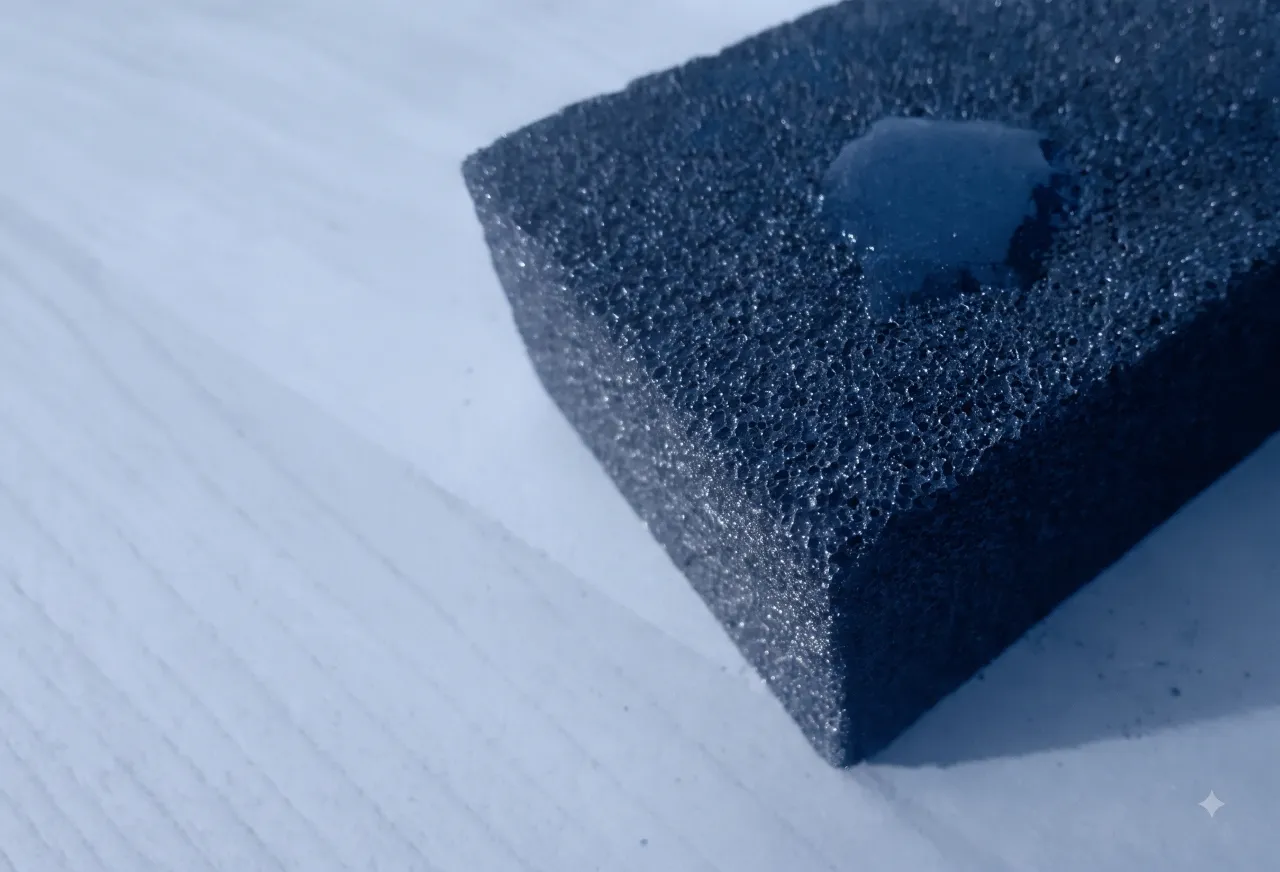
The only element foreign to the glass for the creation of the insulating product is carbon black, i.e. natural carbon powder, dosed in a percentage of 0.5%, with the sole function of an expanding agent. This, uniformly distributed in the compound to be melted, under the action of the heat in the industrial oven, gasifies, causing the vitreous mass to expand, forming billions of air voids and at the same time leaving the typical black color to the final product.
Three formats, multiple applications
The appearance that cellular glass expanded by the industrial process can take on has three possible typologies: compact sheets of regular shape for thermal insulation; small expanded pearls for insulating fills and small loose elements in the form of gravel of various heterogeneous sizes.
Each of these formats performs different functions, just as the production processes are different. We will explore them gradually, with the next releases.