
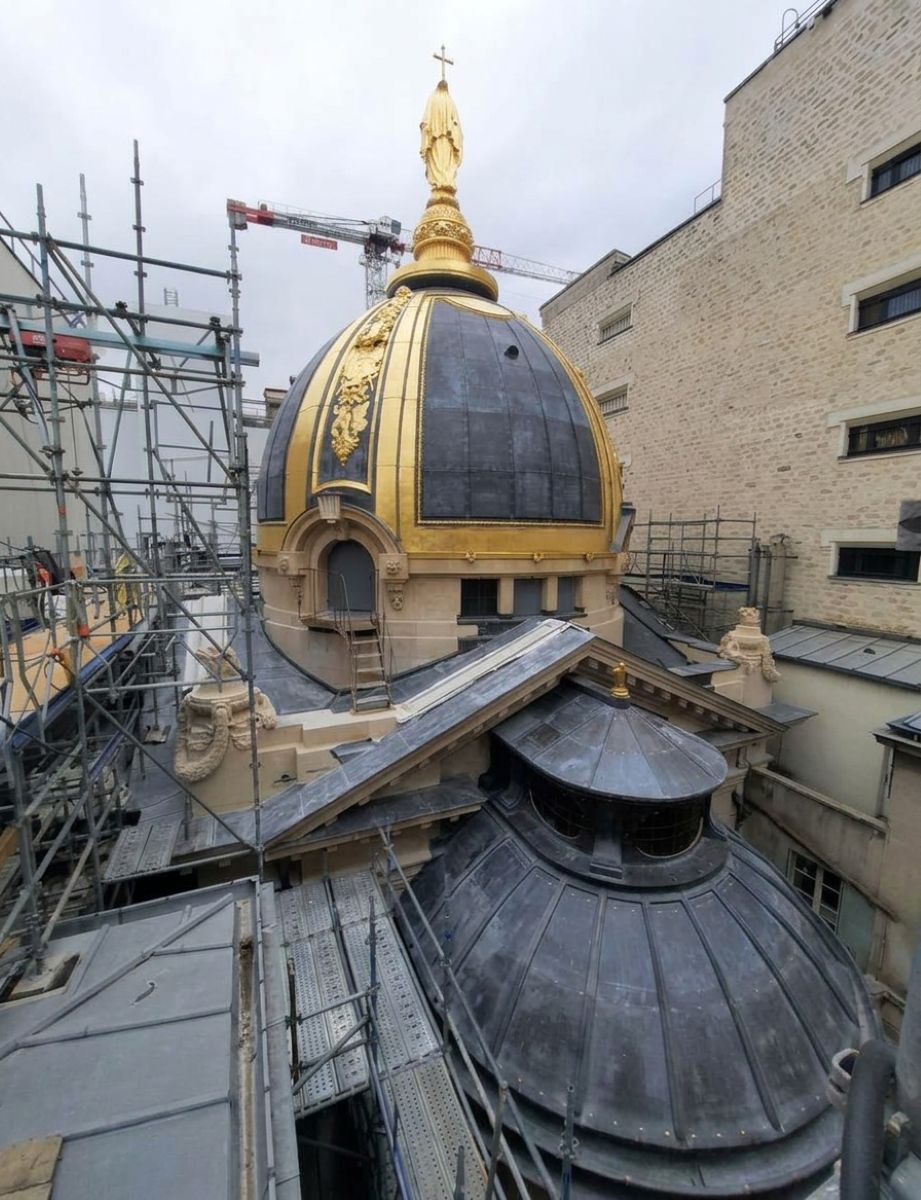
To restore the Notre-Dame-de-Consolation chapel, the Vosges company Coanus is mobilizing rare know-how, between traditional gestures and technical solutions designed to last.
Publi-Information 


Its history left its mark at the end of the 19th century: the Notre-Dame-de-Consolation chapelToday stuck between two tall buildings in the 8th arrondissement of Paris, was built on the site of a tragedy, the fire of the Bazar de la Charitéwhich on May 4, 1897 caused at least 125 victims, the vast majority of them women and children.
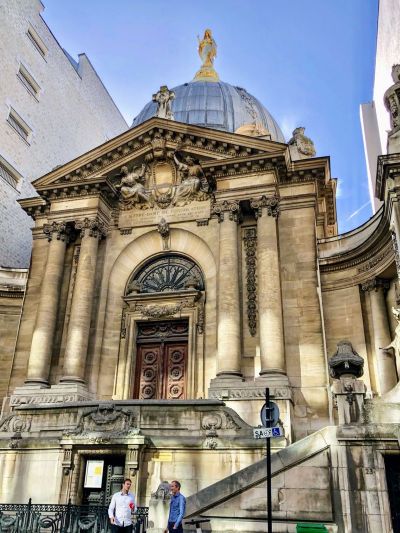
The chapel before scaffolding. © Coanus
A place of commemoration
Wanted like a magnificent memorial by the families of the most silver victimsare, this Louis XVI style building was inaugurated in May 1900 for the Universal Exhibition (and its architect, Albert Guilbert, gold medalist on this occasion). It has suffered the ravages of time and its damaged roof let the rain damage the remarkable interior ornaments.
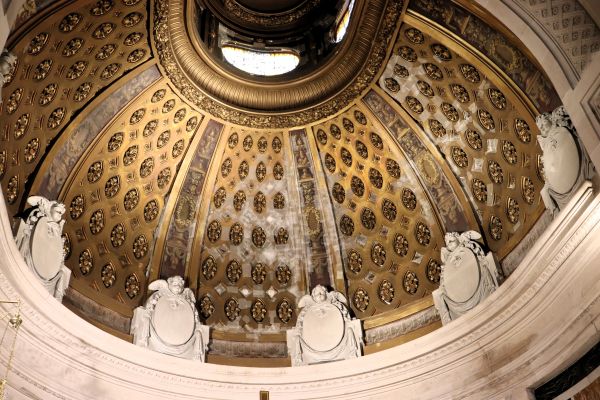
While awaiting the interior restoration, the decorations of the dome are preserved by taking precautionary measures, which also prevent the fall of plaster during services. © EJH
A story of men and passion
For the complete restoration of the chapel, the religious congregation tenant of the premises called on a passionate heritage architect, Arnaud Vialatte de Pémillewho in turn engaged in the adventure a no less passionate Vosges company, Coanus, on the frame-roof lot. A speaker was needed who was up to the challenge to successfully restore the roof to its original condition. “At the time of construction, the structural work was completed in less than three years, which was very fast; but the work was of quality“, notes the architect. Almost 130 years later, and despite some work in the 2000s, the damage to lead roof were such that it was necessary to consider starting the work from scratch.
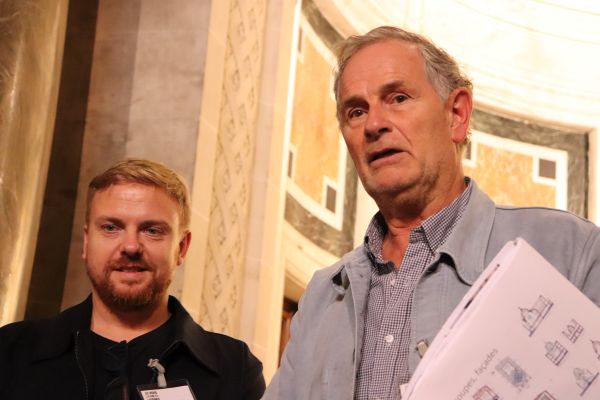
Guillaume Fernandez, general director of the Coanus Roofing branch (left) and architect Arnaud Vialatte de Pémilly. © EJH
The restoration of historical heritage, a vocation
L’architect entrusted the restoration of this rather technical roof to Coanus and welcomes it. There heritage restoration constitutes one of the historic professions of the company created in 1929 in Igney (88). L’Vosges company masters all hatching materialsrture – lead, copper, zinc, aluminum, slate, tile, shingles…
Qualified as Qualibat 3194, it dedicates 30% of the 80 employees in its Roofing branch to historical heritage – roofing will total around 15 million euros in turnover this year). It boasts excellent references, notably through the agency specializing in Historical Monuments that it created in 1985.
Among others, Coanus participated in the reconstruction of the roof of Notre-Dame de Parisin a group with five other roofing companies; a very restrictive project which lasted two years, both on site and in its Vosges custom folding workshop.
In 2025, a antenna dedicated to maintenance and roofing operations in urban areas opens in Chelles (77). “This allows us to respond more responsively to the numerous requests for historical heritage in and around Paris. We work in particular on the roofs of the Élysée and the National Assembly“, indicates Guillaume Fernandez. manager of the Roofing branch would like to point out that all Coanus employeeswhatever their position, were trained in the company primarily in site work. “We all have a passion for the profession and we do everything to pass it on to our apprentices; it is essential to maintain our know-how and our values.”
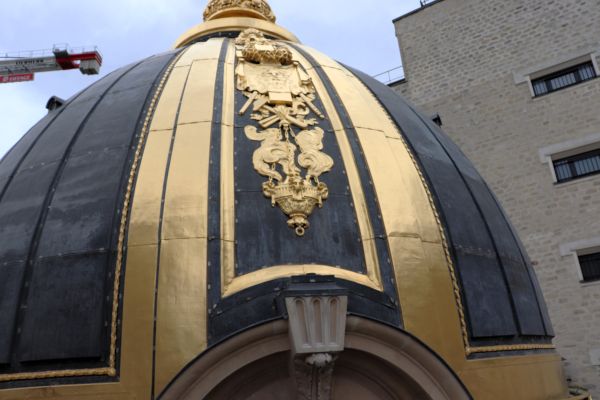
Once restored in the workshop and put back in place, the solid lead ornaments were re-gilded on site. © EJH
An exceptional construction site
Notre-Dame-de-Consolation is a particularly interesting project for Coanus : there roof entirely covered with lead cast on sand consists of a large dome, terraces and a dome of more modest dimensions but with a stronger curvature, above the apse. A lot of layout work was carried out to perfectly reproduce the original appearance.
Started in February 2025, the project will be completed in two months. He appeals to the shaping lead tables cast on sand over the entire roof. The domes are mounted in a double brick vault – preserved as is – covered with a good thickness of plaster, English paper then lead sheets. On the terraces, the flat part of the roof, the lead tables cover stone slabs covered with plaster and English paper. The largest pieces measure 1x2m, which represents a weight of approximately 80 kg.
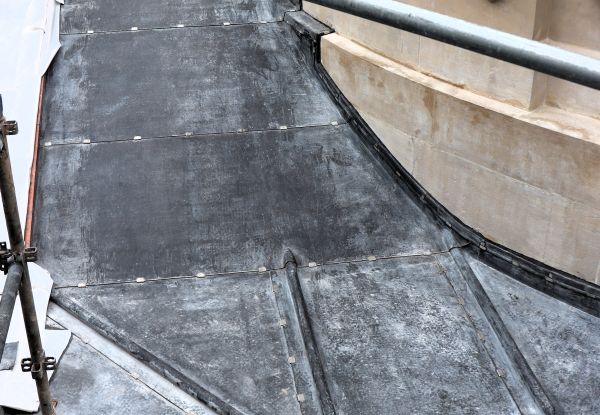
The tables are held together by tinned copper legs soldered to those below and folded. © EJH
Precautions are taken for handling: masks and gloves prevent contact with the material and a footbath at the roof outlet helps prevent the dissemination of lead particles. The installers also have showers in the camp located in the interior courtyard of the building.
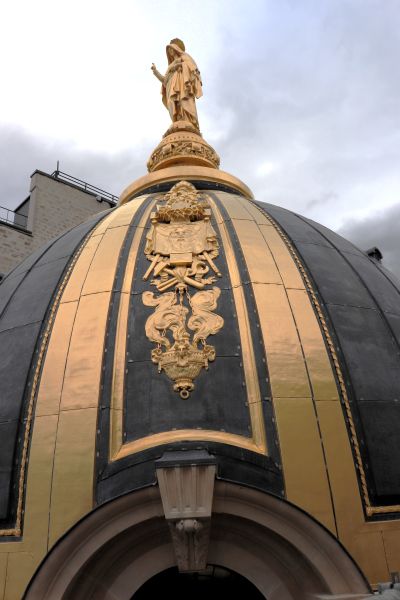
The several meter high statue of the Virgin which dominates the roof is supported by a metal structure hidden in the dome, which has simply been repainted. © EJH
Waterproofing, a sensitive point
“We had to improve our skills in plaster to reconstruct the underside” admits Nabil Tabti, the works manager, who also specifies: “a wooden frame was embedded in plaster in certain places to better anchor certain ornaments“. The removal was carried out by the teams who then installed, which is essential for analyzing the weak points of the roof and being able to correct them.
If the final appearance is identical to the original, the roofers were able to adapt the techniques in order to perpetuate the work For “at least three generations”, as the leader wishes.
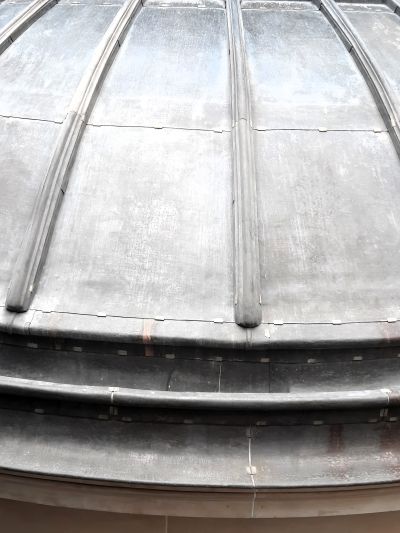
For example, to avoid reproducing certain edges formed on cleats, which had been sheared over time because they were too sharp, the new raised elements were slightly rounded. © EJH
THE areas of water infiltration were linked to lead creep (deformation and sliding on slopes), or somewhat short overlaps. The overlaps of the new tables were made with wider overlaps and reinforced anchoring ensured their stability in areas of steep slope. “We know that no material is ever perfectly waterproof” underlines Guillaume Fernandez, “the goal is therefore to guide the water where it can flow without problem“.
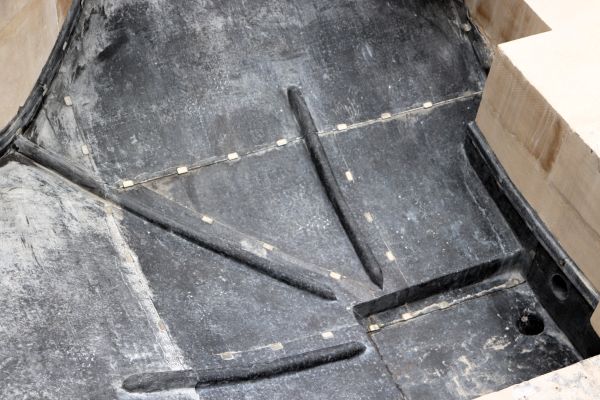
Copper guarantee jackets have been placed under the fittings, which will ensure tightness while guiding the water. © EJH
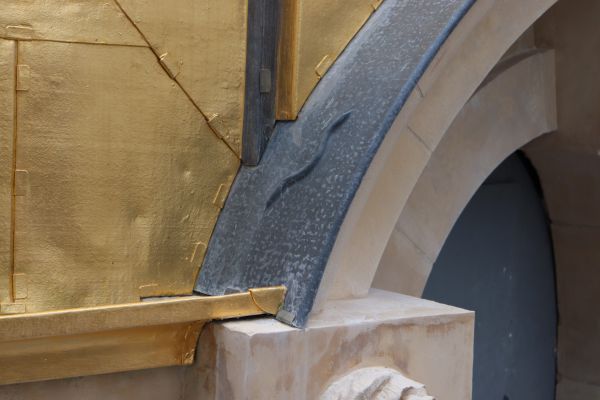
Detail of flow points, this small lead coil guides rainwater towards the gutter. © EJH
Lead cast on sand, a centuries-old technique
Malleable, reusable, durable, the lead is a material with multiple advantagess. Found in Türkiye in statues dating from 3800 BC, widely used by the Romans, it has found common use in religious architecture since the Middle Ages in France. HAS Notre-Dame-de-Consolation, the tables of lead deposited had to be sent to Great Britain to be melted and cast on sand using an ancestral technique which only continues in two artisanal foundries around Birmingham (but with modern protection for the operators!).
Coanus received rolls of lead sheets 3 mm thick, which had to be flattened and then “formed” on site using a capping board. “We beat the lead sheet on the support using beaters, then we refine“, specifies Josselin Viard, the site manager.
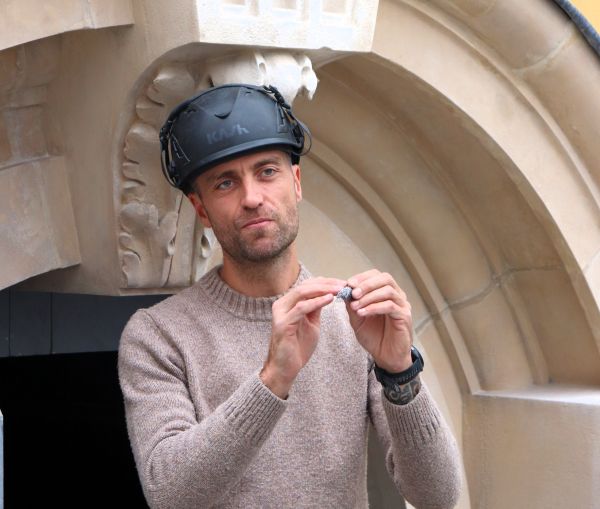
Josselin Viard shows lead wool. © EJH
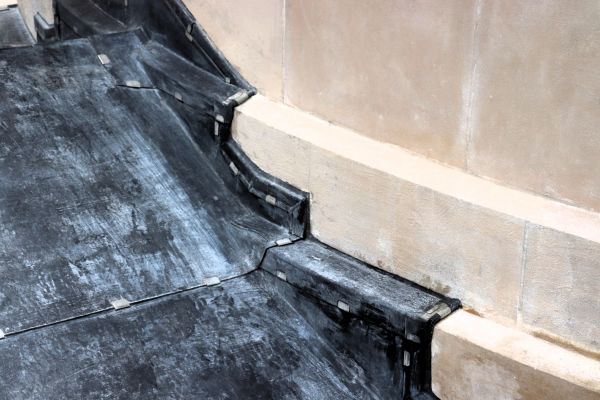
The lead table-stone junction is made by tapping lead wool rolled into a sausage into the groove of the engraved stone. The result is invisible. © EJH
Vosges know-how in the spotlight
Metallurgy is the second largest employer and leading exporting and investor sector in the Vosges department. If Coanus demonstrates particular skill in the restoration of historical monuments prestigious, other Vosges companies operate in the Paris metropolis. They display their know-how, both historical and avant-garde in digital matters, on emblematic construction sites.
Among them, let us mention Viry, a specialist in complex architectural metal structures, who, among others, created the Nuages of the Grande Arche, the Canopée des Halles, the Olympic Rings of the Eiffel Tower and several RER stations.
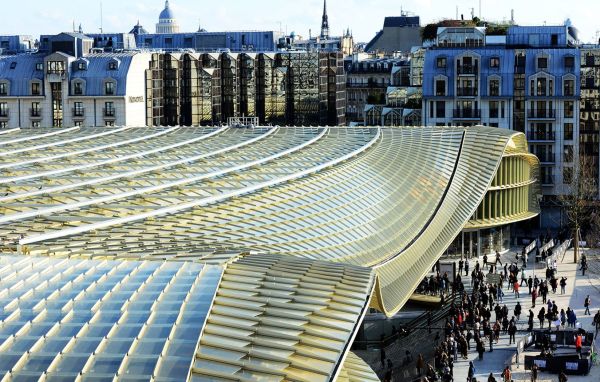
Canopy of the Halles. © Viry
Specializing in the design, manufacturing and surface treatment of metal structures, Framatec is notably involved in the restructuring and modernization of the Opus 12 Tower in La Défense. Another example: it is carrying out the implementation of the domes, roofs, stairs, footbridges, elevator shafts and platform structures for the Sevran-Livry station of the Grand Paris Express.
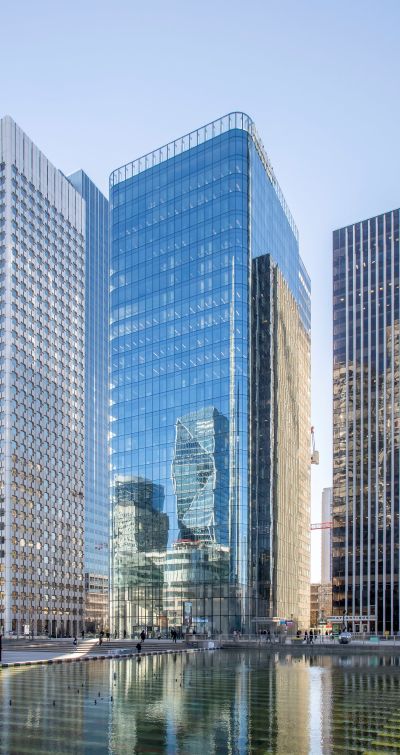
Opus 12 Tower, in La Défense. © Framatec
Another specialist in metal construction, Waltefaugle Bâtiment works on major renovations, transformations of existing buildings, complex frames, glass roofs, historic monuments and large equipment.
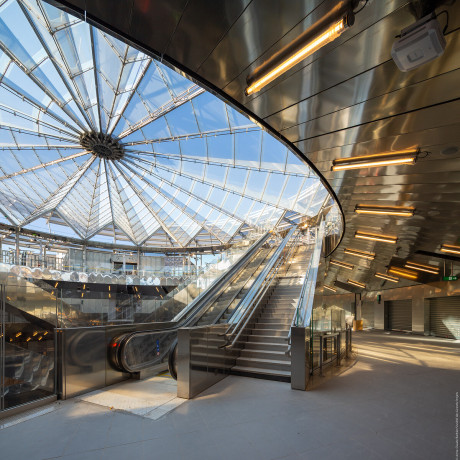
For the Villejuif – Grand Paris station, Waltefaugle Bâtiment notably produced a significant part of the metal framework, the platform transoms, the shafts, the entrances and the roof. © Waltefaugle
Train in the Vosges, from technical skills to engineering
These Ambassadors of the Vosges export their know-how internationally, sometimes very far from their department of origin. They help to promote companies, professions and sectors, to develop collaborations and to strengthen the attractiveness of the department.
Welders, boilermakers, designers, site managers, heritage restorers, engineers… The works carried out in Paris and elsewhere begin in the Vosges workshops and design offices. This industrial territory also has a real training ecosystem, from CAP to engineering diplomas, which supports industry transformations while maintaining rare skills.
Source: batirama.com / Emmanuelle Jeanson / EJH