
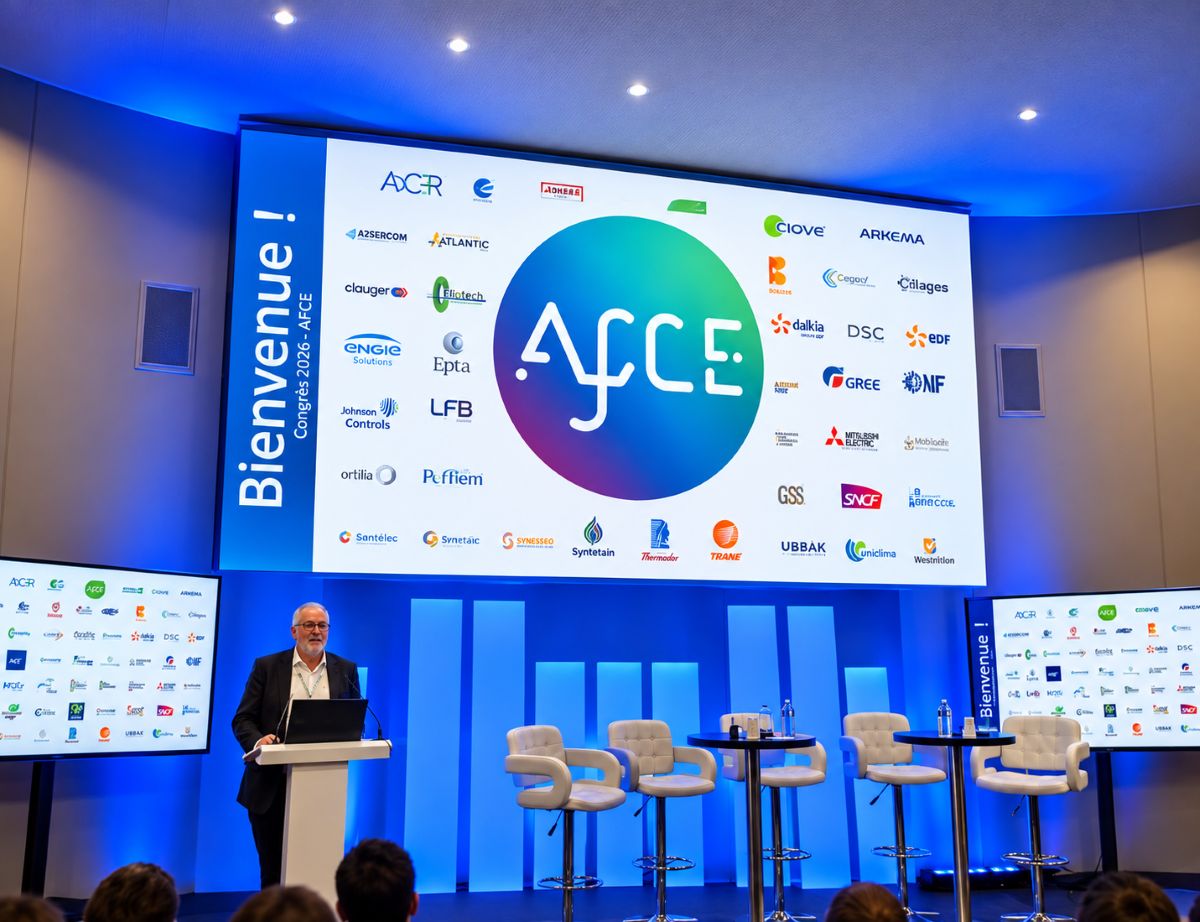
Equipment for companies, training and certification of individuals, low GWP fluids, but flammable, etc. all questions on fluids have been addressed, as well as certain lack of solutions

THE AFCE annual conference took place on September 17, led by Bernard Philippe, its general delegate. To the great relief of all, Thérèse Six, deputy head of office of the DGPR (General Directorate of Risk Prevention) of the Ministry of Ecology, recalled that certainly, the F-Gas Regulation has been amended twice since its publication and that an important step lies ahead of us, since January 1, 2027 provides for a halving of the quotas of fluorinated greenhouse gases placed on the market in Europe, but that the F-Gas regulation itself has not evolved. On the other hand, she emphasized, the French regulations which reflect the F-Gas regulation in our country, have evolved on at least seven points. These developments were, essentially, the content of the AFCE conference.
Developments already implemented, others to come
For starters, there is an official refrigerant tracking service. It is used to enter the intervention forms provided for by article R. 543-82 of the environmental code for operations requiring an handling of fluorinated refrigerants within thermodynamic equipment containing them such as refrigeration, air conditioning and heat pump equipment. It also provides a connection to theTrackdéchets application dedicated to the traceability of hazardous waste for the management of refrigerant waste resulting from these interventions.
The national regulations are essentially contained in articles R. 543-75 to R. 543-123 of the environmental code, in the decree of February 29, 2016 relating to certain refrigerants and fluorinated greenhouse gases and in the decree of November 25, 2025 relating to the certificate of aptitude of actors. This regulation concerns marketers – who must now purchase the quotas that they can market –, owners of equipment which use these fluids and operators who handle fluids and equipment. Equipment owners must have a leak check carried out regularly by a certified operator. The frequency of these checks depends on whether or not a leak detection system has been installed on the site (Article 5 of Regulation (EU) 2024/573), have, for larger equipment, a maintenance logbook which collects all the intervention sheets on the equipment and act as quickly as possible in the event of a leak. If the equipment holder’s site also falls under section 1185 of the nomenclature of classified installations, it must comply with the corresponding regulatory provisions – in particular the labeling of equipment and storage containing more than 2 kg of fluids, have an inventory of equipment on the site containing fluids, insulate the pipes and seal the valve outlets to the atmosphere.
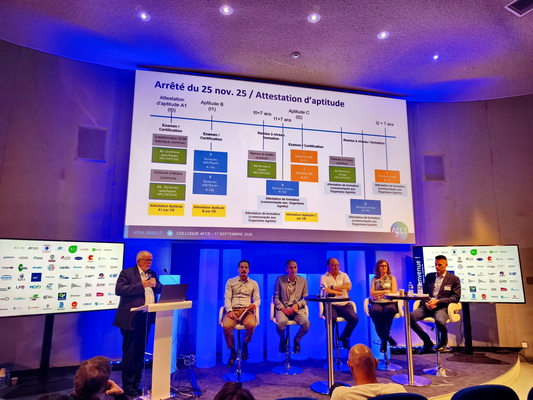
Bernard Philippe explained that the establishment of the certification ecosystem, for companies and for individuals, is practically complete. He recalled that the certificate of capacity for physical operators is now divided into seven different certificates by the decree of November 25, 2025: A1, A2, B, C, D and E, which relate to different interventions and different fluids. CO2 R744 and NH3, R717 are particularly isolated in categories B and C. © PP
THE operators who handle fluids and equipment must, for their part, obtain a “certificate of capacity” for their company, from an approved body, ensure that their personnel who handle fluids obtains a certificate of aptitude or a certificate (personally). L’certificate of aptitude is required for the handling of fluorinated greenhouse gases for the production of cold and air conditioning. THE certificate is required for handling fluorinated greenhouse gases for use in extinguishing, dielectric or solvent.
The certificate of aptitude can be obtained either via the initial training followed by the person, or via recognized professional training, or from a certified assessment body. Notices in the official journal specify the recognized initial and professional training. Finally, since April 2026, the Cerfa 15497*04 form, in other words the intervention sheet for operations requiring the handling of refrigerants carried out on equipment, has been dematerialized.
Approved organizations
The six approved organizations selected for refrigeration and air conditioning issue capacity certificates to companies that handle fluorinated greenhouse refrigerants. These certificates are valid for a period of 5 years. During this period, organizations must conduct one or more on-site audits. They also issue certificates for employees of these companies when the use of fluorinated greenhouse gases is extinction, dielectric or solvents.
In the case of refrigeration and air conditioning, a certificate of suitability is required, it can be obtained from certified assessment bodies, R717. The list of these certified assessment bodies is available on the France Compétences website at the very bottom of the page. This is an Excel file with 139 lines. There are around sixty AFPA agencies, Airwell Academy, several APAVE agencies, various regional professional associations, CFAs, professional high schools, Greta, Costic, Clauger, Daikin, Mitsubishi Electric, Suanier Duval Eau Caude Chauffage and numerous organizations linked to the automobile, because the fluorinated fluids used in automobile air conditioning are naturally subject to the F-Gas regulation.
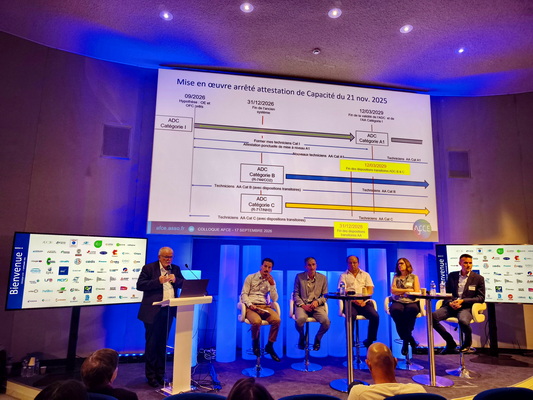
The six organizations approved for the use of fluorinated greenhouse gases for refrigeration and air conditioning are AFNOR Certification, Bureau Veritas Certification, Cemafroid, Certi Kôntrol, Dekra Certification, Qualiclimafroid, SGS International Certification Service, Socotex Certification France and WE-CERT. © PP
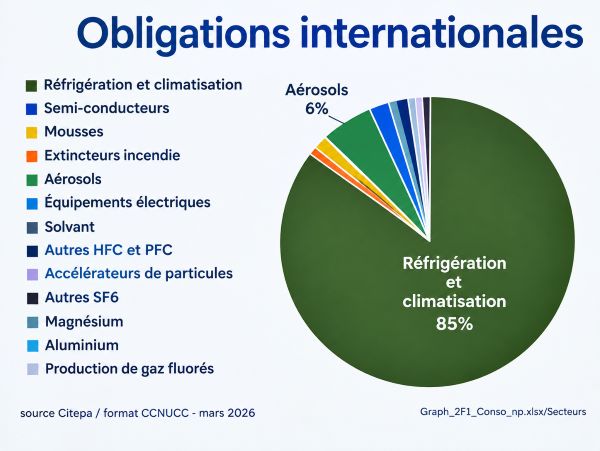
During the AFCE conference, Stéphanie Barrault from Citepa, an association which produces reference data on the climate, highlighted that refrigerant emissions have been falling in France since 2009 in tonnes and since 1994 in tonnes of CO equivalent.2even though the bank (the volume used) of refrigerants in mainland France continues to increase. She explained in particular that refrigeration and air conditioning in France account for 85% of the use of refrigerants. But in 2024, HFCs represented only 2% of greenhouse gas (GHG) emissions in France. © PP
And now ?
THE AFCE conference was ultimately short on replacement fluids. Of course, outdoor packaged heat pumps have now almost entirely switched to R290 and its GWP of 3. Direct expansion air conditioning, from monosplit to tertiary VRFs have chosen R32. But its GWP of 675 makes R32 a transition fluid with a relatively short lifespan.
THE AFCE conference did not offer a solution to replace R32. He also did not mention which fluid could gradually replace the R410A present in practically all direct expansion systems installed in France, because the air conditioning industry does not yet have a collective answer to these two questions. Hilde Dhondt, from Daikin, who presented the replacement of fluorinated fluids in Japan, nevertheless indicated that air (R729, GWP = 0, A1), for ultra-cold freezers up to – 160 °C, NH3 (R717, 0, B2L) and CO2 (1, A1) for commercial refrigeration. However, also emphasizing that R410A and R32 do not yet have replacements in Japan.
