
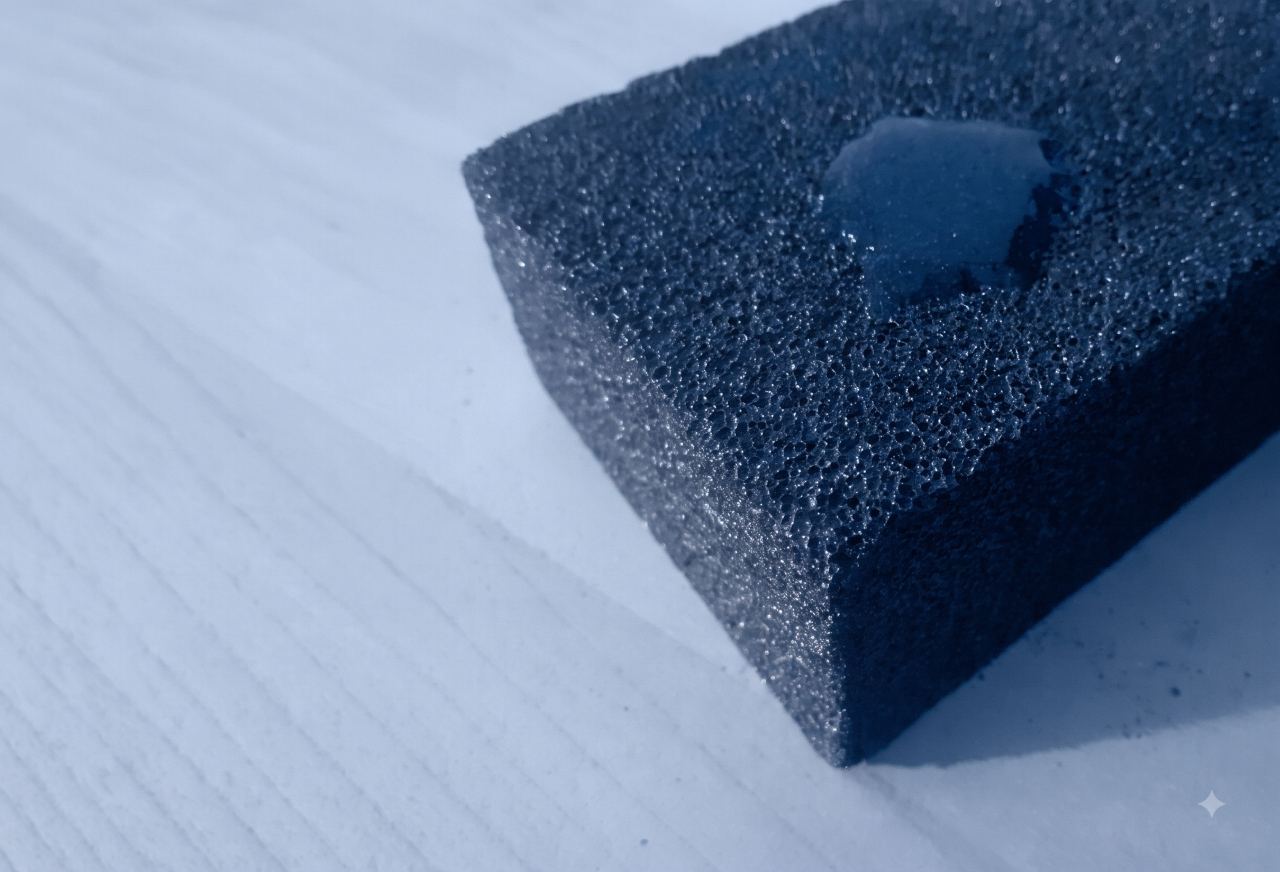
I will never stop affirming that cellular glass is a versatile material, with which many problems can be solved, with a single product which, in fact, replaces other complex applications, avoiding the use of other materials together, extending maintenance times or eliminating them completely.
When cellular glass makes the difference
In normal conditions it is in fact easier to find thermal insulation made with the external insulation system which uses natural materials, derived from the vegetal or mineral world, rather than synthetic ones.
I believe that an external thermal coat made of sheets of cellular glass may make more sense in the presence of particular conditions, in which its unique technical characteristics can be widely exploited: when, for example, it is necessary to insulate an envelope in the presence of constant or frequent surface washout of water, including meteoric water, or where the waterproof consistency of this material constitutes the only lifeline to guarantee technical performance in extreme conditions, as in the case of ventilated facades, with cladding with open joints or external facades that must be clad directly with sheets of stone or stoneware panels. For this application in particular, a tile made of ceramic or stone material glued directly to cellular glass has the certainty of total dimensional stability, with the guarantee of strong cohesion over time.
Differently, for example in the case of a building renovation, we often see its use especially in solving difficult problems, such as the internal insulation of inhabited or habitable rooms, even in conditions of high humidity, or when it is necessary to insulate in the presence of high loads, including dynamic ones. In fact, there are “halter” cases where glass foam constitutes the only possibility to make an accommodation or building habitable with severe building problems, especially due to an uncontrolled presence of water.
A saying for this purpose has been handed down about cellular glass, which states that “where other materials fail, cellular glass solves”; it is not a phrase made up to sell, but a realistic saying based on the experiences of many cases solved by the application of cellular glass.
Insulating and covering walls and floors: installation solutions
This is the case, for example, of the insulation of basement or underground rooms, where, due to external infiltration of water, the habitability of the living spaces is prohibited. In those conditions, by covering the walls, floor and perhaps even the ceilings with this material, a completely insulated volume is created, with a stable temperature, which is not affected by external thermo-hydrometric fluctuations, other than those induced by human presence.
Insulating an existing internal room with this material is very simple, you just need to have flat, coplanar surfaces made of materials that do not crumble, to have a stable and effective base support that can accommodate the sheets with their special glue. The sheets glued to the walls are then anchored with special stainless steel brackets which are hidden within the thickness of the insulation and duly fixed to the wall with special plugs.
The exposed surface, then, can be either plastered, using a directly adhering layer of hydraulic lime, the same used for a normal thermal coat, or covered with sheets of plasterboard, gypsum fiber or similar materials, glued to the cellular glass and anchored to the wall by special screws.
To insulate the floors, once the slabs have been glued to the base support (attic or existing floor) and the edges have been appropriately sealed, the completion system offers three possible variants: creating a glued floor, or a floating floor or another raised one.
To floor with glue, it is necessary to prepare the surface of the bare slabs with a smoothing of natural hydraulic lime, reinforced by a glass fiber mesh, as if it were the finish of a thermal coat. On this perfectly dry surface, any material can be glued in direct contact, be it stone, ceramic or wood.
In the case of a floating floor, it will be sufficient to place an anti-traffic felt or a separation element between the insulation and the floor, which will be simply placed on it. External or internal floors subject to the transit of dynamic loads, such as the wheels of vehicles in car parks, silos or garages, can be insulated with sheets of cellular glass, as long as the slabs above are suitably reinforced.
The formation of a raised floor, however, which involves the positioning of a raised metal structure, involves the positioning of a distribution element under each support point, for which a ceramic or stoneware tile is generally used, where the height-adjustable foot will be placed with which the elevated surface will be created.
The rigid and non-deformable condition of the cellular glass, once it is glued to the wall or floor, allows it to be covered with stone or ceramic slabs, stoneware, wood or other materials, without the risk of cracking, as long as the cellular glass support is prepared ad hoc with the same smoothing system adopted for the floor.