
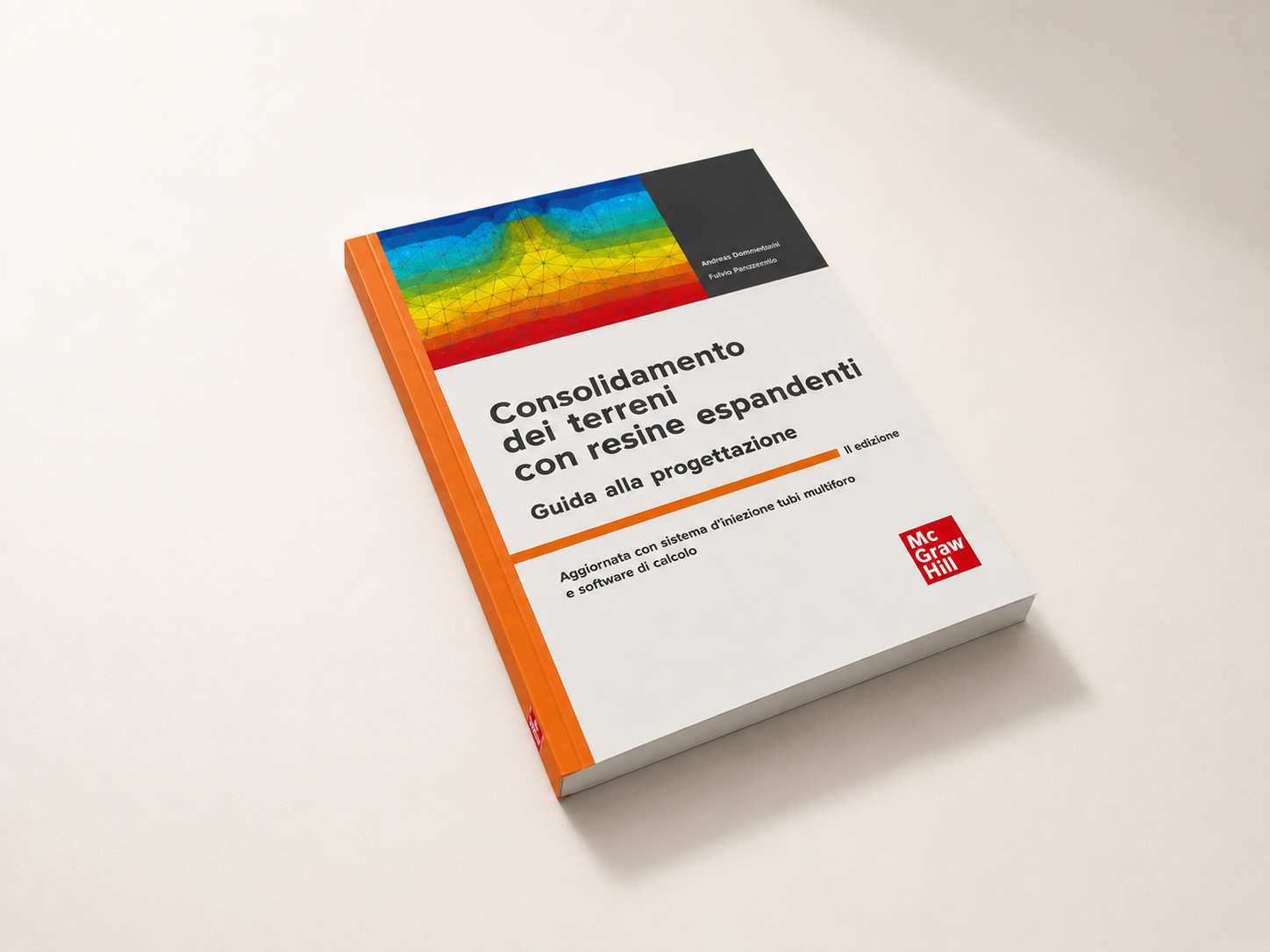
The consolidation of soil through injections of expanding resins today requires an increasingly structured design approach, capable of relating geotechnical characteristics of the soil, behavior of the resin, geometry of the intervention and response of the structure. For the designer, the challenge is therefore not only to choose an intervention technology, but to have calculation models and verification criteria capable of predicting its effects and correctly defining its sizing.
The second edition of is inserted in this context “Soil consolidation with expanding resins: Design guide”published by the Uretek company (and downloadable at the end of the article). The volume collects research results, theoretical models, numerical simulations and calculation examples and introduces updates related to the SIMS 2.0 software and the Multipoint injection system, with the aim of providing professionals with operational tools for the design and verification of interventions. Let’s find out more.
>> Are you interested in articles like this? Click here, it’s free
Research, modeling and injection technologies
The new Uretek guide – signed by professors Andrea Dominijanni and Mario Manassero – was born from the Uretek–Politecnico di Torino research project, with the support and coordination of engineer Matteo Gabassi, Uretek’s Research and Development Manager.
The volume collects the results of the company’s research and application experience, illustrating the scientific foundations, calculation tools and technologies for designing and implementing interventions.
In the field of soil consolidation with expanding resins, Uretek is the only company to have proprietary design software. Used for over ten years, the tool today evolves into SIMS 2.0, perfected through operational experience and research developments.
The software allows engineers and designers to model the treatment and conduct design checks based on the characteristics of the terrain and the intervention. Professionals can use the instrument directly or rely, in whole or in part, on the Uretek technical office.
With Multipoint, Uretek has also innovated the way in which resins are injected into the ground. The patented multi-hole tube system allows you to create a columnar treatment, distributing the resin according to the deformation response of the different layers crossed and concentrating the treatment in the most compressible ones: a solution that allows you to optimize consumption and performance.
From the behavior of the soil to the sizing of the intervention
The volume accompanies the professional from understanding physical phenomena to planning the intervention. Starting from the properties of expanding resins, it analyzes their interaction with coarse-grained and fine-grained soils: from expansion and compaction in granular soils to fracturing mechanisms and the response over time of cohesive soils. Theoretical models, numerical simulations and calculation examples allow the effects of injections on the ground and structures to be evaluated, clarifying the conditions of applicability of the different approaches.
In particular, the ninth chapter translates this scientific framework into operational tools for sizing and verifying interventions with multi-hole pipes: from the definition of the geotechnical parameters to the estimate of the quantity of resin needed and the expected improvement, up to the lifting and fracturing checks. The guide also illustrates the relationships derived from construction site data and implemented in SIMS 2.0, linking modeling to Uretek’s application experience, and analyzes how to optimize injection placement and resin consumption.
The volume is completed by in-depth information on the assessment and mitigation of the risk of liquefaction and on the use of building anchoring systems to increase the resistance to lifting during injection and promote soil compaction.
With this publication, Uretek makes the wealth of knowledge underlying its technologies available to professionals: a commitment that expresses the company’s engineering culture and the desire to evolve the tools with which interventions are designed and implemented.
Resources available
Uretek has made its guide available for free to professionals in the sector, together with other insights and a presentation video: