
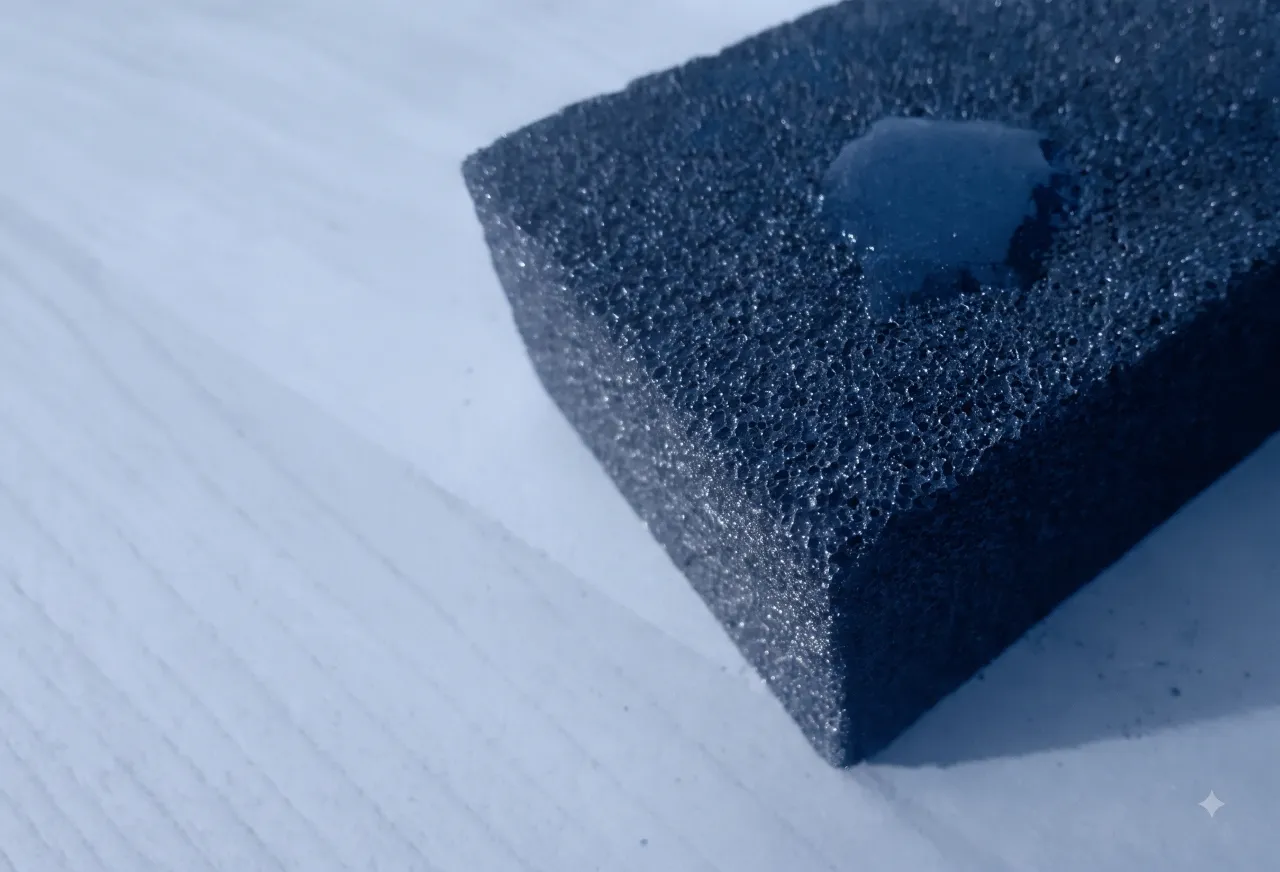
Cellular glass as a barrier to radon gas
For this particularity, with the gluing of the sheets in total adhesion, perfectly watertight to the passage of water, it also becomes a protection system against the risk of entry of Radon gas, especially in the case of slab foundations, where the positioning of the cellular glass should also be placed rising up the edge of the foundation, up to the base of the external thermal insulation, thus constituting a protective tank for the entire foundation level.
In the case of its use as a barrier against Radon gas, it is therefore not enough to install only the panels side by side, but all the panels must be made perfectly watertight by gluing them together with the appropriate waterproof adhesive. The positioning under the foundation should be set on the level of the screed and not, as some claim, on a distribution surface of a layer of thin-sized gravel graded for levelling.
The importance of a regular installation plan
By its very nature, cellular glass is a material resistant to high distributed loads, but it is also a fragile material, especially to concentrated loads; therefore, the escape of a stone, or of any element that exceeds the base bottom plane, can constitute an obstacle to the support of the slabs and cause them to break, even partially, at the point of contact, if it is subjected to any external pressure.
Likewise, a sudden difference in height, even just a few millimeters on the support surface, can literally break the panel at that point. To avoid these risks, it is therefore recommended to create the cleaning layer (lean) using a greater dosage of cement, so as to limit the leakage of the aggregates and guarantee an excellent support surface for the panels, perfectly smooth and stable.
When cellular glass replaces the ventilated crawl space
Logically speaking, therefore, considering these insulation characteristics of the bottom plane, the cellular glass sheets can in all respects replace, as a system, the ventilated crawl space, even in the case in which the sheets are applied above the foundations, such as for example on the existing floor of the first deck, in contact with the ground, during a building renovation. In fact, it is not necessary to create a ventilation system to counteract the presence of humidity coming from the ground, when there is a thermal insulating and waterproof material at the same time, which constitutes a barrier to humidity and allows the inhabitant of the ground floor to keep “his feet warm”.
In the specific case of this application, the cellular glass adopted as a system – which includes only the sheets glued together – is undoubtedly the cheapest, safest and most economically advantageous solution compared to the ventilated crawl space. Just consider that a single material, becoming a construction system, replaces the ventilation elements, represented by today’s recycled plastic domes, the concrete and the structural metal mesh, the waterproof stratigraphy and the anti-Radon gas sheet, as well as the ventilation openings with their protective grilles.
If we then consider the reduced execution times of the works and the absence of risks connected to possible incorrect interactions between the various processes of the ventilated crawl space, it is easy to understand the great advantage that the cellular glass system has.
Beyond the initial cost: the value of durability
As already mentioned previously, cellular glass is often considered an uneconomical material and, for this reason, it is easily not considered usable as an insulating material, preferring other alternative materials, even if sometimes of lower quality or poor durability. This is the case, for example, of high-density extruded expanded polystyrene, which is adopted instead of cellular glass for the insulation of the foundation surface, by virtue of its presumed waterproof power, at a lower cost.
In fact, there are XPS panels, produced in a single layer, coated on both faces and battened, which have declared high technical characteristics of resistance to compression (such as from 700 to 230 kPa), with low water absorption. In reality, recent experience has taught us that some products of similar consistency, such as XPS, suffer from the loss of the waterproof characteristic over time, to the point that – as Silvia Piardi and others mention in her text “Building healthy buildings. Guide to choosing products” (by Silvia Elvira Maria Piardi, Paolo Carena, Ilaria Oberti and Andrea Ratti, Maggioli editore 1996) – “it can be said that the waterproofness of the expanded cells is inversely proportional to the aging of the productThis situation leads the finished product, in direct contact with the bare earth, to be constantly stressed by the presence of the water present there and which risks, over time, being introduced into the structure, potentially limiting the resistance.
A different matter, however, for sheets of cellular glass, made up of rigid panels of expanded mineral, completely impermeable to water, even in total immersion, which in this condition not only do not lose their thermal power, but maintain impermeability and resistance to loads forever. If those who work in construction knew better the physical-mechanical characteristics of materials and not just the economics, they would probably shift their attention towards those products considered innovative, such as cellular glass, observing that a certain cost also corresponds to a certain quality, durability, reliability, safety and absence of risk, including the absence of maintenance over time.