
Established in Dijon since 1926, Léon Grosse is celebrating a century of presence in Burgundy-Franche-Comté, continuing its development between energy renovation, health equipment and large-scale real estate projects.

On October 8, 2026, the construction group Léon Grosse celebrated the centenary of its Dijon agency, one of its first locations outside Savoie. In a century, the company has completed more than 1,000 projects in Burgundy-Franche-Comtéfrom hospital equipment to energy rehabilitation operations, including wine heritage. Several structuring projects today demonstrate its desire to continue its regional development.
Dijon, first stage of national development
The story begins in 1881, when Léon Grosse founded a masonry company in Aix-les-Bains, Savoie. Forty-five years later, the group chooses Dijon to open its first large establishment outside its territory of origin, a decision which marks a turning point in its national development and places it sustainably in the construction landscape in Burgundy-Franche-Comté.
The first projects are helping to establish this presence. The École de la Maladière, in Dijon, built in 1931 and still visible today, as well as the Autun Military School are among the achievements that accompany the company’s expansion in the region. Over the decades, the agency diversified its interventions, participating in particular in the construction of the pediatrics building of the Dijon University Hospital, the construction of the Dauphine shopping center and that of the Grangier car park, in the city center.
In the 1980s, the group continued this dynamic with the delivery of the Besançon University Hospital, a symbol of the modernization of hospital infrastructure, and the Toison d’Or complex in Dijona large-scale complex combining a shopping center, hypermarket, aquatic center, hotel and amusement park. The history of the Toison d’Or also illustrates the company’s ability to support the development of equipment beyond its initial construction. In 2012, the complex embarked on a vast expansion and modernization program, once again entrusted to the Léon Grosse group.
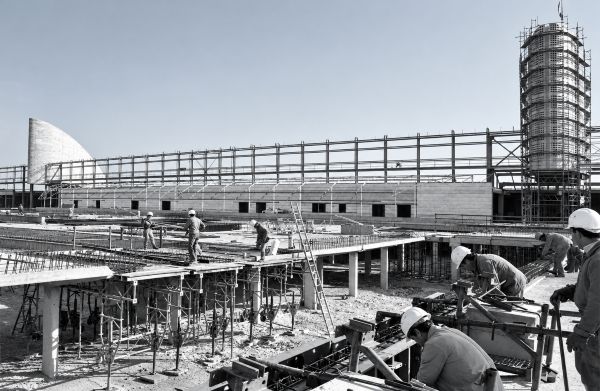
In the 1980s, the company delivered the Besançon University Hospital, which embodies hospital modernity. © Léon Grosse
More than 1,000 projects, from heritage to energy renovation
In a hundred years, theDijon agency has carried out more than 1,000 projects in Burgundy-Franche-Comté ; a presence covering very different areas: public buildings, health establishments, housing, industrial sites, historical heritage and civil engineering works. The Pont de Bourgogne, in Chalon-sur-Saône, notably illustrates the group’s skills in complex infrastructure projects.
Regional heritage constitutes another axis of development, supported in particular by SNEP, subsidiary of the group specialized in this field. Its teams have worked on emblematic buildings of the Burgundy vineyard, including the Château de Meursault, the Clos des Lambrays and the Domaine de Faiveley. This diversity of achievements reflects a strategy based on the complementarity of expertise as well as knowledge of the territory. It allows the group to respond to both new construction needs and the challenges of conserving existing buildings and transforming buildings.
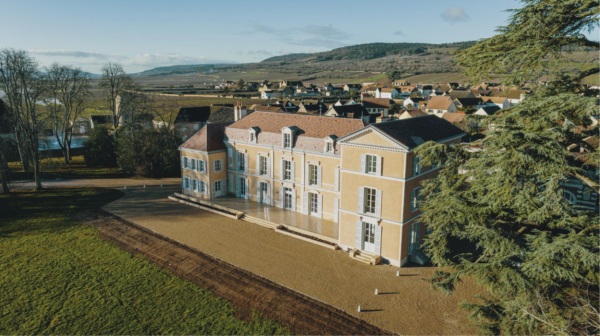
Château de Meursault, a Côte de Beaune wine estate, is distinguished by its historic architecture and its cellars dedicated to the aging of great Burgundy wines. © Léon Grosse
With IRIS, its entity dedicated to the energy rehabilitation of housing on occupied sites, Léon Grosse intervenes in the regional social housing stock, with operations which must reconcile works, improvement of the performance of buildings and keeping residents in their homes. In Dijon, IRIS is currently renovating the Montée de Guise complex for CDC Habitat Dijon. The operation involves 238 housing units spread across five buildings. In Belfort, the Bohn, Alsace, Koechlin complex, carried out for Territoire Habitat, involves 258 housing units spread across three towers and a block of buildings.
Beyond the work, these operations involve specific organization in order to limit disruption to residents’ daily lives. The group also highlights support for tenants, professional integration and the use of local businesses, all levers which contribute to its territorial anchoring.
Health and innovation: two projects to prepare for the future
The agency’s centenary comes at a time when several structuring operations are underway or in preparation in the Dijon metropolis. Among them, the Sully Santenov project, co-developed with Bart Patriarcheshould give rise to a hybrid real estate complex of 9,100 m2. The program will bring together teaching, training, research, innovation and entrepreneurship activities on the same site, with the objective of promote exchanges between players in the health and digital sectors in Burgundy-Franche-Comté, by bringing together the skills and structures that contribute to their development. For the group, this project is part of a logic of supporting regional economic changes, beyond just real estate development.
Another project in the field of health: theextension and rehabilitation of the RéadapTIC building at Dijon University Hospital. This connected structure must offer 99 beds and combine cutting-edge rehabilitation care with research laboratories.
These two operations illustrate the place of specialized equipment in the agency’s activity, but also the requirements that the construction sector now meets, which are also to design buildings adapted to evolving uses, to integrate multiple functions and to support the development of new activities in a territory.
A regional anchor supported by the group’s CSR commitments
For Mario Pinto, the French Building Director of Léon Grossethis anniversary constitutes above all a stage in a story which must continue: “fAfter its 100 years of existence, the Léon Grosse agency in Dijon is looking to the future and intends to continue its lasting commitment to the Burgundy-Franche-Comté region. To support it in its changes while responding to the major challenges of environmental transitions, we rely on the expertise of the 5 business centers of the Léon Grosse Group and on our CSR commitment framework which sets quantified objectives for 2030 in terms of the circular economy, integration, feminization and responsible purchasing“.
With a network of 65 agencies and some 3,000 employees, Léon Grosse claims a historic territorial network in France and is now continuing its development on a European scale.
The group also intends to place its growth within an approach of social and environmental responsibility. Its objectives for 2030 relate in particular to the circular economy, professional integration, the feminization of professions and responsible purchasing. In 2026, the company also obtained the Platinum medal from EcoVadis, the highest level of distinction in this assessment of corporate CSR performance.