
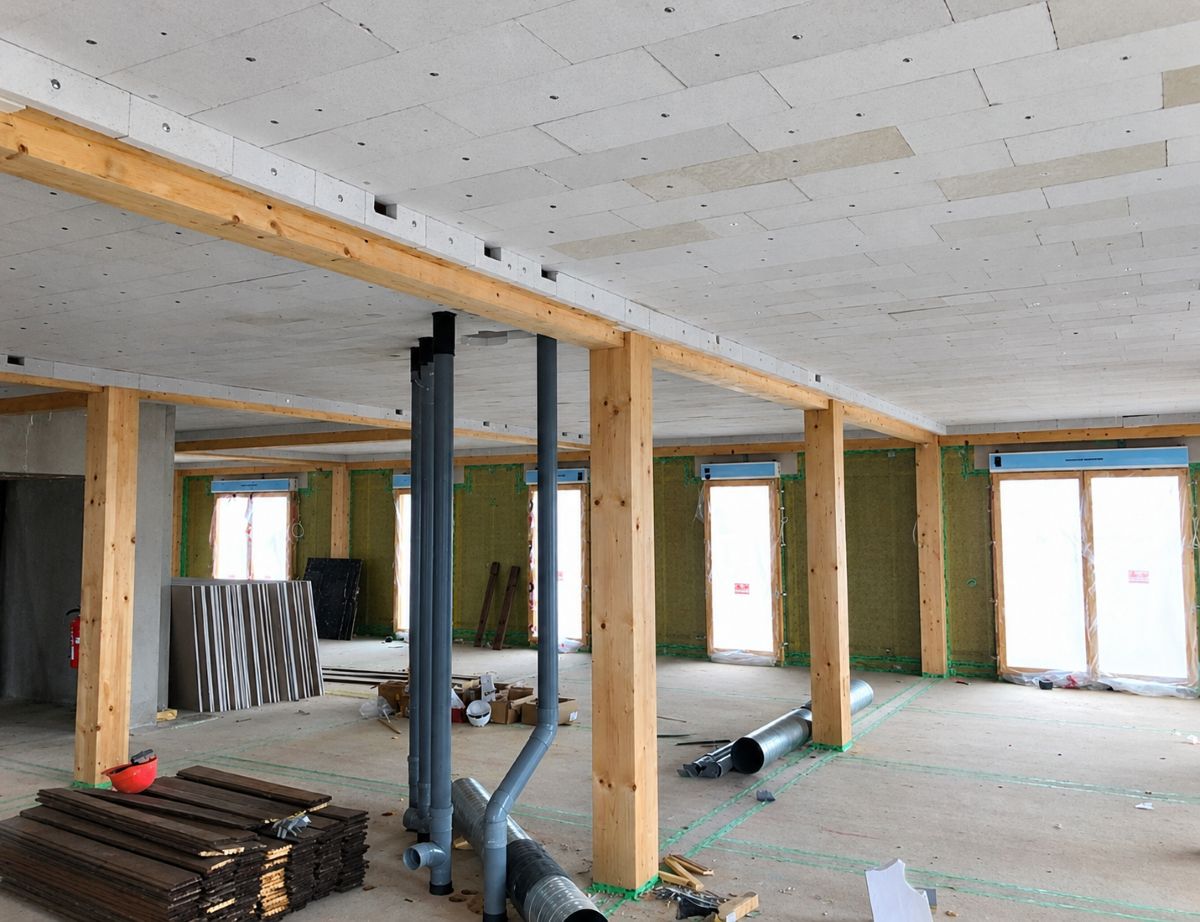
More than 100 housing units in RE2025 for ICADE opposite the Hôtel du Département formerly called PULSE, by Edouard François with Léon Grosse’s wood division in charge. Ile-de-France news for next year.

If we launched a competition for designate the most beautiful hotel in the department of Francethat of “93” would be well placed. The overly textured exterior is lightened by fine polychrome aluminum cladding, but it is above all the atrium of the building which seduces, with its immense glass roof and its calm. For Icade which is in charge of the revaluation of the immense territory of general stores, this “Pulse” operation was less calm, both in the very long study phase with the Fassio-Viaud agency (now BFV Architectes) and Mathis implementing its high wood construction skills. THE building would dominate the large square of the Popular Front also bordered by the vertical garden of Castrogateway to the Condorcet campus. The IOC invested in it during the preparation of the 2024 Olympics and finally, it found its perfect client, the department.
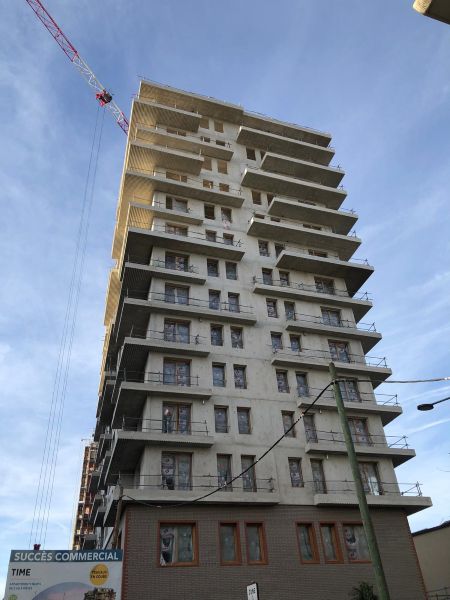
The bow of the ship will be enhanced with a wooden structure house profile. © Jonas Tophoven
The new carbon architecture
To the north of the ring road, on the Aubervilliers and Saint-Denis side, there is still a lot to do, this land poorly valued by wholesalers’ stores invites the construction of housing directly connected to the capital by the extension of line 12. At the south-east corner of the square, opposite the departmental hotel, a Icade plot offers the possibility of building more than a hundred housing units, at the foot of the metro. The architect’s team Edward François must take into account the environmental charter thatIcade has signed with the city of Saint-Denis.
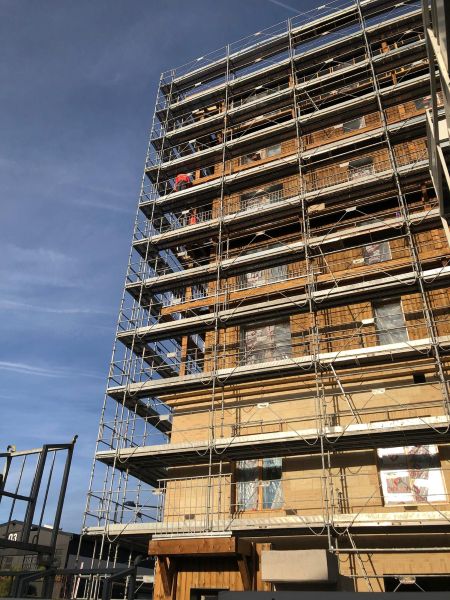
On the south side, the third block is made of wood and it shows. © Jonas Tophoven
TIME innovation showcase
What emerges is a set of three plots which separate the construction techniques. The bow tower, at the corner of the main square, is made of concrete with vertical Hoffmann cement and horizontal CEMIII. In the attic, a timber frame construction. At its feet, collective works in prefab earth (Terrio). The final South block is made of wood and it will show. Of the wooden balconiesA wooden cladding. Behind, a structure which will be hidden but which, from R+2 to the penultimate floor, plays the CLT card on BLC posts, as in the beautiful era of wooden construction.
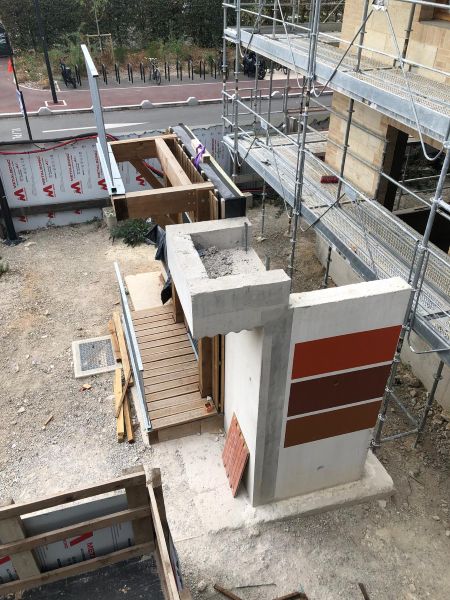
Two models for the facades of the concrete and wooden blocks. © Jonas Tophoven
CLT floors in search of salvation
The CLT BLC pole pair has not resolved its congenital problems: price, fire resistance, bulkiness or even acoustics. But carbon storage had to be stored somewhere. Icade, with Jérôme Duruis behind the development of a protection solution on the underside of CLT floors by applying cellular concrete slabs. THE process was developed in particular by Piveteau for ribbed solutions in competition with Azurtec from Mathis, and the prospect of improving the behavior of the ribs because of the cellular concrete which frames them. The PV passed with Xella is however open, to the point that it is possible not only to apply the solution with CLT slabs from Stora Enso, but also in a situation without ribs.
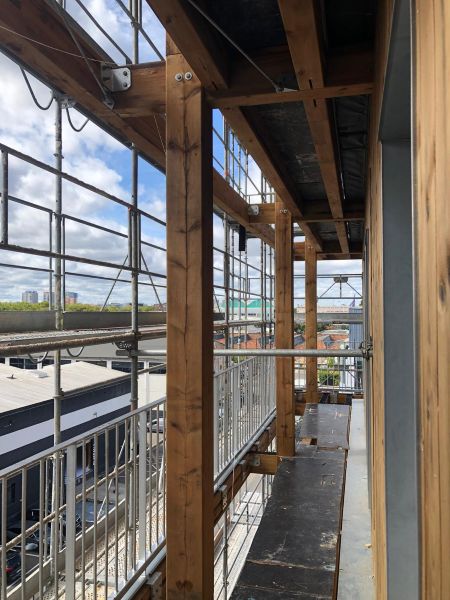
Solid wood balconies worked to avoid water retention. © Jonas Tophoven
Test the innovation
At Léon Grosse, there is a wood core nourished in particular by the experience of Stellata de Rueil, nourished by the expertise of Woodeum. TIME is welcome. It makes it possible to test both Hoffmann cement in plots A and B, and the Xella solution in plot C. The results are not entirely conclusive for the moment, neither on the side of “carbon-free” cements, nor on the side of wood. The positive aspect of Xella does not lie in off-site ideology, but in the practical reality of construction sites. The slabs are insensitive to bad weather. They are applied dry on site and their grip is small compared to common suspended plaster ceiling solutions with plenum and insulation. Samy Ferhah, site manager: “the question of screwing still needs to be optimized and the installation time is currently four times longer than expected, especially since it was also necessary to protect the sides of the joists“.
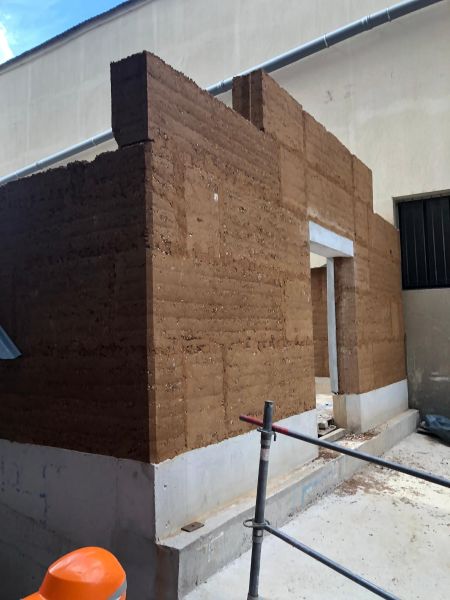
Common spaces in Terrio (prefab rammed earth) under construction. © Jonas Tophoven
The solid wood balcony
The other advance of Léon Grosse on the TIME, on the wood side, is the self-supporting all-wood balcony. An option that makes you smile, and which cannot be interpreted as a return to wood after the relative vicissitudes of Stellata with the Arcelor solution which had not been originally developed for a CLT structure (is there to date in Europe a low carbon solution of balconies associable with the wood construction ?). For the TIME is architectural balance who counts and that doesn’t matter, thewood/wood option is developed with Douglas and attention to avoid water retention while respecting the fire requirements of facades.
TIME, a technical milestone
TIME is the first big test for the Xella solutionjust like the Wood E by Chartier Dalix, in Pantin, was the first big test for the Azurtec. The Wood E was presented at the International Wood Construction Forum in February 2026, the Xella solution in the Innovations Tribune, while TIME will undoubtedly make the headlines in Nancy in October 2027, when the site will be deliverable and will reveal all its facets, including the use of Terracotta tiles from Rairies on the facades as an extension of the work accomplished for Icade in Lot D for the Athletes’ Village.
Léon Grosse comes out of the woods
We must face the facts, the news of biosourced construction is increasingly governed by EGs. In the case of Léon Grosse, they bought a Techniwood, had a specialized operations director like Philippe Favier, integrated specialists like Christophe Zellek, developed a core team which also managed to transform masons into installers of wooden structures, quickly rose in proficiency and brought a broader perspective to the profession.
Greener EGs
The old rivalry between carpenters bled by subcontracting with structural work is not buried and it is even expressed within EGs which integrate carpenters. But it must be noted that the EGs and their collaborators provide technical attention and climate awareness which strengthens the biosourced sector.
Jonas Tophoven / © Jonas Tophoven