
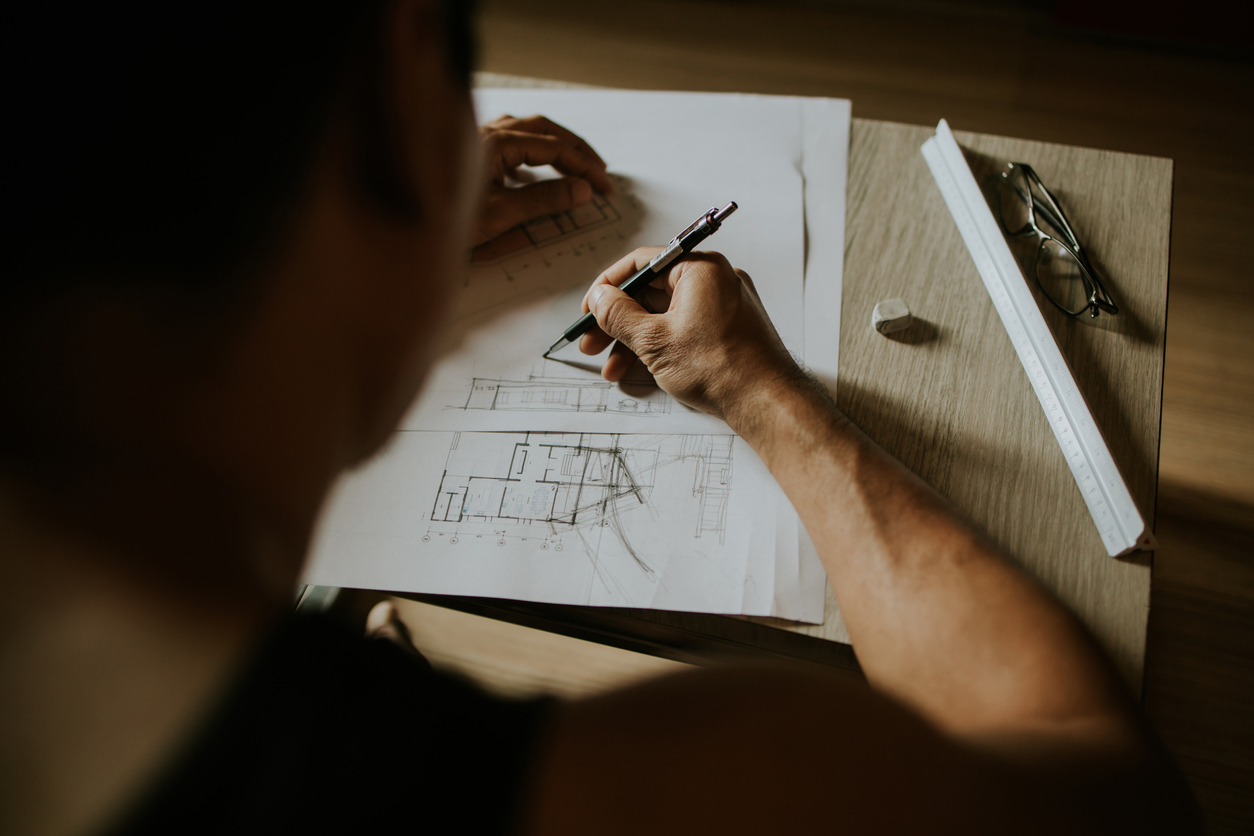
A few weeks ago a friend alerted me to an interesting article published in a Ticino magazine, The regionthe subject of which was a conversation with the architect. Eva Prats, extraordinary professor at the USI Academy of Architecture in Mendrisio, as well as co-founder, with Ricardo Flores, of the Flores&Prats studio in Barcelona.
Hand drawing and computer: two complementary tools in design
Well, architect Prats believes that both methodologies will continue to coexist and interact, since in the early stages of designing a project “you have to think about and make many things work at the same time, namely the client’s wishes, the place and context where the building will be built, its use, as well as the land, the structure, etc.”, and the pencil allows better concentration, with the hand graphically translating our thoughts. On the contrary, with the PC there is a risk of being too focused on the instrument, because the computer – another interesting concept expressed by Prats – is a tool more suitable for producing but less suitable for reflecting.
On the basis of this, both in professional and teaching activities, Prats calls for the use of both tools. In fact, he says that, as in his studio, in the first phase we use pencil and paper more, we discuss and keep track of all the steps, and only in the subsequent phases, where the project has been outlined in its basic elements, does the computer become a fundamental tool for speeding up different work phases. The same happens, in the university context, with the students: at the beginning they are all scared, because it is now a constant to have the computer as the only expressive tool, but then with a little commitment, everyone begins to draw with traditional tools, with a lot of enthusiasm and a continuous exchange with their classmates.
As proof of his thesis, Prats makes two further considerations that I have actually always used: relying only on the computer, uncritically, as is often done today, does not help one to reason, limits comparison and, in the case of abandoning a possible solution, one risks losing track of the work carried out up to that point; while with glossy paper, with sketches, comparison and the possibility of recovering initially abandoned hypotheses is easier.
The second consideration is linked to the executive phase, where, on the construction site, a detail to be specified to the workers must necessarily be drawn by hand: in fact, it must represent what the construction operator understands and in this sense, computer drawing is not the most effective tool for interacting in this context.
Artificial intelligence in architecture: between information support and creativity
A further topic covered was that of Artificial Intelligence and the use that the architect can make of it. Here too, probably against the grain, according to Prats it is good to use it as a means of information for regulatory issues, but not as a creative means, because the project is a set of voices that the designer must put together through a construction process, which generates considerable satisfaction, but only if it is the fruit of his own intellect, certainly not of AI.
Well, in the words of the interview and in the story of his own experience as a teacher, I found what I have experienced for almost 30 years with my courses for the professional qualification exam for architects and civil construction engineers. I found my own words and concepts, and I noted, with Prats’ considerations, the same effects that I have noticed, for many years, with graduates who turn to me for the qualifying exam, after manual practice in university has unfortunately been increasingly reduced, if not totally abandoned.
I therefore had confirmation that someone else, much more famous and professionally established than me, believes the use of computers and AI is something which, if not correctly governed, risks extinguishing intellectual and creative capacity. Trusting exclusively in technology in an uncritical way, as happens today, especially in Italian university teaching, seems to me to be the best way to prevent students from growing intellectually.
The effects of technology on cognitive abilities and learning
And all this is also supported by something else. We know, for example, that some nations at the forefront in the use of technology in schools – for example Sweden – are retracing their steps, having tested the negative effects on students generated by the abandonment of manual practice, such as handwriting and reading.
Furthermore, some neuropsychologists state, to summarize, that the brain must be stimulated, otherwise it loses cognitive abilities. In this sense, neuropsychologist professor Giuseppe Alfredo Iannoccari, in a recent interview, specifies that to keep the brain young and in training it is important to activate:
- curiosity, which serves to maintain active attention and trigger learning and memorization processes;
- creativity that generates the ability to connect different information in order to reach new solutions;
- emotionality, which allows us to imprint the sensations and experiences we have had in our memory.
Here, therefore, the brain must be trained like a muscle, while the continuous use of technology – for example the use of a phone book of telephone numbers instead of memorizing them as was once done, or the widespread use of the calculator even for elementary mathematical calculations – makes us lose skills and turns off some abilities. Added to this are the changes in attention that social media generate in all activities, which according to the neuropsychologist do not help and actually damage the brain.
The training of architects and engineers: from university to the state exam
I notice what I have read partly in myself, but even more so in the new generations, such as in the young people who turn to me to prepare for the state exam: there is an increasingly present lack of attention, as well as an inability to concentrate, understand and memorize basic concepts, practical regulations, basic design models, all very useful in resolving more or less complex issues, present in the exam as in professional life.
But the question I always ask myself is: why do only a few people notice such effects? Why is it that, at an institutional level, no one is doing anything to reverse a trend that is absolutely not bringing good results for the country system? Why do we continue to propose facilitating shortcuts instead of putting the individual and his intellectual growth back at the centre?
And I ask myself this question even more, since recently one of my students, very good, with a final state exam result with top marks, confessed to me, during the preparation that “the course is giving me a lot, also as a complement to previous work experience. We can see that the body of knowledge he transmits to us is the fruit of many years of patient and counter-trend work. In this sense, I believe that the course you are taking should be integrated into university preparation, instead of a good portion of exams of dubious usefulness for the profession. In the end, you have to learn practically everything on your own and I find it unfair considering the heavy efforts in terms of time and money.”
Faced with this beautiful certificate of esteem, the words I heard from many university professors came to mind, who state that the university must provide culture, not teach a trade. And then perhaps I understand why the voices of the architect Prats, and of Professor Iannoccari, which I have made mine today in this text, seem to be faint cries in a desert.
>> If you want to receive news like this directly on your smartphone, subscribe to our new Telegram channel!
Thank you for subscribing to the newsletter.