
Long confined to distinct uses, LoRaWAN and Zigbee are converging in the technical management of buildings. At the IBS 2026 show, their growth reflects a major evolution in wireless communication solutions.
Publi-Information 

The IBS Show (Intelligent Building Systems) was held in Paris, Porte de Versailles, on October 14 and 15, 2026. It brought together more than 200 exhibitors and welcomed more than 8,000 professional visitors.
There GTB, the energy performance of buildingsdriven by the Tertiary decree and the BACS decree, were important themes. The management of photovoltaic electricity produced on site, the management of electricity storage in batteries in buildings and optimization of self-consumption appeared this year.
But what struck the visitors the most was the rapid development of LoRaWAN communication protocols (Long Range Wide Area Network) And Zigbeeas well as the strong convergence of their uses in construction.
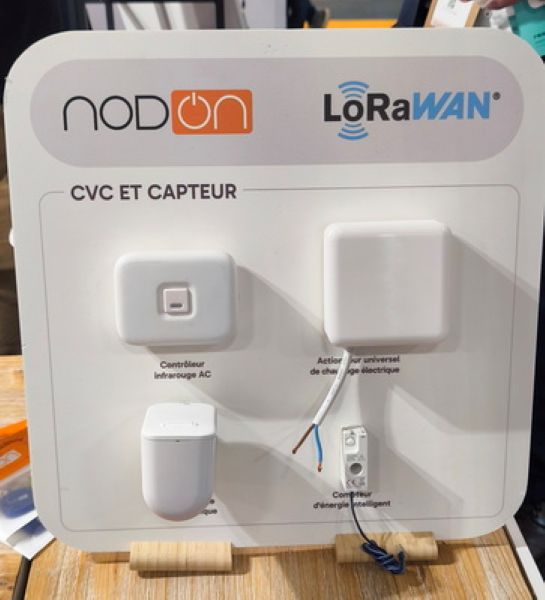
NodOn showed a whole new LoRaWAN range at IBS 2026, including a multifunction actuator which embeds three essential functions in a single module: pilot wire electric heating control, On/Off relay for electric radiator without pilot wire or other electrical equipment, integrated temperature probe. Below left, the TRV-8-1-00 thermostatic faucet head comes with three valve adapters of different diameters. It regulates the temperature room by room via a LoRaWAN network which can reach several kilometers in a building, by acting directly on the position of the water radiator valve according to the defined setpoint temperature. © PP
The LoRaWAN protocol
Originally, the LoRa radio communication technology (Long Range) is a standard of wireless communicationrather on the royalty-free 868 MHz frequency band, with a significant range of 2 to 3 km in dense urban areas and up to 10 or 15 km in rural areas. THE LoRaWAN protocol (Long Range Wide Area Network) defines the network architecture.
This protocol was created by Grenoble-based Cycléo in 2009, bought by Semtech in 2012. It is today developed throughout the world by the LoRa Alliance which has more than 500 members, including around fifty French organizations. The Mixte Nièvre Numérique union is a member of the LoRa Alliance, alongside the Syndicat Mixte Manche Numérique, Montpellier Méditerranée Métropole, the SNCF, the FNCCR (Fédération Nationale des Collectivités Concédantes et Régies), the French manufacturers Adeunis, MobiWire, Socomec, Groupe Lacroix, Sagemcom, Watteco, ABB, Siemens, Honeywell International, from Thermokon Sensortechnik, Orange, Savoie Mont Blanc University, Grenoble Alpes University, Dekra and Bureau Veritas. When we consider the list of LoRaAlliance membersit is clear that the first users were interested in the long range of LoRaWAN and it is still widely used in agriculture, industry, logistics, for the management of water and electricity distribution networks and the management of cities.
But at last IBS show in Paris more than thirty exhibitors showed applications for building controlconsumption measurement, etc. so many applications that do not require long distance transmission. But, advantage in building, LoRaWAN easily passes through reinforced concrete walls and can fetch data from several underground levels. At IBS show, LoRaWAN, LoRaWAN sensors and actuators were largely battery-powered and designed to transport a small volume of data with a reduced throughput. Which allows limit the energy consumption of connected objects and of offer autonomy of several years on batteries. LoRaWAN, wireless, is particularly well suited to modernizing the control of existing buildingsdue to the low energy consumption of connected objects and the good signal propagation through concrete.
L’architecture of a LoRaWAN network is star: wireless equipment communicates with LoRa gateways. In turn, these gateways communicate via Ethernet over TCP/IP with application servers. A single gateway may be sufficient for a tertiary building. Several gateways can be connected to the same application server. LoRaWAN does not allow direct dialogue between two connected objects. To do this, they must go through the application server.
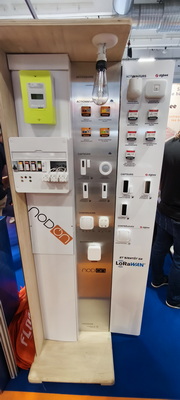
NodOn was showing its range of Zigbee actuators at IBS and announcing their upcoming availability in LoRaWAN, including a smart energy meter and an infrared controller for air conditioners. © PP
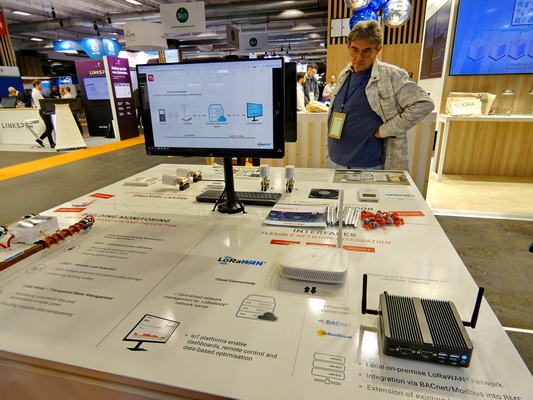
Thermokon now places LoRaWAN at the center of its range of communication protocols, highlighting the fact that LoRaWAN is the first radio protocol whose range extends from basements to the roof and emphasizing that its long range is perfectly suited to long distances in commercial buildings and industry. © PP
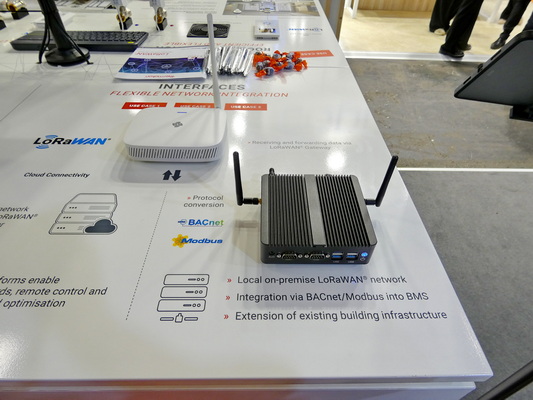
In total, Thermokon offers 31 products under LoRaWAN, including NBnano, the LoRaWAN data converter to BACnet IP and Modbus TCP/IP. The NBnano contains a LoRaWAN network/application server and allows conversion to BACnet IP or Modbus TCP/IP for direct connection to a building management system. External LoRaWAN® gateways, including the new LRW Indoor RAK 7268 gateway, which are connected to the NBnano, serve as radio receivers. © PP
LoRaWAN right down to the heads of thermostatic valves
At IBS, many exhibitors took LoRaWAN down to temperature sensors, thermostatic heads and many other actuators. Thermokon showed for example NOVOS 3 INC LoRaWANa wall-mounted room control unit, MCS LoRaWAN, a compact multifunction sensor And WK02+ ext. LoRaWan, a condensation sensor. All the NOVOS family of sensors and control units from Thermokon works in LoRaWANbut also in Modbus, KNX, enocean and BACnet. There The star of Thermokon’s LoRaWAN offerings, however, was JOYa connected, direct-acting room thermostat. It controls the heating, cooling (chilled water, not direct expansion) and ventilation systems. It acts locally on equipment and offers long-range communication.
Even Schneider Electric presented its new multi-site GTB at IBSCloud, for small and medium buildings with the EcoStuxure Building Activate management solution. In this solution, the connection of terminal equipment is based on LoRaWAN or Zigbee. While the feedback of information goes through the multi-protocol EcoStuxure Flex Server gateway which communicates locally using Zigbee, LoRaWAN, Modubus TCP, Modbus RTU and BacNet IP.
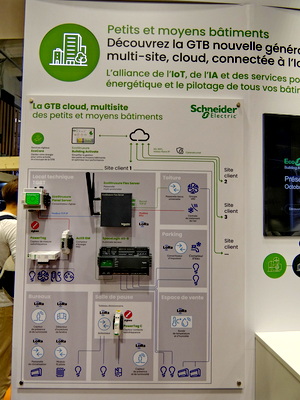
The new multi-site BMS from Schneider Electric is capable of controlling actuators for lighting, air conditioning and hot water heating in LoRaWAN. While using information from LoRaWAN probes for ambient temperature and humidity, presence, brightness and window opening detectors. It reports information from pulse water meters, also in LoRaWAN. While electrical energy metering is carried out primarily using PowerTag and PowerTag C under Zigbee which send their information to a Zigbee concentrator, called EcoStruxure Panel Server, itself connected to the EcoStuxure Flex Server gateway via Modbus TCP. © PP
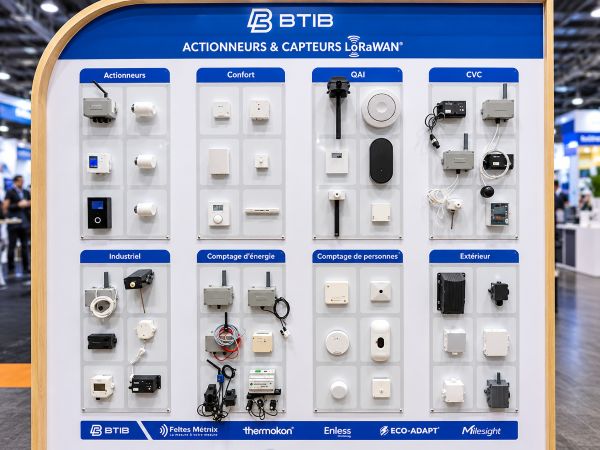
BTIB, a distributor of Niagara supervision, has made its market with Enless Wireless, Thermokon, Sontay, ECO-ADAPT and Milesight to offer an ultra-complete range of actuators, probes, electricity metering, both indoor and outdoor. © PP
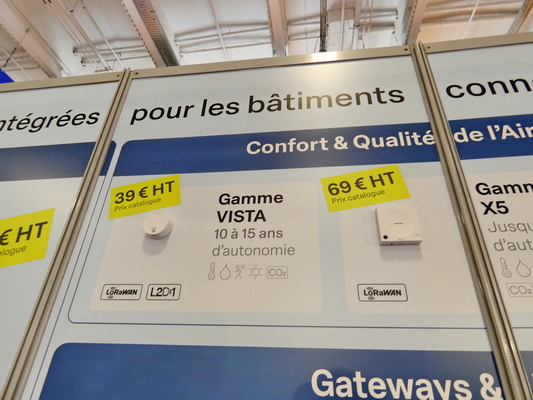
NEXELEC did not hesitate to indicate the public prices of the components of its VISTA range under LoRaWAN. © PP
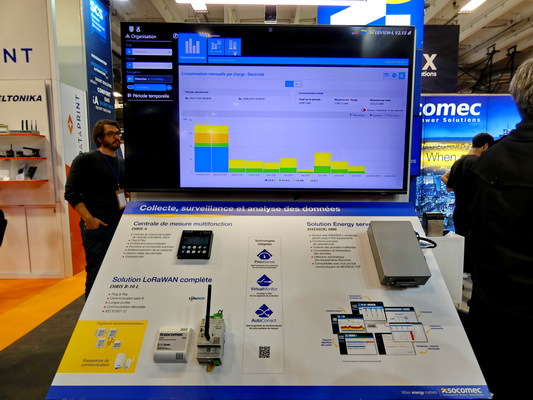
Socomec, the electrical equipment manufacturer, presented its complete LoRaWAN solution at IBS DIRIS B-10 L. It is a measurement center in a modular format, incorporating LoRaWAN wireless communication. Its four independent RJ12 current inputs manage several types of departures: 4 single-phase loads or 1 three-phase load + 1 single-phase load. The DIRIS B-10L is combined with current sensors (RJ12 connection), suitable for any type of installation: closed TE current sensors, opening TR/iTR and flexible TF. It also receives data from SOCOMEC environmental sensors under LoRaWAN: ambient temperature and humidity sensor, temperature sensor, multi-fluid counting, etc. © PP
Zigbee, the intrinsically secure protocol
The other high profile protocol at IBS was the Zigbee mesh radio protocol. Each Zigbee plugged-in device connected to the mains acts as a router and relays the signal, extending the range and strengthening the stability of the network as devices are added to an existing Zigbee network. The Zigbee protocol uses the 2.4 GHz frequency band worldwide and also the 868 MHz band in Europe. By construction, it includes AES128-bit data encryption. Initially, LoRaWAN and Zigbee served different needs. LoRaWAN carries low-volume messages, a few times per hour, transmitted by devices distributed over a large area. While Zigbee is able to handle frequent reading of many devices in a building. But, with the considerable expansion of end device offerings under LoRaWAN that we saw at IBS, it is clear that the distinction between the two protocols is blurring. The development of Zigbee is managed worldwide by the CSA https://csa-iot.org/fr/all-solutions/zigbee/ Connectivity Standards Alliance which also takes care of Matter. Last June, CSA introduced the new Suzi protocol, a long-range mesh network that offers users the ability to connect more devices and extend the reach of their connected environments. CSA says Suzi excels in commercial building installations that cover large areas, multiple floors and harsh RF environments using long communication range, wall penetration, energy efficiency and true mesh networking. Which places Suzi in direct competition with LoRaWAN.
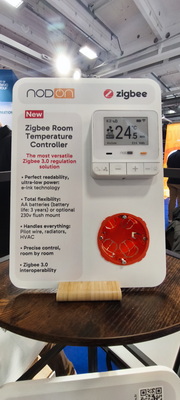
The French NodOn is one of the main propagators of the Zigbee mesh protocol. He presented at IBS his new Zigbee 3.0 compatible room thermostat, the most recent specification of the protocol. It works on the mains or with two AA batteries with a lifespan of three years, due to its low electricity consumption. It controls everything: air conditioning, hot water heating, electric heating under a pilot wire, etc. NodOn also presented a whole new range of electricity meters, with or without a torus, under Zigbee. © PP
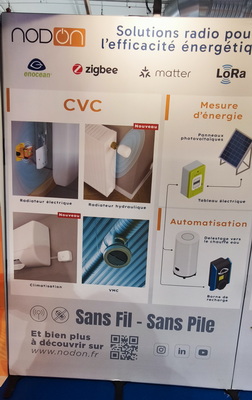
NodOn masters all wireless communication protocols: enocean, Zigbee, LoRaWan and even the most recent Matter on Thread. Matter, the application layer without a transport layer, compatible with Thread, Wifi, PoE, Ethernet, was very little present at IBS. Only ABB and Thermokon mentioned it. © PP
BACnet and Modbus are still widely used by manufacturers of automation and HVAC equipment. Modbus is not a secure communication solution at the moment. The Modbus protocol does not include encryption, authentication or integrity checks. Modbus must therefore only be used on otherwise secure network segments. BACnet now includes a secure version, BACnet SC or BACnet Secure, but no exhibitor at IBS highlighted compatible equipment. © PP
In 2027, IBS will still be held in Paris, Porte de VersaillesOctober 5 and 6.