
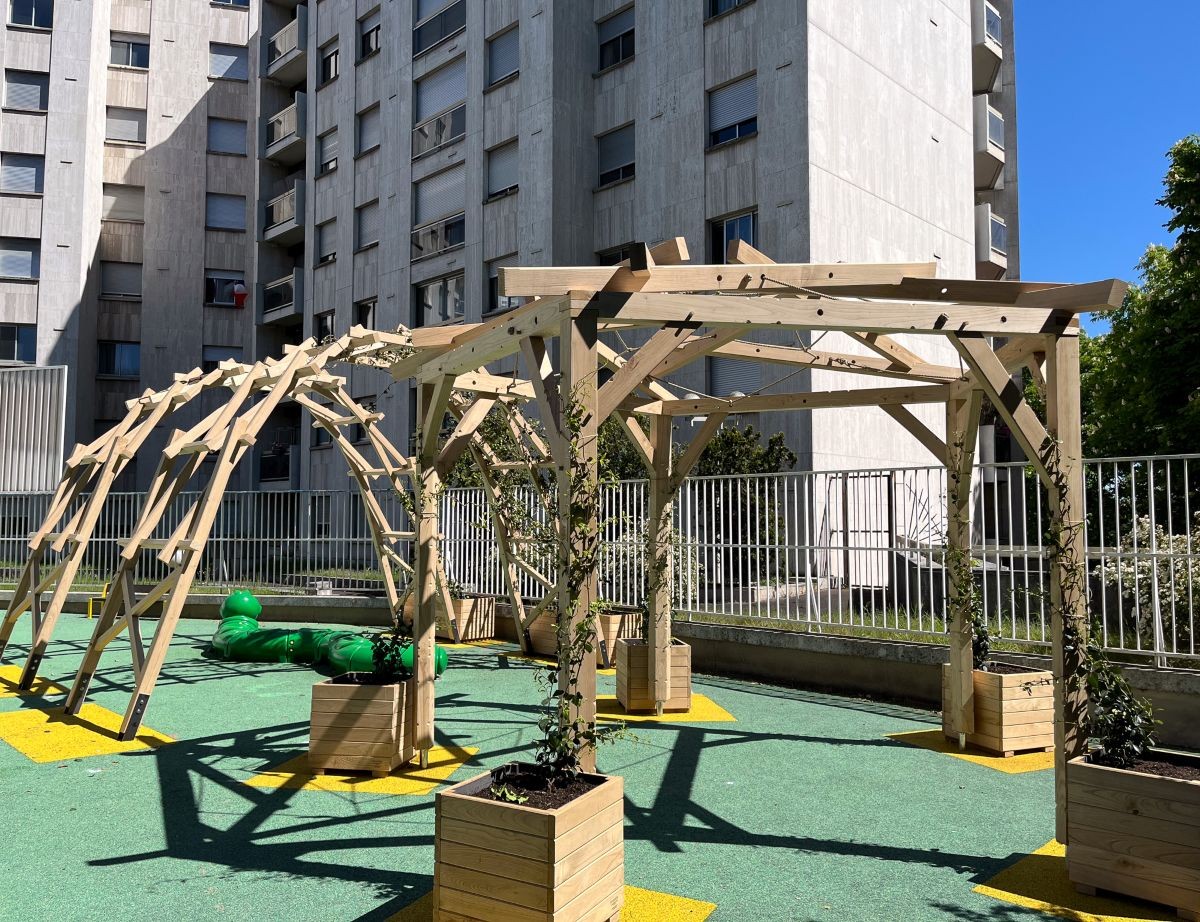
Breton chestnut shade shades with reciprocal structures and climbing plants from Sinallagma are conquering schoolyards, following the example of the Eugénie Cotton nursery school in Choisy-le-Roi.

In many cases, the shade houses proposed by Sinallagma allow you to complete Oasis-type procedures dewaterproofing of school groundsby offering an outdoor classroom location. But it happens that schoolyards located at height do not allow waterproofing. In the case of the kindergarten Eugénie Cotton from Choisy-le-Roi, the courtyard is positioned above a parking lot. No possibility of planting or drilling into the ground.
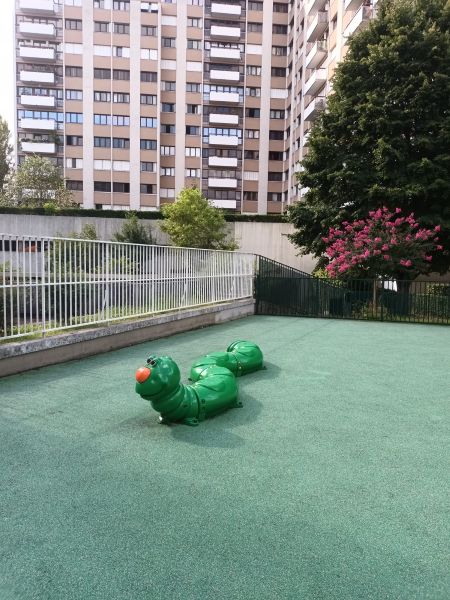
The courtyard of the Eugénie Cotton kindergarten in Choisy-le-Roi before work. © Sinallagma
A major operation
There courtyard of the Eugénie Cotton kindergarten is installed on a terrace with a soft floor covering. Playground objects rest there without anchoring. There temperature can rise sharply in case of excess sunlight. When theinstallation of Sinallagma was carried out in April, the air temperature was 24 °C and the temperature of the soft ground exceeded 50°C. It is appropriate to create shade to protect childrenbut also cool the ground surface. Finally, the measurement of the ground in the shade of the plants of the shade houses was close to that of the air and did not rise above 30°C.
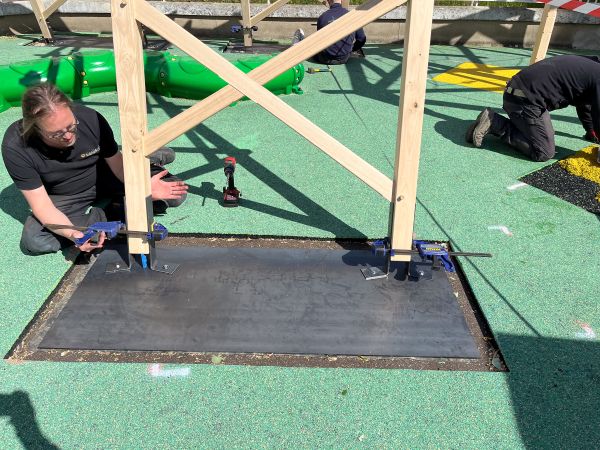
Fixing the shade structure on the metal plate. © Sinallagma
In spring 2026, the school is therefore choosing from several “Bout du Monde” type shade houses” in order to distribute the shade as much as possible and to create a welcome diversity in this rough courtyard. For the first time, Sinallagma is obliged to fix its works on plates which distribute the weight without drilling and help to ballast the whole thing. But this is good because the specialist in chestnut works works with an ironworker who knows how to integrate wrought iron elements which personify the work by also creating supports for climbing plants.
Recreating the meadow
There reciprocal structure shade break is child’s play, a clear advantage when it comes to intervening in in-service schoolyards. In this specific case, part of the flexible floor must be removed and, subsequently, replaced with a poured anti-fall surface. At the same time, Sinallagma supplies containers for plants which provide most of the shade. In all, this type of intervention largely takes place within a period of usual leave. The supplier provides evidence from thermal cameras to show how much the shade can lower the ground temperature.
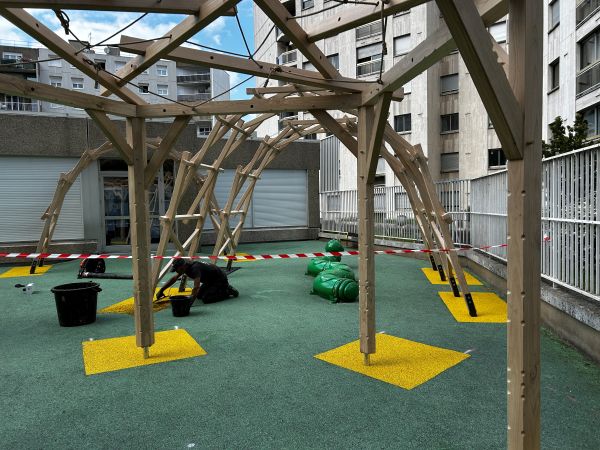
Protection of the plates by pouring flexible flooring. © Sinallagma
These make it possible to verify that a shade house works mainly because of the plants and not so much by the shade of a pergola type installation… and even less under photovoltaic panels! As journalist Hugo Clément shows in a recent video, thetree provides by far the best reduction in ground temperature, thanks to its transpiration. In cases where trees are missing, vegetated shade houses are a good alternative.
The educational shade
Almost at the end of the runway at Orly airport, and in the heart of a residential complex which houses it, the artificial courtyard of the kindergarten is not in itself a model of development. However, the shade houses give children back contact with natural materials and plants, while the banks of the Seine are close by.
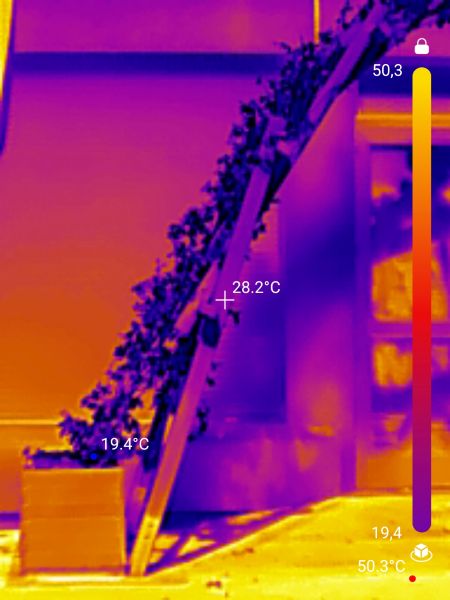
The thermal camera shows a gradient of more than 30°C. © Sinallagma
THE Oasis type courses constitute a revolutionbecause summer shelters for the elderly are anticipated there, in the wake of the heatwave of 2003. And now nature enters schoolyards and schools, not just a few withered and often diseased chestnut trees and installations that even the fertile imagination of children cannot eternally animate. This time, the sun protection function is coupled with an object lesson (plants, wood, ironwork, ropes, etc.) and the possibility of leaving classes at appropriate times, not only in the beautiful courtyards of the Jules Ferry schools, but also in those which have been installed around the big bars, in an artificial urban context.
When it’s the shadehouse that makes the school
There schoolyard resuscitation is underway, and the renovation market is becoming the majority, like the city of Paris which wants to renovate 700 establishments by 2050. However, there is not yet a new school designed from the schoolyard shade housestherefore the effect of the frames in reciprocal structure, the curvatures, the particular effect of the plants. It is difficult to do the opposite, to ask the reciprocal structure shade houses to adapt to the school architecture developed by the architects.
Clearly, the issue is to create a built environment architecturally compatible with schoolyards to feature Oasisclass outside, for works which know how to erase the sharp gap between the building and the layout of the gardens, while making full use of bioclimatic springs. An approach which would undoubtedly require a design-construction approach. As such, Since its beginnings, Sinallagma has developed green surface facades in the same reciprocal spirit, which can also bring a biomimetic and natural touch to orthogonal facades under renovation.
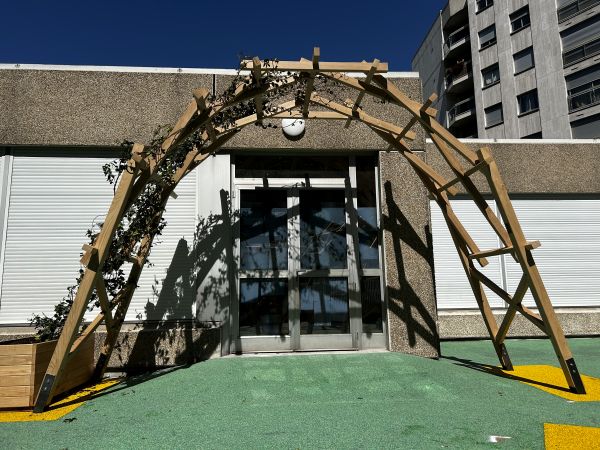
One of the Bout du Monde shade houses delivered with its climbing plants which will take advantage of the year 2026 to expand. © Sinallagma
Jonas Tophoven / © Sinallagma