
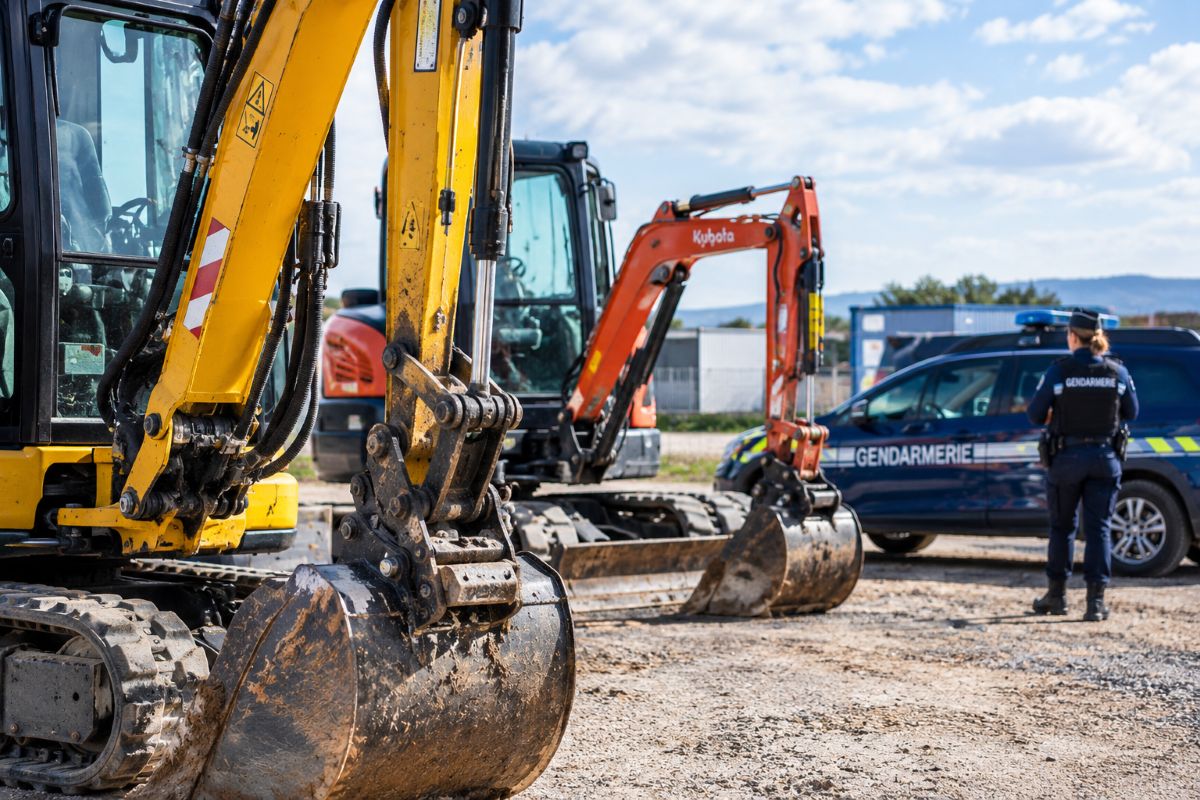
From mini excavators intercepted in Germany to machines found in Belgium, several recent operations show the effectiveness of cooperation between professionals and law enforcement. DLR wants to go further.

THE thefts and scams targeting construction and handling equipment no longer constitute just a succession of news items occasionally affecting companies in the sector. Behind certain cases, structured networks are emerging, capable of quickly moving machines from one country to another as well as multiplying offenses, forcing professionals to strengthen their exchanges with the investigation services. It is in this logic that DLR, which brings together players in the distribution, rental and maintenance of construction and handling equipmenthas been developing for several years a collective mobilization around its “Stop theft” commission.
The examples presented by the Federation give an idea of the effectiveness that this cooperation can produce when it operates at full capacity: materials recovered in a few hours in Belgium, five mini excavators intercepted in Germany or three machines worth 200,000 euros found in the space of a weekend. In addition to these rapid operations, there were longer investigations, which allowed several arrests and, above all, to highlight networks likely to be responsible for dozens of acts.
Beyond these results, the observation drawn up by DLR is clear: in a sector where equipment can be stolen and then moved very quickly, the circulation of information between companies and law enforcement constitutes one of the main levers to improve the chances of finding the machines and tracing them back to the perpetrators.
A chain of actors where everyone has their role
There “Stop theft” commission is therefore not limited to intervening once the equipment has disappeared. Its role also consists of working upstream, raising companies’ awareness of risks, identifying theft, fraud and attempted scamsbut also by collecting feedback in order to identify operating methods and better document a phenomenon whose scale remains difficult to understand in its entirety.
This dimension of the work is essential: taken in isolation, a theft can appear as an event limited to a company and a territory, while the bringing together of several reports can bring out the same method, the same circuit or common practices between several cases. “Every theft counts, so does every report“, summarizes the Federation.
This organization is based on a precise distribution of responsibilities. Companies constitute the first link in the chain by passing on the information they have; DLR centralizes and structures them, while ensuring awareness-raising work among the profession and bringing the reality of the phenomenon to those concerned. THE members of the “Stop theft” commission For their part, they bring their knowledge of the field and their experience of equipment and professional practices in order to develop the systems put in place. Its president, Joël Fruchart, notably ensures the operational link with the police interlocutors.
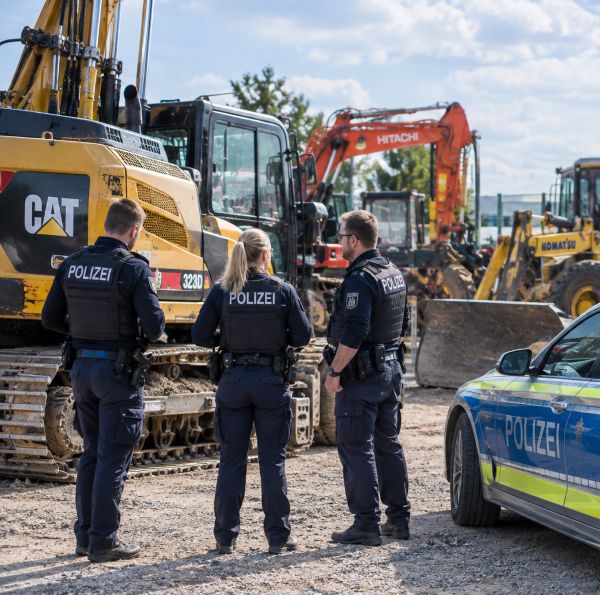
The Federation does not replace the police: investigations, arrests and interventions remain the exclusive responsibility of the police and the gendarmerie. Its role consists above all of facilitating the transmission of information to specialized services and of improving exchanges with a sector which knows precisely the machines sought, their characteristics and their circuits of use. © IA / Laure Pophillat
This cooperation also takes on a European dimension. The operations carried out in Belgium or Germany show in fact that the fight against the theft of professional equipment can no longer be thought of only on a national scale, machines being able to cross borders in a few hours. DLR thus cites among the services and partners mobilized:
– the Vehicle Investigation Platform (PIV);
– the National Judicial Police Unit of the National Gendarmerie (UNPJ-GN);
– The Central Office for the Fight against Traveling Delinquency (OCLDI);
– As well as the Central Office for the Fight against Organized Crime (OCLCO) of the National Directorate of Judicial Police (DNPJ).
Research sections, territorial services and various European partners are also participating in this fight.
DLR, a network of more than 1,000 companies
This mobilization is part of the broader DLR missions. The Federation represents companies involved in the distribution, rental and maintenance of construction and handling equipment, a sector which occupies a strategic position in the construction chain since these companies ensure both the marketing of the equipment, their provision and their maintenance.
With more than 1,000 members, DLR claims around 70% of the market and also relies on several affiliated unions, including ACiM, FNAR and UFL. Its vocation thus goes beyond the sole representation of the economic interests of its members: the Federation also seeks to promote exchanges between professionals, to defend their interests with public authorities and to contribute to improving the competitiveness of companies in the sector.
There fight against theft and scams is part of this networking logic. By allowing professionals to share their experiences and by organizing dialogue with specialized services, DLR seeks to transform scattered reports into collective knowledge of the phenomenon.
Business words BFM TV. © BFM TV
© IA / Laure Pophillat