
The FFB lowers its forecast for 2026 and now anticipates a decline of 0.3% in construction activity. New housing, renovation, employment and cash flow are deteriorating. 2027, dark year?

There French Building Federation lowers its forecast for 2026 and now anticipates a decline of 0.3% in construction activity in volume, as it announced during its back-to-school press conference – this Tuesday, September 15, 2026. All the main markets are deteriorating, while companies see their margins contract and employment continues to decline: “the building is doing badly, even very badly, all segments of our activity are in the red“, noted Frédéric Carré, president of the FFB.
For the Federation, the 2027 finance bill must absolutely support housing, renovation and investment.
The rebound in new housing does not resist leading indicators
New housing constitutes the main point of alert. Certainly, the construction starts still show an increase of 26.4% over the first seven months of 2026 compared to the same period of 2025. But this increase comes after several years of collapse and does not reflect, according to the FFB, a real recovery in the market.
On an annual basis, only 302,000 housing units are currently started. The level thus remains more than 50,000 units below the average of the last forty years. The Federation also estimates that the annual volume should fall back below 300,000 housing units in 2026, a far cry from the approximately 420,000 housing units needed to meet identified needs.
Building authorizations fell by 8% over the last three months to the end of July, with a particularly marked drop in the collective (-16.6%). Over seven months, they have already stagnated (-0.2%). The movement is also visible upstream. Developer sales fell by 2.9% in the first half of 2026, after a drop of 34.1% between 2022 and 2025. sales to individuals remain close to their historic lowswhile sales to institutional investors decreased by 8.3%. At the same time, new sales intended for individuals fell by 13.2%. Another warning signal: after their rebound in 2025, sales of individual homes are also turning around. They decrease by 5.8% over the first seven months of 2026 and even by 19.3% over the last three months.
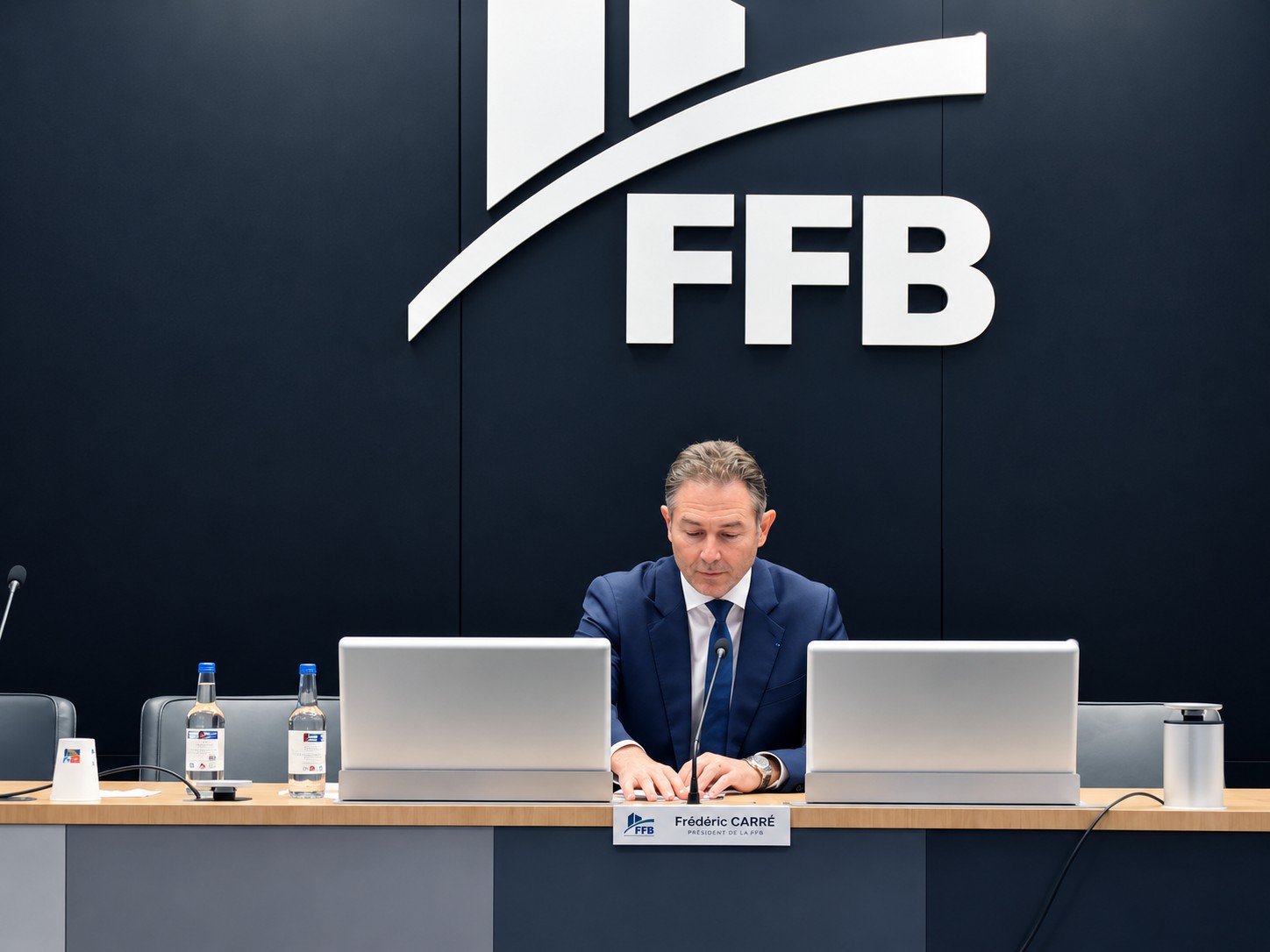
For the FFB, the diagnosis is clear: the rebound in construction starts observed in 2026 is based on authorizations and decisions taken previously. It does not herald a new phase of growth. The deterioration in sales, permits and real estate credit, on the contrary, suggests a further decline in construction starts in 2027. “2027 is already almost written, which is why we must react very quickly” warned Frédéric Carré, here in photo. © PP
The production of new property loans for households thus fell by almost 20% year-on-year at the end of August. Real estate loan rates reached 3.31% on average in July-August, while the rise in bond rates and the ECB’s new monetary tightening raise fears of a continued deterioration.
Therefore, the FFB considers that theobjective of 2 million additional housing units by 2030, included in the “Housing Recovery” plan, cannot be achieved under these conditions. “We continue to sink into the crisis, we are unscrewing and we don’t know how far we will go“, once again alerted Frédéric Carré.
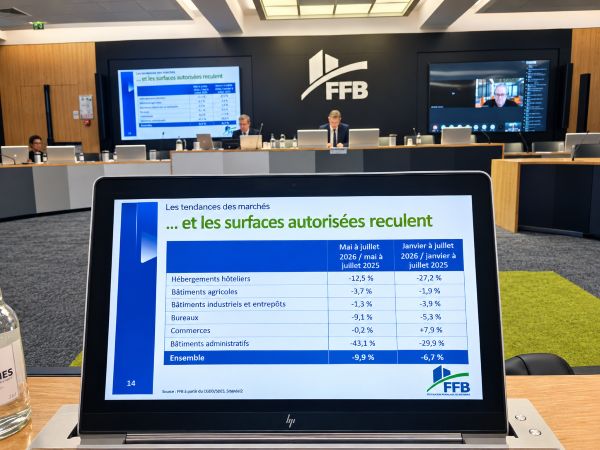
The situation is hardly more favorable for new non-residential properties: surface areas started only increased by 1.2% over the first seven months of the year, to an annual level of around 21 million m2. Even more worrying, authorizations fell by 6.7% over one year. Administrative premises collapsed by 29.9%, particularly as a result of the backlash from municipal elections and the slowdown in new community projects. And the other segments do not compensate for this decline… For the FFB, public procurement therefore no longer plays its countercyclical role. The movement should lead to a further drop in surface areas started and then in new non-residential activity in 2027. © PP
Energy renovation is also taking off
The reversal is now also evident in theimprovement-maintenance, which represents approximately 60% of building activity. In the second quarter of 2026, activity fell by 3.3% year-on-year in volume. This is the seventh consecutive quarter of decline, with -3.1% in housing and -3.7% in non-residential.
There situation is even more degraded in energy renovation since activity fell by 4.3% over one year, including -4.5% for housing. Excluding the Covid period, this is the largest decline recorded since the start of the series in 2018. Non-residential, which had held up until then, also fell into the red with a decline of 3.5%. The FFB points out in particular the effects of uncertainties surrounding energy renovation aid and the planing of the Green Fund. With 3.9 million energy strainers, “the needs for energy renovation are immense, it is incomprehensible that this segment is declining“, explains Frédéric Carré.
The outlook does not allow us to hope for a rapid recovery: business leaders surveyed by the CERC network still anticipate a drop of 2.8% in activity between the third quarters of 2025 and 2026.
Companies lose on all counts
The drop in activity is now compounded by increased pressure on costs. Between February and June, the “materials” item increased by 4.3%or 3.3 times faster than general inflation. Some products show much greater increases:
– + 35% for bitumen and non-road diesel;
– More than 20% for diesel at the pump, PVC products and cellular plastics;
– And almost 10% for plastic profiles, steel products and wooden panels.
This situation has a direct impact on margins, as companies find it increasingly difficult to pass these increases on to their customers. THE operating margin rate in construction has lost 1.5 points since the end of 2025. Payment deadlines also remain a concern. They still exceed their long-term average for both public and private customers, while cash flow is already weakened by the decline in activity and the increase in costs.
Insolvencies are decreasing slightly, by 4% over the first eight months of 2026, but remain at a high level. The FFB expects around 12,000 companies to be affected throughout the year. Above all, the movement now affects structured companies more: collective procedures are increasing by 30% for companies with 20 to 49 employees and by 21.1% for those with 50 employees or more.
20,000 jobs at risk in 2026
Employment constitutes the other direct consequence of this deterioration: the construction sector lost 14,200 jobs in the first half of 2026 compared to the first half of 2025, including 16,600 employees. The decline in employees and temporary work is only partially offset by the increase of 5,900 self-employed workers. Over one year, thetotal employment in construction falls by 0.9%or 15,200 positions in the second quarter.
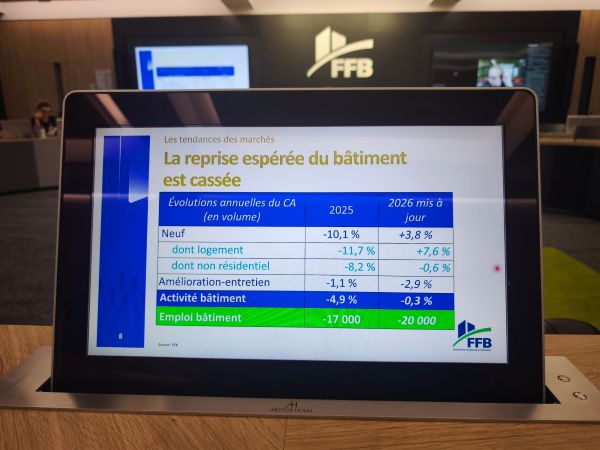
The FFB now anticipates an acceleration of the movement in the second half of the year, which would bring the losses to 20,000 jobs over the whole of 2026. Over four years, nearly 60,000 jobs would have disappeared in the sector. © PP
The Federation also warns of the situation of young people and work-study workers, whose employment is falling further in a context where companies anticipate a 16.4% drop in their hiring in 2026, compared to 6.5% for the economy as a whole.
The FFB’s proposals to get out of the crisis
For the Federation, the 2027 finance bill now constitutes the main lever to avoid further deterioration. In particular, it asks:
– the improvement of the “Jeanbrun” system, particularly in the existing system, as well as its extension to new individual houses;
– The launch of Anru III to support urban renewal;
– The absence of further planing of the PTZ and raising of the RLS;
– Maintaining budgetary commitments in favor of MaPrimeRénov’, energy savings certificates and the Green Fund;
– The relaxation of the rules of the High Financial Stability Council, in particular the effort rate ceiling of 35%, in order to facilitate access to real estate credit;
– The suspension of the next stages of RE2020 planned for 2028 and 2031, in particular time to better take into account summer comfort;
– Maintaining a stable budget for learning and associated support;
– Implementation of electronic invoicing adapted to the specificities of the building, in particular deposits, work situations, warranty retentions and subcontracting;
– And, finally, an overhaul of the building REP, which the FFB considers too costly and insufficiently effective.
The Federation also requests that negotiations around the next five-year framework for Action Logement prioritize investment in the territories, in new construction and renovation. Finally, Frédéric Carré counts on the 2027 finance bill to provide new support measures to the sector. Satisfied that “housing is invited into the debates for the presidential election“, THE president of the FFB also intends to meet all the candidates.