

The statutory change of director comes at a good time for Marie-France Thévenon, who takes over from Laurent Bléron, while the recruitment of engineers is in full swing with 97 students, including 27 female students.

In recent years, most engineering courses, including ENSTIBcomplained of recruitment difficulties, unlike architecture for example. And we quickly realized that young people want to rebuild the world but without being sure that it will hold. There management of ENSTIB did not veer into collapsology, but judiciously rethought its approach to recruitment. The efforts of all the teams, combined with a great communication strategy and always impeccable reception of those eligible by the Student Office, and, the climate undoubtedly helping, the gauge was reached for the second time since 2015, allowing for high-quality recruitment.
As a reminder, the National School of Wood Technologies and Industries is a public engineering school dedicated to wood and its sector.
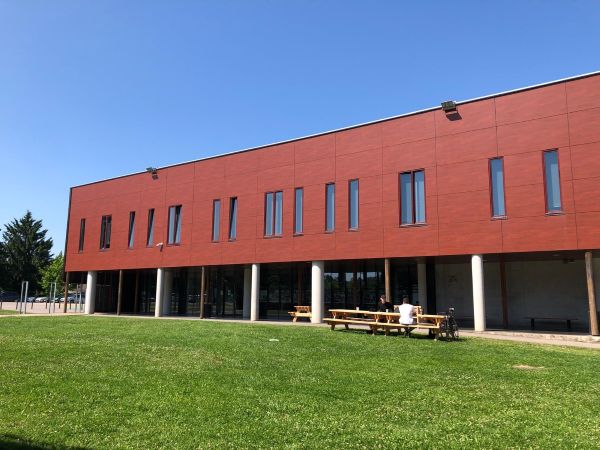
One of the ENSTIB buildings in Epinal. © Jonas Tophoven
First class training
The start of the engineering training program is off to a full start when, after two consecutive mandates, Laurent Bléron must statutorily give way and reinstate his position as Professor/teacher-researcher. Alone large public school training wood engineers, ENSTIB is part of theUniversity of Lorraine via Lorraine INP which brings together eleven schools and an integrated prep.
The school offers professional license training which can constitute, through its specific “expertise” course, a gateway to engineering training. But the The main route to engineering training at ENSTIB remains that of national competitions open to students from preparatory classes for Grandes Ecoles (CPGE), as well as theadmission at the end of La Prépa des INPwhich provides access to around forty engineering schools. As part of the CPGE competitions, theENSTIB specific oral exam constitutes a determining stage of admission. According to Marie-France Thévenon, 80% of engineering students take it as their first choice.
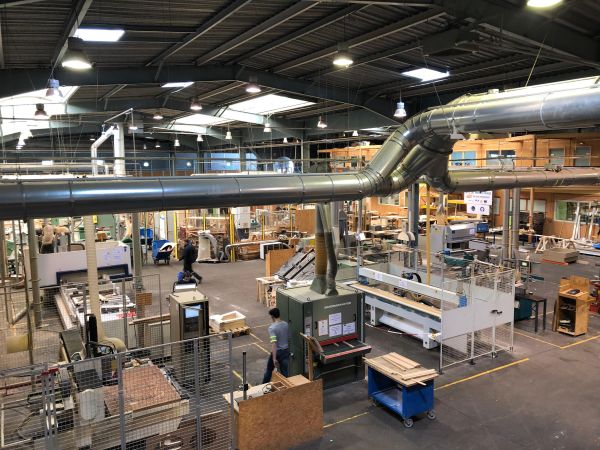
The industrial hall, status 2019, has been modernized. © Jonas Tophoven
Engineers above all
L’ENSTIB offers general training for engineers applied to woodwith a specialization in the 3rd year. On the Campus Bois, ENSTIB benefits from the presence of three research laboratories and CRITT Bois which links industrial demand and research. The practical dimension is sharpened in all areas of expertise developed at ENSTIBthanks to the machine park in the industrial hall, as well as the various laboratories available, but also by the presence all year round of 90 external speakers, coming from the wood sector and the industrial world.
ENSTIB also offers twelve double degrees, including the Master ABC (Architecture Wood Construction) whose Wood Challenges 3.0 are an emblematic event for the school and wood construction.
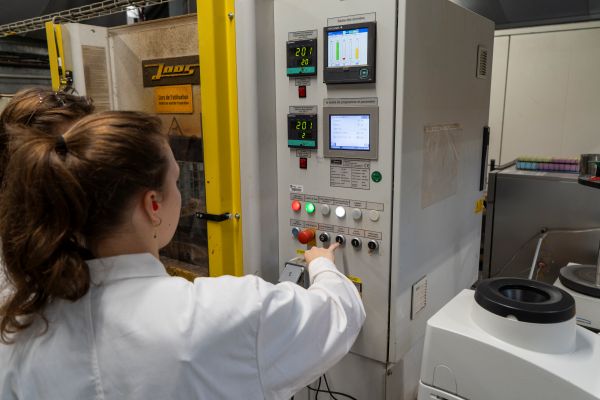
Research is one of the pillars of ENSTIB. © ENSTIB
The Forum experience
Among the others highlights of the school’s life, there is participation in the International Wood Construction Forum. We are used to meeting young people at the Forum with their orange or navy blue t-shirts, the Forum ants, flexible, capable of taking charge of everything, the conference management, reception and especially the rapid assembly and dismantling operations. Forum week is an important experience for student volunteers, especially as they take turns attending the conferences that interest them. This moment confronts them with the market where they will evolve and puts them in contact with fellow ESB students as well as students from architecture schools.
An educational engineer model under review
L’ENSTIB wants to review its educational model to take into account scientific and technological advances – in particular the re-use and recycling of wood –, as well as the needs of the sector, with the prism of cascading use of available resources. According to Marie-France Thévenon, this will involve more clearly displaying the environmental dimension of this engineering training. The educational model dates back to 2013 and must also take into account regulatory developments in the Eurocodes and new rules concerning fire protection.
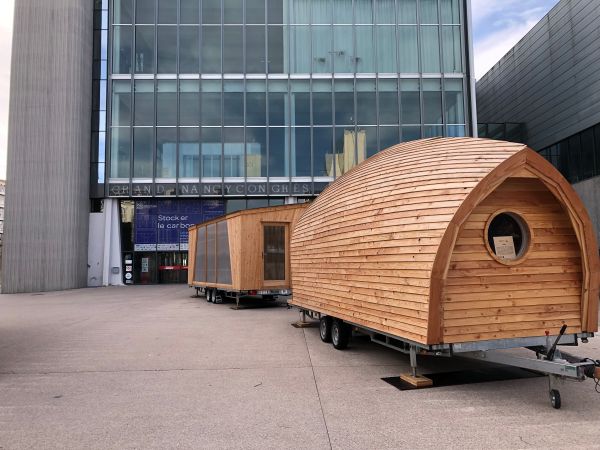
The other pillar is construction: here, some tiny houses/small houses on wheels created as part of the Wood Challenges 3.0 in spring 2023 and exhibited on the forecourt of the Prouvé Center in Nancy as part of the 13th International Wood Construction Forum in April 2024. © Jonas Tophoven
If the destination of Epinal may, a priori, appear less attractive than other university centers, the Bois Campus, the ENSTIB premises (including the large activity hall), the richness and liveliness of student associative life, the lower cost of living and the proximity to the Vosges massifs attracts future wood specialists.
The framework of the French wood construction industry
As the quest for meaning becomes a primordial question, ENSTIB presents great opportunities to work for the ecological transition. Currently, with some 4,000 engineers trained over 40 years, we can say that the fabric of French wood engineering relies largely on ENSTIB. Over the years, the ENSTIB engineers have not only invested in the world of wood production and construction, but also trading, and even project management. When a general company or a lessor expresses its intention to create a wood center, this results in thehiring an ENSTIB engineer.
Opportunity
As revealed by ENSTIB press release announcing the appointment of the new directorthe statutory change of director offers the school the possibility of employing a researcher fully invested in the wood protectionand a manager accustomed to governance, who is also very attached to ENSTIB. This is not a coincidence, but the result of the work accomplished by this school since its creation, by creating a great diversity of actors, some of whom, like Marie-France Thévenon, augur a management perfectly aware of the subject and the issues. This is good news at a time when the decree of February 19, 2026 on the fire protection of ERP is reshuffling the cards for wood construction in France, in a context of weakening resources, the construction crisis and climate change.
Jonas Tophoven / © ENSTIB