
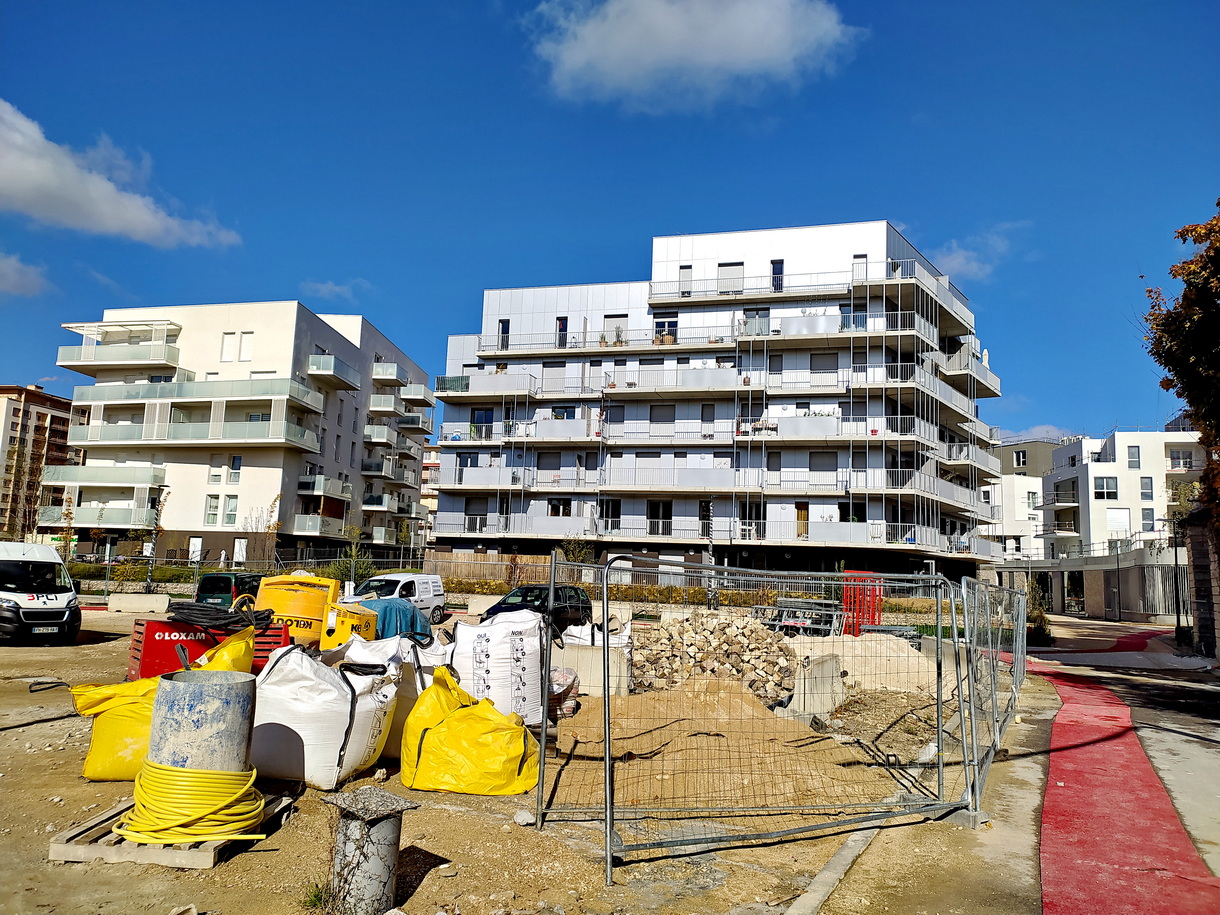
Many factors weigh on sales: economic situation in France, resumption of inflation, war in Iran, presidential elections in 2027, ineffectiveness of the Jeanbrun system, etc. The result is catastrophic

On Wednesday September 9, Pascal Boulanger, president of the FPI, and Didier Bellier-Ganière, the general delegate of the FPI, presented the results of new housing in the second quarter of 2026. The tone was not optimistic at all. After stabilizing at a low level since 2023, new home sales fall again in the second quarter of 2026 with a drop of 23.6% compared to the second quarter of 2025. During the first half of 2026, the drop reached 18.3% compared to 2025, bringing, underlines Pascal Boulanger, the accommodation reservations below the threshold of 40,000 housing units, never reached until now.
This deterioration is mainly explained by thecollapse of bulk sales – essentially now sales to social landlords, because institutional investors, such as insurance companies, have disappeared from the market – which fell by 40.8% in Q2. Sales to individuals also fell by 11.3%, with a particularly marked drop among owner-occupiers (-17.9%). Only sales to individual investors are beginning a very timid recovery (+13.4% in Q2). This “rebound”, which the new status of the private lessor could help to consolidate, however, remains fragile and concerns particularly low volumes.
New construction in France in the second quarter of 2026
According to state and FPI figures, authorizations for construction of new housingfor all players combined – individual social landlords, developers – and including managed residences, reached 98,166 housing units in Q2 2025, but only 90,400 in Q2 2026, a drop of 7.6%.
In detail, individual houses increased by 26.8% to reach 25,623, grouped houses increased by 6.2% to 11,557, but collective housing fell by 19.8% to 40,485.
For the record, specifies the FPI, between 2015 and 2018, the average quarterly volume of construction authorizations totaled 113,300 authorized housing units, including 59,600 collective housing units. © PP
THE persistent gap between authorizations and collective construction starts (34,497 in Q2 2026 compared to 50,000 between 2015 and 2018) confirms that the transition from building permit to the actual opening of construction sites is far from automatic. This very low level of reservations leads to a drying up of sales which fell by 17.9% in Q2 2026 to reach 18,740, while the FPI observed an average level of sales in Q2 of 24,655 between 2020 and 2026.
During the first half of 2026, the put on sale reached 32,483 homes, a decrease of 12.9% compared to H1 2026. The REIT observed an average of 43,560 for sale in H1 between 2020 and 2026.
THE reservations for new accommodationthat is to say the housing salesdecreased by 23.6% in Q2 2026 to reach 19,356 reservations. The average observed in Q2 between 2020 and 2026 was 28,829.
There sudden drop in bulk sales (-40.8%) is the main explanation for the sharp contraction in total sales. Sales to individuals fell by 11.3%. Sales to investors are gradually resuming (+13.4% to 3,427 homes) in certain areas, while remaining at a very low level, with an increasing share carried out under the status of the private lessor. Its deployment is hampered by the uncertain economic context. Sales to owner-occupiers fell by -17.9% to 9,267 and represented 73% of housing sales in Q2 2026.
Finally, in H1 2026, the new home sales reached a new level of decline (-18.3% to 38,932), falling below the threshold of 40,000 units, after three years of stabilization at an already historically low level. Over the first six months of 2026, sales to individuals (-9.7% to 25,422) and block sales (-37% to 9,810) contract dramatically. The latter no longer fulfill their countercyclical role of supporting housing production.
The action of Caisse des Dépôts is no longer enough
Which also means that thepurchase of new housing en bloc off-plan (Value in Future State of Completion) by the CDC (Caisse des Dépôts et Consignations) and its subsidiaries CDC Habitat and Banque des Territoires, for a time massive support for the real estate development sector is no longer enough. However, the Banque des Territoires announced on May 21, 2026 an ambitious roadmap in favor of housing: bringing out 650,000 affordable housing units (social, intermediate or free, rental or ownership) by 2030, via a global financial mobilization of €100 billion. And the Banque des Territoires financed almost half of the housing built in France in 2025.
Certainly, points out the FPI, sales to investors are slowly picking up (+ 19.4% to 6,573 homes) during H1 2026, but the volume still remains very low. Conversely, sales to owner-occupiers fell significantly (-16.8% to 18,849), penalized by a very unfavorable economic and geopolitical context. In addition, observes the FPI, the lead time for available supply reaches 19.6 months in Q1 2026 and increases to 21.4 months in Q2 2026. In France, Pau is very well placed with a lead time of 4.3 months, Dijon also at 10 months. While the record belongs to Grenoble (50 months), followed by Clermont-Ferrand (43.3), Reims (37.8), Brest (32.7) and Rennes at 30.6 months. However, the price of new housing remains relatively stable since Q1 2023, oscillating between €4,826/m2 and 5,174 €/m2. In Q1 2026, this price, which is a national average, reached €5,127/m2. It fell to €5,034/m2 in Q2 2026.

The Jeanbrun system, introduced it is true only in February 2026 and also called private lessor status, was expected to bring 4,000 sales per month. It seems to be used for only 150 to 200 sales per month, according to Pascal Boulanger. © PP
In short, the objective of building 2 million new homes by 2030, or 400,000 per year, seems largely out of reach. The Jeanbrun system is based on the principle of depreciation which consists of spreading the cost of real estate over time in order to reduce the income subject to tax each year. The FPI ardently hopes that its attractiveness will be increased thanks to the 2027 Finance Law, the discussion of which begins in the fall. In particular, she would like an increase in depreciation rates, an increase in the ceiling on land deficits, the extension of the mechanism to individual houses, as well as the possibility of housing descendants and ascendants in housing benefiting from the Jeanbrun system.