
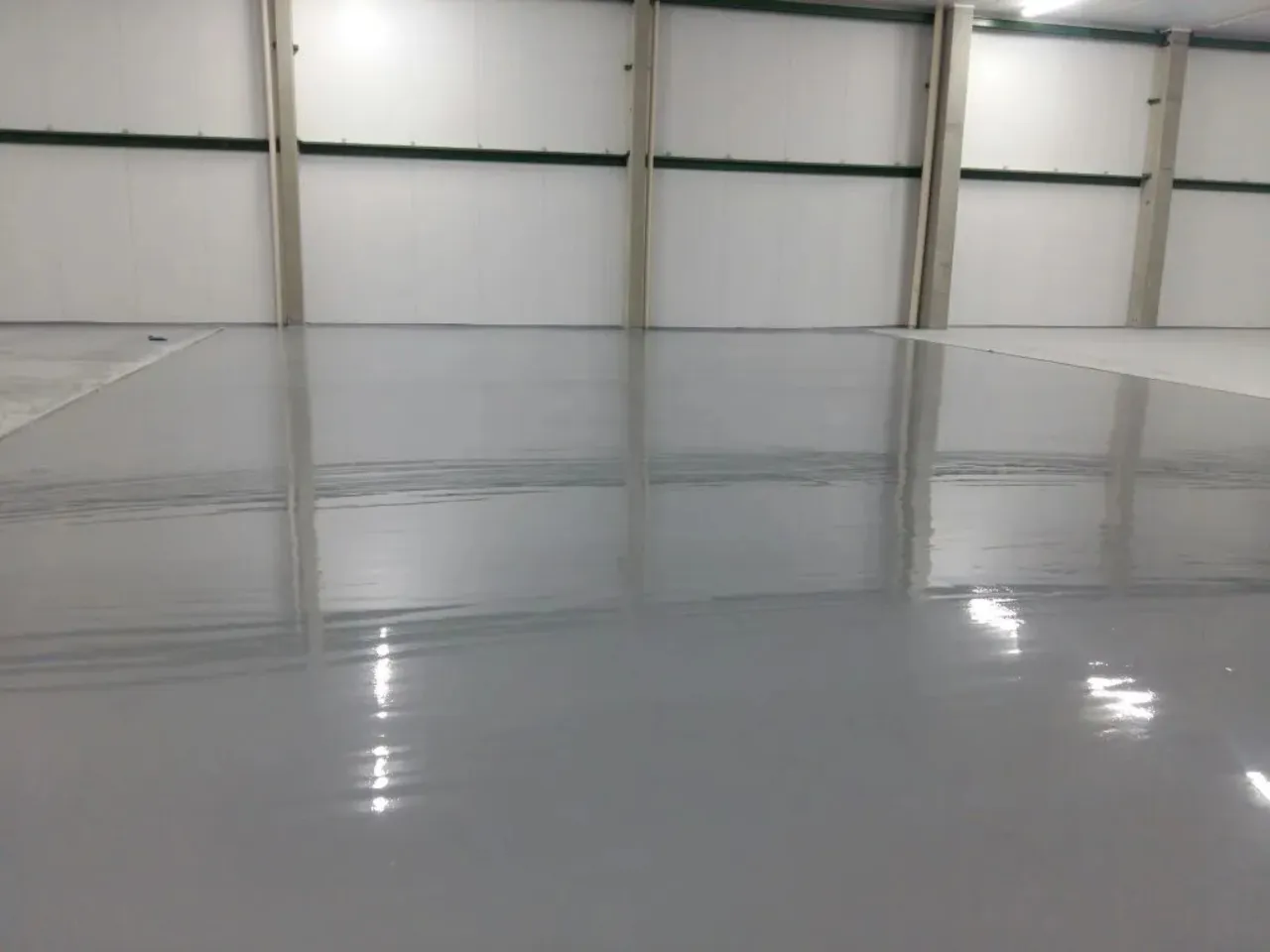
The substrate: obligatory starting point
Any quality industrial coating begins with the evaluation of the concrete substrate. Before proceeding with the installation of any resin system, it is necessary to check that the support is intact, cohesive and compact and has no rising damp. These checks are not optional, but constitute an essential technical prerequisite.
Preparation operations may include mechanical smoothing or milling of the surface, removal of friable or inconsistent parts and treatment of existing cracks. Only an intact substrate free of contaminants guarantees the correct adhesion of the resin systems applied in subsequent layers.
Industrial resin floors: types and application systems
Industrial resin floors are distinguished according to the chemical nature of the products used and the type of application system. The two main families are epoxy resins and polyurethane resins, each with specific characteristics in terms of hardness, elasticity, chemical-mechanical resistance and temperature behavior.
Epoxy resins are two-component chemically cross-linked systems, characterized by high surface hardness, adhesion to concrete and resistance to chemical agents. They find preferential application in industrial environments subject to intense mechanical stress and contact with aggressive substances. Polyurethane resins, on the other hand, offer greater elasticity and resistance to abrasion, making them particularly suitable in contexts with significant temperature variations or where a certain flexibility of the coating is required.
Icobit’s MAGMA Resin Surface line includes resin systems compliant with UNI 10966, designed to meet the different needs of civil and industrial flooring: impregnation systems, non-toxic resin systems, thin film, thick film, self-levelling, waterproofing, multilayer and drive-over resin systems, internal and external.
From industries to warehouses, a complete range designed for performance and durability: a set of solutions for the creation of continuous high-performance industrial flooring that guarantee safety in working environments.
MAGMA – Resin Surface: the line of resin systems for industrial and civil flooring
The installation of a resin system for industrial flooring follows a sequence of well-defined phases, each of which is decisive for the final performance of the coating. An incorrect application in any of these phases can compromise the entire system, regardless of the quality of the materials used.
Resin impregnation systems
Industrial concrete floors structurally tend to have problems with porosity, dust release and vulnerability to liquids. To safeguard these surfaces, the ideal solution is the impregnating treatment of the Imprymo line. This technology penetrates the support ensuring effective cortical consolidation, a drastic reduction in permeability and a long-lasting anti-dust action. Where superior protection against chemicals and corrosive agents is required, the Imprymo Oil variant ensures a total barrier even against the most aggressive liquids.
Non-toxic resin system for food environments
In the food sector, preserving the healthiness of raw materials and finished products is an essential regulatory and structural requirement. To isolate the concrete and avoid any risk of cross-contamination, Alymento comes into play, a specific, HACCP-certified non-toxic resin system. The application of this coating generates a colored and waterproof film (with a dry thickness between 0.3 and 1.0 mm) which combines maximum hygiene with total food safety.
Thin film resin system for civil and industrial flooring
Porosity and the tendency to crumble are critical issues common to almost all cement floors and substrates. The Skyn single-component thin film resin system was created to counteract the absorption of liquids and eliminate dustiness, without sacrificing aesthetics. The result is a colored covering with a refined design, easy to sanitize, stain-resistant and with a dry thickness within 0.3 mm. For the most demanding industrial contexts, the Skyn Chem version further enhances the formula, offering excellent shielding against chemical attacks.
Thick film resin system for civil and industrial flooring
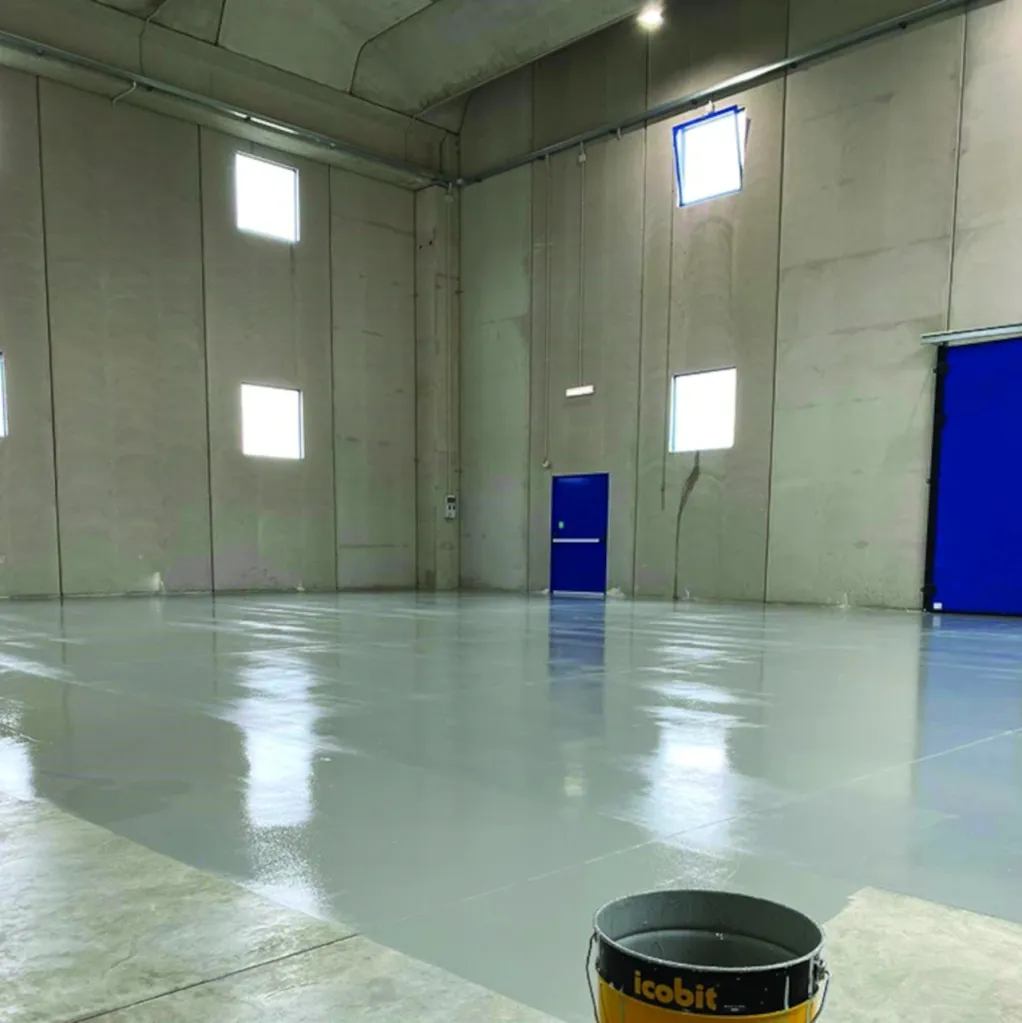
Operational contexts characterized by standard transit of commercial vehicles and moderate passage of forklifts expose concrete to progressive wear and loss of surface cohesion. To meet this need, the Rilyevo range was developed, a thick film resin system. With a dry thickness varying between 0.3 and 1.0 mm, this self-levelling solution creates a waterproof, colored and highly resistant shield to mechanical and chemical stress, simplifying cleaning operations thanks to its stain-resistant properties.
Self-levelling resin system for civil and industrial flooring
When road traffic flows become intense, pavements must withstand strong static stress, dynamic friction and premature wear. In these scenarios, optimal protection is offered by the Rilyevo Plan self-leveling resin system. This application generates a continuous, joint-free covering of at least 2 mm thick. The final surface stands out for its very high mechanical strength and excellent wear resistance, while offering anti-slip properties, waterproofness, a colored finish and ease of maintenance.
Multilayer resin system for civil and industrial flooring
Inside production plants with heavy and continuous logistics flows, floors are put to the test by extreme abrasion and imposing loads. The Resysto line responds to these critical stresses through a multi-layer resin system designed for true armored protection of the support. The treatment creates a continuous, non-slip and waterproof surface, with a minimum dry thickness of 1 mm, which can be modulated according to the specific loads of the intended use. It guarantees uncompromising chemical and mechanical resistance, as well as a colored and stain-resistant finish.
Resin waterproofing system for vehicle traffic
External parking areas or multi-storey structures require targeted waterproofing to defend the integrity of the concrete from the constant transit of vehicles and atmospheric agents. For areas with medium flow, the Veycolo line represents the ideal drive-over resin system to block infiltrations. If the project requires superior resistance to manage extremely intense and heavy traffic flows, the Veycolo Hard formulation guarantees maximum durability and protection of exposed surfaces.
Mechanical and chemical resistance: performance requirements
An industrial resin floor must meet precise performance requirements, defined according to the intended use. UNI 10966 is the Italian technical reference that establishes the criteria for the design and application of resin systems. Together with the European reference standards, including EN 13813 for screed materials and EN 1504 for the protection and restoration of concrete structures, they provide the technical criteria for the classification and evaluation of resinous flooring systems.
Key performance characteristics of an industrial resin system include abrasion resistance, chemical resistance, compressive strength, and water impermeability. In environments subject to intense dynamic stress, such as warehouses with forklift traffic or loading and unloading areas, impact resistance becomes a critical parameter to consider in the design phase.
The epoxy and polyurethane resins of the MAGMA line are formulated to guarantee chemical resistance and mechanical resistance. The treated surfaces are waterproof, stain-proof and resistant to prolonged wear, with performance maintained over time even in harsh operating conditions.
The choice of the resin system: technical criteria
The selection of the most suitable resin system for a specific industrial flooring requires a preliminary technical analysis that considers multiple variables. The designer or construction manager must evaluate: the type and intensity of the expected traffic, the nature of the chemical substances present in the environment, the degree of humidity of the substrate, the thermal variations to which the floor will be subject and any applicable health and hygiene regulations.
A further element to consider is the thickness of the system: it ranges from simple saturation impregnations of a few tenths of a millimeter, suitable for the light protection of existing floors, up to 3–5 mm multilayer systems, designed for environments with very high mechanical loads. The choice of thickness directly affects the durability and long-term performance of the coating.
Anti-slip systems represent a specific requirement for environments subject to the presence of liquids or where the safety of operators is a priority. The coatings of the MAGMA line can be formulated with mineral fillers to guarantee the required friction coefficient depending on the application context.
Correct maintenance over time is the last, but not least, element to consider in the design phase. A well-made industrial resin floor requires minimal routine maintenance operations, but it is essential to provide periodic inspections to promptly identify any surface damage, detachment or water infiltration that could compromise the integrity of the system.
A systems approach for durable flooring
The creation of an effective and durable industrial resin floor cannot be reduced to the choice of product alone: it is the result of a complex and integrated technical approach that starts from the analysis of the substrate, continues with the correct design of the system and is completed with an application carried out in a workmanlike manner and an ordinary maintenance plan. Each phase has its specific weight in determining the final performance of the coating.
The resin systems of Icobit’s MAGMA line represent a structured technical response to this complexity, offering certified and verified solutions for the main categories of industrial and civil flooring. The combination of epoxy resins and polyurethane resins, applied through differentiated application cycles, allows us to respond precisely to the specific needs of each application context, guaranteeing waterproof, chemical-resistant and mechanically high-performance surfaces over time.