
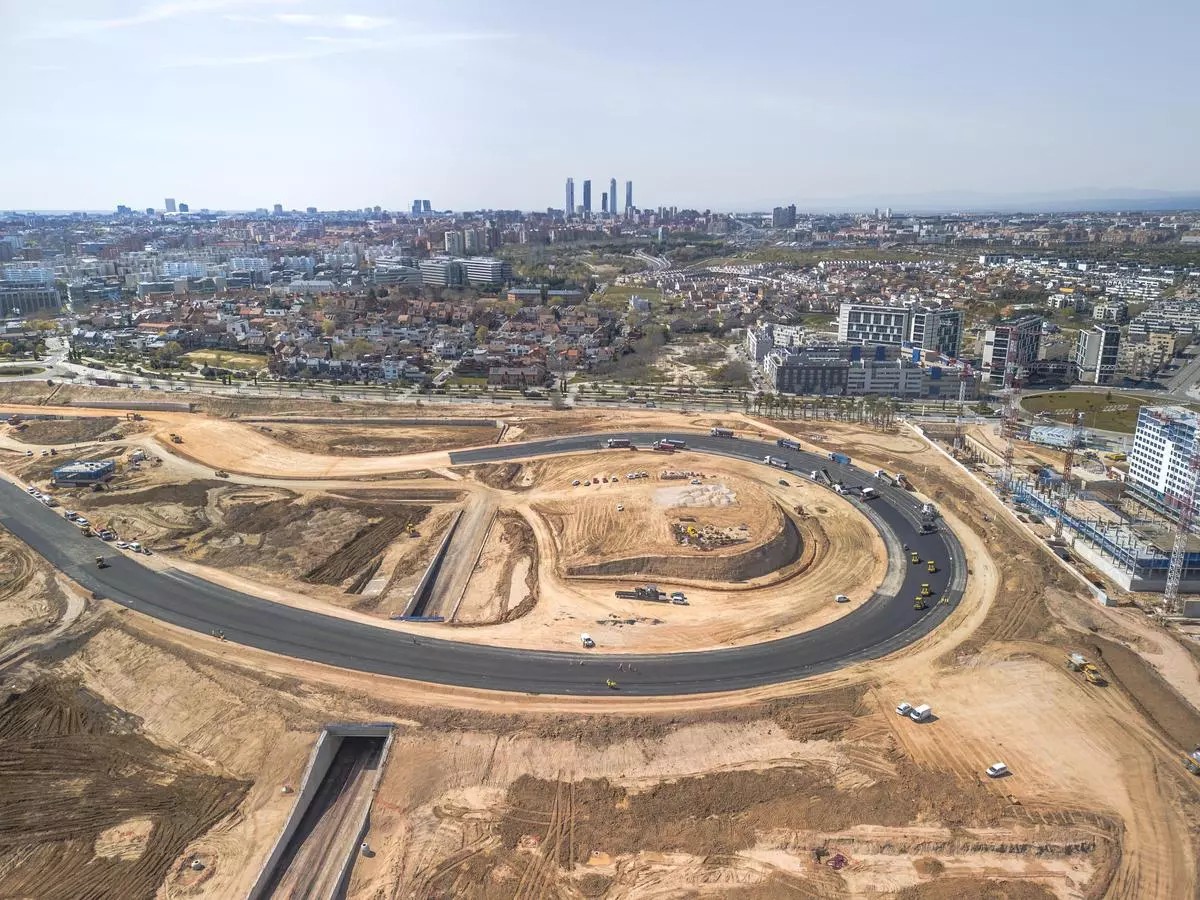
In Madrid, work on the Madring urban circuit is progressing in preparation for the 2026 Formula 1 Grand Prix. A 5.474 km project combining urban roads, heavy civil engineering and the extreme technical requirements of the FIA.

HAS immediate proximity to Madrid-Barajas airport and the IFEMA complexa set of road developments as well as temporary and permanent works is being carried out in order to accommodate the Formula 1 Spanish Grand Prix : THE Madring project is based on a hybrid urban circuit of 5.474 km integrating existing roads, development zones ex nihilo and dedicated event infrastructures.
Two construction giants, including Eiffagethrough its subsidiary Eiffage Construction, in consortium with Accionawere assigned the design and construction contractfor a total amount of 83.2 million euros, with a share for Eiffage of 33.3 million
The site announces a capacity of around 110,000 spectators in its initial configuration, expandable to 140,000 depending on the development phases. THE 1st F1 Grand Prix in Madrid will take place on the weekend of September 13, 2026, and all places are already reserved.
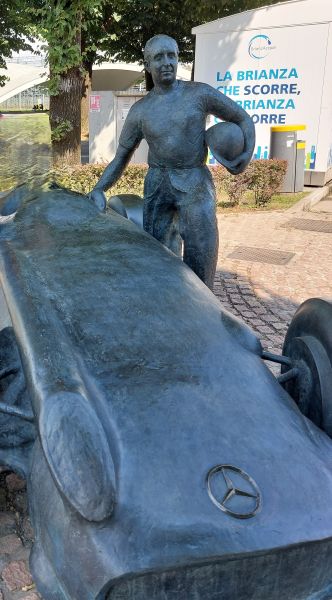
Madrid becomes the first major European capital to host a Formula 1 Grand Prix, and this milestone is directly reflected in the identity of the circuit. The name “Madring” naturally associates “Madrid” with the term “ring”, widely used in the world of F1 to designate racing tracks. Throughout the championship, circuits are most often referred to by their location – like Monza here – even if their full names are rarely used in common usage. In this logic, Madring was designed as a short name, immediately identifiable and easily remembered, anchored in a direct reference to Madrid – without the need for translation. © Laure Pophillat
A hybrid route of 5.474 km between urban roads and heavy civil engineering
THE circuit is structured around a geometry of 22 turnsalternating fast sections, technical zones and heavily braked portions. The total development is divided into three functional groups:
– the first sequence crosses the IFEMA park for approximately 2 kmintegrating the main straight and pits : this zone requires direct cohabitation with the site’s event activity, which can reach several tens of thousands of simultaneous visitors during trade shows;
– The second portion, located in the Valdebebas sectorrepresents approximately 2.1 km of new route: it is based on complete earthworks and the creation of road platforms adapted to the dynamic loads of F1with structural layers sized for speeds above 300 km/h ;
– The last section, approximately 1.3 km long, reuses public roads with a temporary closed urban circuit operation; two tunnel structures allow the crossing of the M11 axis linking Madrid to the airport.
The monumental “Monumental”
The racing profile was defined with a top speed estimated at over 340 km/h on main straightsand a theoretical lap time of approximately 1 min 34 s. The route includes several identified overtaking zones, positioned at turns 1, 5, 11 and 17, combining late braking and lane widening.
One of the structuring elements is a raised curve of 550 meters of development – more than 1,800 cubic meters of asphalt were necessary, the equivalent of a layer of 25 centimeters –, equipped with a transverse slope of up to 24%, named “La Monumental” and already iconic. There curve has even already seduced Carlos Sainzwho praised a route equipped with “charisma and personality“, believing that The MonumentL was called to become the symbol of the future Madrid circuit and one of his most notable signatures.
However, a major modification of the initial layout was imposed by the FIA: theaddition of an entry chicane on this curve to reduce the approach speed from 350 km/h to around 280 km/hfor reasons of structural safety and limitation of lateral loads.
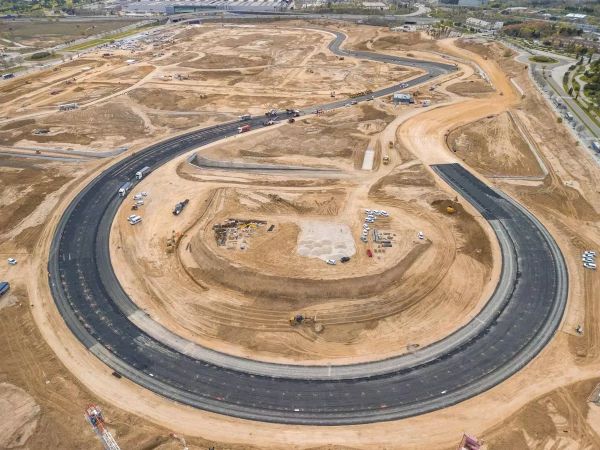
The Monumental is already shaping up to be one of the most spectacular elements of the future Madrid circuit. Inspired by the circular architecture of the Spanish arenas, this semi-circular curve displays unusual dimensions: almost 550 meters of development, a width of approximately 12 meters and a slope reaching 24%, one of the largest observed in Formula 1. The cars should remain engaged there for several seconds – 6, to be exact – at very high speed. The infrastructure has also been designed as a real open-air amphitheater since stands located around this emblematic section will be able to accommodate up to 45,000 spectators. © Eiffage Construction
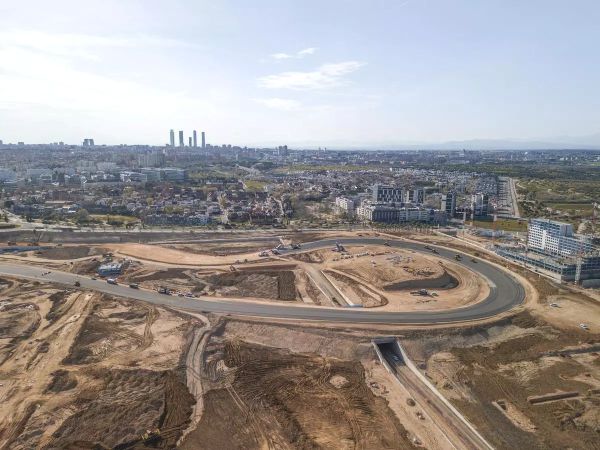
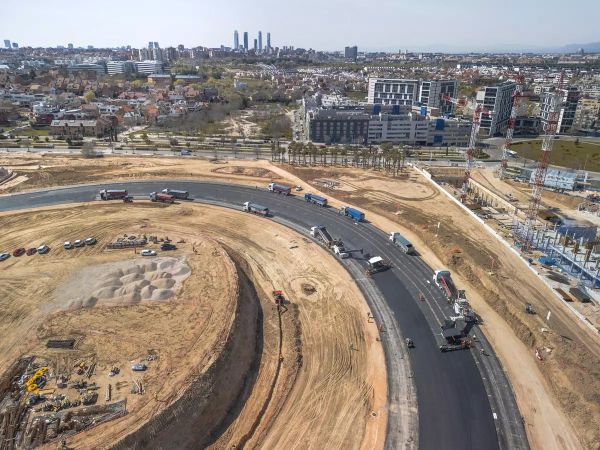
The FIA is involved at all stages of validation, from geometric design to final approval, including a two-month phase dedicated to passive and active safety devices – barriers, clearances, impact zones, escape routes. © Eiffage Construction
Multi-layer coatings, millimeter tolerances and continuous control
There roadway construction is based on a superposition of three main layers of asphalt, with formulations adapted to each zone of mechanical stress. THE number of asphalt recipes went from 12 initially planned to 19, adjusted according to the requirements of flatness, adhesion and thermal resistance.
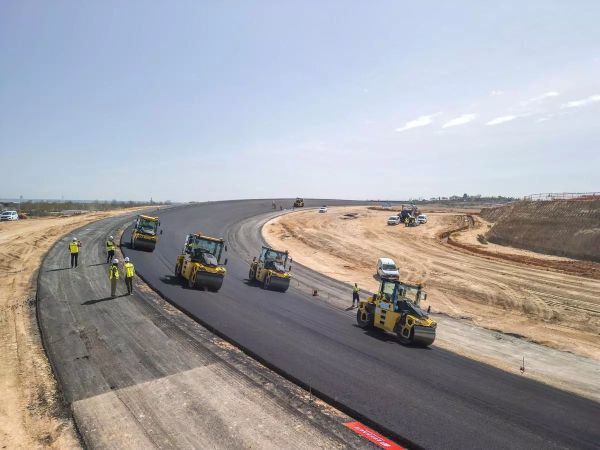
Finishing tolerances are extremely low: the maximum allowable deviation is 2 mm on a 3 meter ruler, i.e. a level of precision less than the thickness of a coin. Non-conformities are corrected by targeted micro-milling, carried out by a specialized subsidiary, allowing the geometry to be reproduced locally without complete reconstruction of the layer. © Eiffage Construction
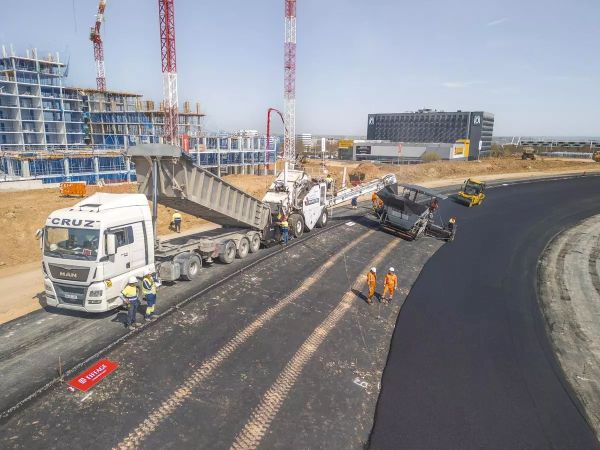
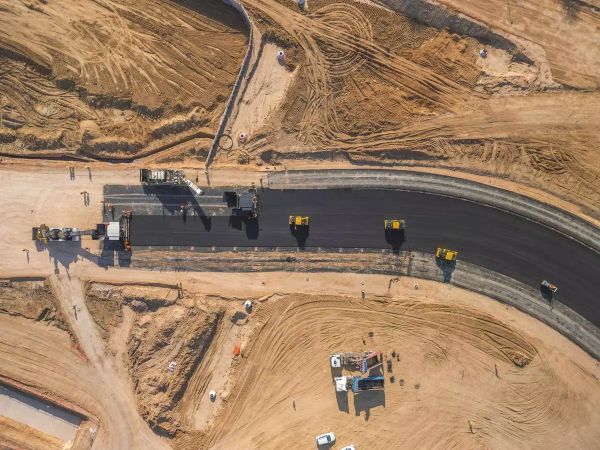
The equipment fleet can reach around 20 machines in simultaneous activity on certain critical phases of the site. © Eiffage Construction
Industrialized logistics, planning AI and quality supervision
The digital dimension of the site is centered on logistics optimization. Artificial intelligence is used exclusively for flow planning: calculation of truck rotations, synchronization of asphalt deliveries and management of production capacities. The drones provide regular photogrammetric surveys, allowing progress monitoring and volumetric control of earthworks. They do not intervene in technical decisions, but serve as a verification and documentation tool.
There asphalt production is located approximately 12 km from the sitein order to limit thermal lossesand each load is checked on arrival by a mobile laboratory, with the possibility of immediate refusal in the event of non-compliance of temperature or composition.
The site also integrates several environmental measures: reuse of excavated materials, movement of 583 trees, reduction of acoustic pollution via mobile screens, and implementation of photocatalytic coatings in certain secondary areas.
An infrastructural set
In parallel with the circuit, a built complex dedicated to Formula 1 is developed within the IFEMA parkwhich includes permanent extensions as well as temporary structures that can be reused depending on the sporting seasons. The main building is based on a metal frame of 1,800 tonnes and approximately 2,600 m3 of concrete. The lower levels accommodate the boxes, technical areas and race logistics, while the upper levels are dedicated to VIP hospitality areas, terraces and spectator platforms.
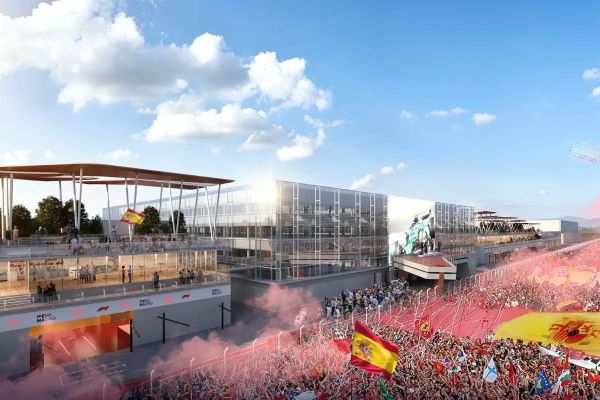
The project is part of a constrained phasing, with progressive delivery until the summer of 2026, maintaining the activity of the exhibition center on part of the land. The entire system is part of a 10-year operating contract, covering the period 2026–2035. © Eiffage Construction
In summary
Key technical parameters of the Madring construction site
| Setting | Value |
|---|---|
| Circuit length | 5,474km |
| Number of turns | 22 |
| Average track width | 14m |
| Maximum slope (La Monumental) | 24% |
| Maximum elevation | About 10m |
| Estimated top speed | More than 340 km/h |
| Flatness tolerance | ± 2 mm over 3 m |
| Number of coating formulas | 19 |
| Capacity | 110,000 spectators (up to 140,000 eventually) |
| Mobilized workforce | 300 to 350 people |
Eiffage Construction