

The 20% limit in cultural heritage
As regards the field of cultural heritage, article 149, paragraph 2 of Legislative Decree 50/2016 (now repealed) regulated the possibility of variation up to 20%, in consideration of the nature of the protected assets, indicating only three cases such as:
- the changes necessary to safeguard the property;
- for the pursuit of the objectives of the intervention;
- for the evolution of the criteria of the restoration discipline.
As regards Article 21, paragraph 2 of Annex II.18 to Legislative Decree 36/2023, the same conditions and activities indicated in the previous point are repeated verbatim.
For interventions referring to both the repealed and current regulatory provisions, and in application of the special regulations that are prescribed for cultural heritage, it follows that the 20% limit, by express specification of the law, is applicable only to the 3 types of work indicated and does not extend to other types of modifications which are of a general nature even if included in interventions on cultural heritage (structures, systems, general civil works). This condition is strengthened by the fact that the law does not provide for an express limitation to 20% of all other categories of work relating to cultural heritage nor does it define the 20% limit as applicable to the entire intervention.
This means that the regulatory regulation of modifications of a nature other than “limited” ones (safeguarding of the property, pursuit of the objectives of the intervention and for the evolution of the criteria of the restoration discipline) is attributable to the general principles of the code for modifications of contracts during construction and contained in article 106 of the previous legislative decree 50/2016 and in article 120 of legislative decree 36/2023 and therefore extendable, for remaining work categories, at 50% referred to in paragraph 2 of the same article (it was paragraph 7 for article 106 of Legislative Decree 50/2016).
The applicability of 50% in cultural heritage
Article 149, paragraph 2 of Legislative Decree 50/2016 and Article 21, paragraph 2 of Annex II.18 to Legislative Decree 36/2023 therefore do not regulate all contractual modifications of an intervention falling within cultural heritage but limit to 20% only the modifications that are necessary for: the protection of the property, the pursuit of the objectives of the intervention and for the evolution of the criteria of restoration discipline.
For other types of modifications (structures, systems, finishes, …) the general regulations referred to in Article 106, paragraph 1, letter b) and c) of Legislative Decree 50/2016 and in Article 120, paragraph 1, letter b) and c) of Legislative Decree 36/2023 remain applicable, which allows the modification of the contract without a new procedure provided that such modification does not exceed 50% of the contract initial, a condition that would require a new procedure. These modifications must consequently fall within the scope of additional works, services or supplies or variations made necessary by unforeseeable circumstances in accordance with the provisions of articles 106 of Legislative Decree 50/2016 and 120 of Legislative Decree 36/2023.
In compliance with the principle of maintaining contractual balance and to remain within the scope of modifications without a new procedure, the increase in the contractual amount is limited to the three types already indicated for cultural heritage (within the limit of 20%) and can be extended to 50% for the remaining types of work to be modified (also in a cultural heritage contract) in application of the provisions of article 106, paragraph 7 of Legislative Decree 50/2016 and from article 120, paragraph 2 of Legislative Decree 36/2023.
The specific legislation of Legislative Decree 50/2016 and Legislative Decree 36/2023 for the variations of cultural heritage
In Legislative Decree 50/2016 (now repealed) the variations procedure was governed by article 106 (for ordinary sectors) and by article 149 (for cultural heritage).
Provisions of Legislative Decree 50/20216: in Legislative Decree 50/2016 the ordinary sectors are defined by art. 3, paragraph 1, letter gg):
…” gg) “ordinary sectors”, the sectors of public contracts, other than those relating to gas, thermal energy, electricity, water, transport, postal services, exploitation of geographical area, as regulated from part II of this code, in which the contracting authorities operate;”…
Part II includes articles from n. 35 at no. 163 included, therefore including both the ordinary sectors and that of cultural heritage (an integral part of the same ordinary sectors) and defines a regulatory framework which, even for the variants, establishes a general regulation which, in some conditions, can be integrated by a special regulation without prejudice, for all other situations, to the reference to the general one.
In fact, this is what happens for the three cases mentioned (safeguarding of the property, for the pursuit of the objectives of the intervention and for the evolution of the criteria of the restoration discipline) for which the special regulation limits the possibility of carrying out variations in the cultural heritage without a new procedure to 20% of the original contractual amount. For other processes, which do not fall within the “limited” ones, the general rules apply and therefore can be carried out up to 50% of the initial contractual amount.
In summary, the 20% limitation for the three cases indicated and reported in Article 149, paragraph 2 of Legislative Decree 50/20216 (and renewed in Article 21, paragraph 2 of Annex II.18 to Legislative Decree 36/2023) determines a special regime for cultural heritage applicable only to the types of modifications referred to; in other cases (again for cultural heritage) the special regulation no longer applies and the regulatory regulation of other types of modifications operates in application of article 106, paragraph 1, letter b) and c) of Legislative Decree 50/2016 and article 120, paragraph 1, letter b) and c) of Legislative Decree 36/2023, in the cases indicated by these articles and within the limit of 50% of the initial contractual amount without the need to activate a new procedure.
The specific legislation of Legislative Decree 50/2016 and Legislative Decree 36/2023 for variations in ordinary sectors
Provisions of Article 106 of Legislative Decree 50/2016: Article 106 of Legislative Decree 50/2016, within the scope of the variations that can be carried out in ordinary sectors without a new procedure, mainly provides for two cases prescribed by paragraph 1, letters b) and c) applicable, for the general condition, also to cultural assets:
…” b) for additional works, services or supplies by the original contractor which have become necessary and were not included in the initial contract, where a change in the contractor produces both of the following effects, without prejudice to the provisions of paragraph 7 for contracts in ordinary sectors:
1) is impracticable for economic or technical reasons such as meeting the requirements of interchangeability or interoperability between existing equipment, services or systems provided under the initial contract;
2) involves significant inconveniences or significant duplication of costs for the contracting authority or contracting entity;
c) where all the following conditions are satisfied, without prejudice to what is provided for contracts in the ordinary sectors by paragraph 7:
1) the need for modification is determined by unforeseen and unforeseeable circumstances for the contracting authority or contracting entity. In such cases, the changes to the object of the contract are called variations in progress. The aforementioned circumstances may also include the occurrence of new legislative or regulatory provisions or provisions of authorities or bodies responsible for the protection of significant interests;
2) the modification does not alter the general nature of the contract; …”
The most recurring criteria, which support the variations in the ordinary sectors (and therefore also in the cases of general categories of cultural heritage) are:
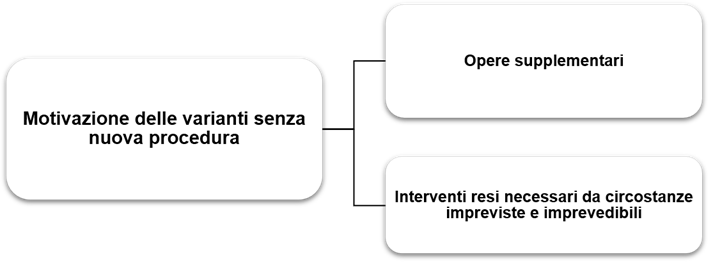
The same 50% limit was applicable for increases in amounts for variations without a new procedure referred to in article 106, paragraph 7 of Legislative Decree 50/2016 (now repealed).
Provisions of Article 120 of Legislative Decree 36/2023: Article 120 of Legislative Decree 36/2023, within the context of the variations that can be carried out in ordinary sectors without a new procedure, mainly provides for two cases (similar to those of Article 106 of Legislative Decree 50/2026) prescribed by paragraph 1, letters b) and c) applicable, for the general condition, also to cultural heritage:
…” b) due to the need for additional works, services or supplies by the original contractor which have become necessary and were not included in the initial contract, where a change in the contractor at the same time:
1) is impracticable for economic or technical reasons;
2) causes significant inconvenience or a substantial increase in costs for the contracting authority;
c) for variations during construction, to be understood as modifications made necessary during the execution of the contract due to the following unforeseeable circumstances on the part of the contracting authority. These circumstances fall within these circumstances, without prejudice to the further cases provided for by sector legislation:
1) the needs deriving from new legislative or regulatory provisions or from measures taken by authorities or bodies responsible for the protection of significant interests;
2) extraordinary and unforeseeable natural events and cases of force majeure that affect the assets subject to the intervention;
3) discoveries, unexpected or not foreseeable with due diligence in the design phase;
4) execution difficulties resulting from geological, water and similar causes, not foreseeable by the parties based on the technical-scientific knowledge consolidated at the time of design.” …
The criteria that support the variations in the ordinary sectors (and therefore also in the cases of general categories of cultural heritage) are the same as those reported in the last diagram of the previous paragraph, i.e. the additional works and interventions that have become necessary due to unforeseen and unforeseeable circumstances.
Also in this case the amount increase limit for variations without a new procedure of 50% referred to in article 120, paragraph 2 of Legislative Decree 36/2023, without prejudice to the specifications already reported regarding the applicability of 20%, in the context of cultural heritage, only to specific processes.