
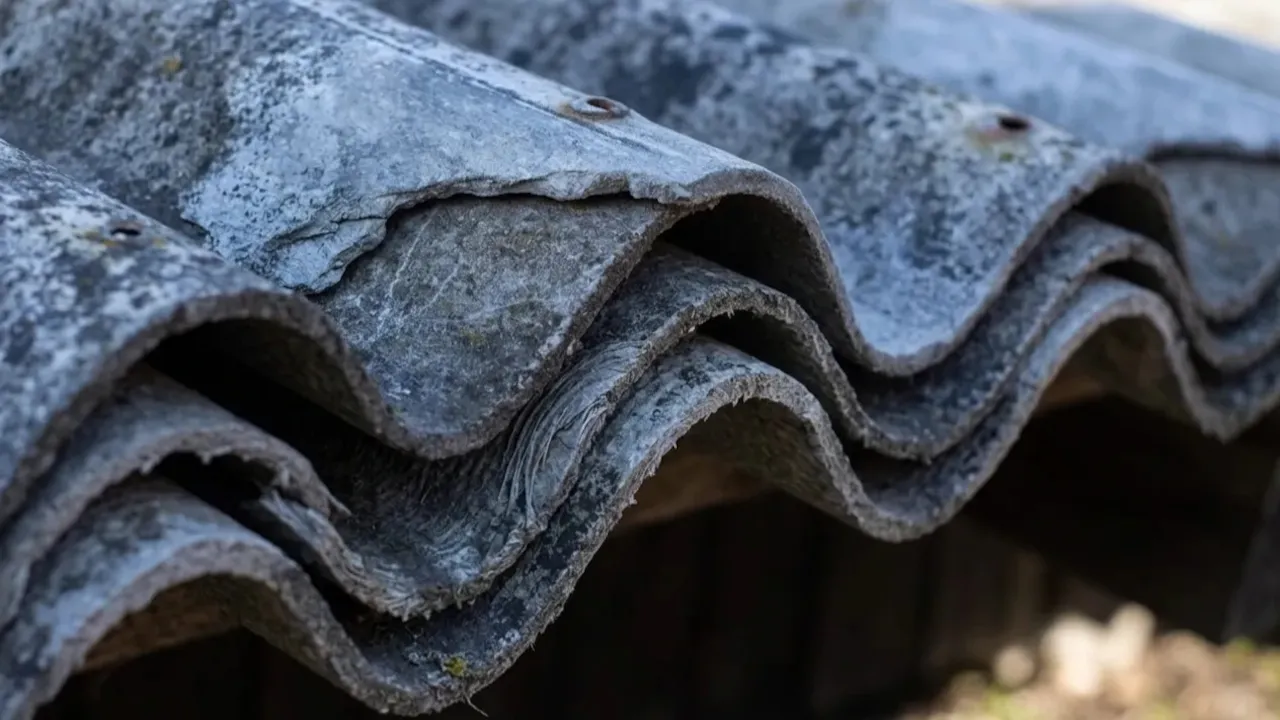
Although the production and marketing ban dates back to Law no. 257/1992, the Italian building stock still has millions of square meters of asbestos-cement roofing. The safety of buildings containing asbestos, called reclamation works, is among the most significant in the field of safety and restitution of contaminated buildings, systems and areas.
Among the reclamation strategies governed by current legislation, asbestos encapsulation stands out as the most practicable solution for roofs in structurally intact conditions, involving treatment with liquid products that act as a penetrating and/or covering action respectively to incorporate/restore adhesion to the support and to create a film that acts as a barrier to the release of fibers from the exposed surface.
This operation is advantageous for the following reasons:
- reduction of intervention times and costs compared to removal;
- lower risk for workers;
- less pollution caused to the environment compared to removal operations.
The reference regulatory framework
The reclamation of products containing asbestos is regulated in Italy by a complex regulatory framework, the core of which is represented by the Ministerial Decree of 6 September 1994, issued in implementation of Framework Law no. 257/1992. The decree defines the three permitted intervention macro-strategies, establishes the criteria for choosing between them and regulates the operating conditions for each type.
The Ministerial Decree of 20 August 1999 integrates the previous framework by establishing the minimum performance requirements for encapsulating coatings for asbestos cement, differentiated by type (A, B, C, D) depending on the position of the product and exposure to atmospheric agents. Failure to comply with these requirements invalidates the technical and legal validity of the intervention.
The designer in charge of supervising the works is required to verify the conformity of the products used, document the application cycle and prepare a periodic control program. The intervention must be carried out exclusively by operators in possession of the qualifications required by law for the management of materials containing asbestos.
The three remediation strategies: removal, confinement and encapsulation
The Ministerial Decree 6/9/1994 identifies three distinct approaches, each with specific indications of use, advantages and operational limitations.
Removal involves the physical dismantling of the sheets or elements containing asbestos, with subsequent disposal in an authorized landfill. This is the most radical solution, but also the one that exposes workers the most to the risk of inhalation and which generates the highest quantity of special waste, with consequent significant economic and environmental impacts.
Confinement involves the installation of a physical barrier that isolates the asbestos material without removing or treating it directly. It is applicable in specific contexts, but does not interact with the surface of the product and does not restore its waterproofing performance.
Encapsulation consists of the application of penetrating and/or covering liquid products which incorporate the asbestos fibres, prevent their release into the environment and, in the case of covering coatings, create a continuous waterproof membrane on the treated surface. The Ministerial Decree 6/9/1994 explicitly defines it as “the treatment of choice for slightly friable cement-type materials”.
How encapsulation works: mechanism of action and types
The principle behind encapsulation is the formation of a continuous protective film that encapsulates the surface of the product, preventing the detachment and dispersion of the asbestos fibres. The long-term effectiveness of the treatment depends on the mechanical and physico-chemical characteristics of the product used, as well as on the expert application of the encapsulating system.
The Icobit company develops solutions for the encapsulation of asbestos in compliance with the Ministerial Decree 08/20/99, according to which it is possible to cover the material containing asbestos, from a flat or corrugated roofing sheet to a chimney, with the use of special colored liquid formulations. Depending on the application, the encapsulation coating can be:
- Type A: exposed external encapsulation, exposed to atmospheric agents. Requires high resistance to UV, water and thermal shock. The cycle includes: Icofiss penetrating primer, first and second coat of the contrasting color Icoper Multiuso liquid protector, with an average total thickness of 300 μ and minimum consumption of 700 g/m2.
- Type B: visible internal encapsulation, for products in closed environments. The cycle includes: penetrating primer using Icoper Multiuso and first and second coat of Icoper Multiuso in a contrasting colour. Average total thickness 250 μ, minimum consumption 600 g/m2.
- Type C: hidden encapsulation, to support confinement operations. The cycle includes: penetrating primer using Icoper Multiuso and first and second coat of Icoper Multiuso in a contrasting colour. Average total thickness 200 μ, minimum consumption 500 g/m2.
- Type D: auxiliary treatment for the removal phases, aimed at inertizing the fibers before, during and after dismantling. The cycle includes: penetrating primer using Icoper Multiuso. Minimum consumption 80 g/m2.
A mandatory requirement for all types, established by law, is the color contrast between successive application coats. This requirement allows you to visually check the coverage of the covering during installation and, during the maintenance phases, to immediately identify the areas in which the surface layer has undergone degradation that requires restoration.
The application cycle: operational phases and technical measures
- Preparation of the support: the correct success of an encapsulation operation depends significantly on the preparation of the support. The asbestos-cement sheets must be cleaned carefully, eliminating moss, lichens and any organic deposits that could compromise the adhesion of the covering. The support must be dry, cohesive and free of loose, crumbly parts. As anticipated, for asbestos-cement products the application of a penetrating consolidating primer is generally expected as a preliminary phase, with the function of anchoring and consolidating the superficially degraded parts.
- Application of the encapsulating coating: after the primer has completely dried, proceed with the installation of the covering encapsulating coating. Icobit systems require the application of at least two coats in contrasting colours, with a minimum interval of 24 hours between one coat and the next. The products in the line are single-component, ready to use, applicable by brush, roller or spray with an airless system.
As mentioned above, Icobit’s Icoper Multiuso system is suitable for all four types of encapsulation required by law (A, B, C and D), in compliance with Ministerial Decree 06/09/1994. It is a single-component, water-based continuous waterproofing membrane which, once dried, creates an elastic film resistant to UV rays, water stagnation and hail, and which does not require final protective layers.
Furthermore, for localized interventions, the Icobit systems also include specific product alternatives for types B and C: Fiber Stop In is a resin-based encapsulating coating for intrados and confinement, applicable on both compact and friable matrices. Fiber Stop Up meets the same performance needs as types A and C, with a similar elastomeric formulation and identical mechanical characteristics, but intended for extrados surfaces, exposed externally. Both products are permeable to water vapor and resistant to the aggression of industrial and marine atmospheres.
Advantages of liquid membranes
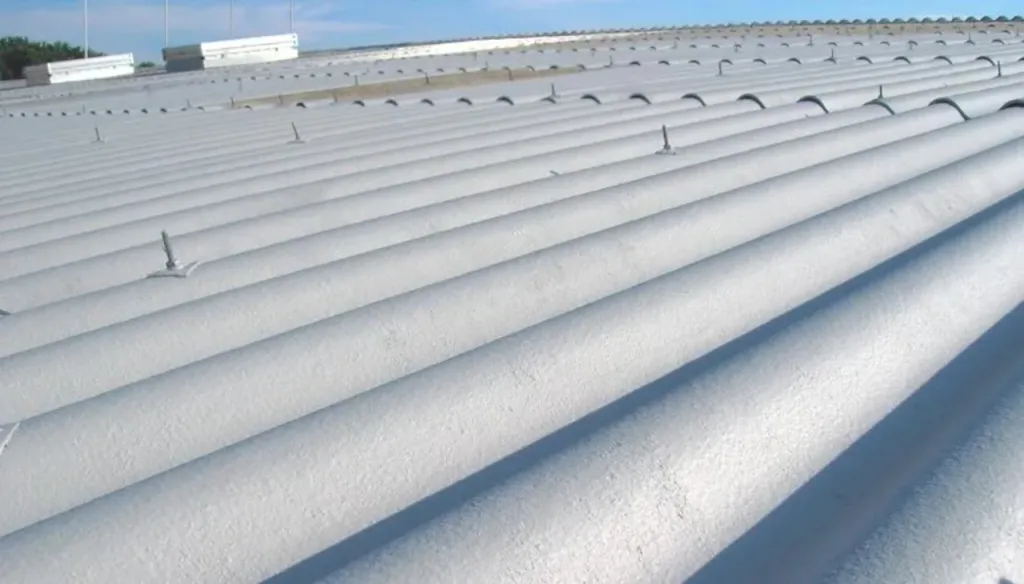
Liquid sheaths offer significant technical and operational advantages, particularly evident in the remediation of asbestos-cement roofing. Once applied, they form a continuous layer without joints and overlaps, adaptable to any surface geometry, including the typical undulations of fiber cement sheets.
The main technical and managerial advantages of encapsulation with liquid systems are:
- Absence of disposal: no special asbestos waste is generated, with a significant reduction in costs and risks for operators.
- Non-invasive interventions: activities can be carried out without interrupting the operation of the building.
- Restoration of waterproofing performance: the covering coating does not simply block the fibers but protects the roof from atmospheric agents, improving its overall durability.
- Maintenance: visual verification of the state of the coating is simplified by the color differentiation of the application coats.
- Environmental compatibility: Icobit systems are formulated in aqueous emulsion, solvent-free and certified in Class A+ for VOC emissions, and equipped with an EPD environmental product declaration.
Icobit’s Icoper Multiuso system also complies with the UNI 11928 standard on liquid waterproofing products and also has certification Broof according to EN 13501-5 for the external fire behavior of roofs, a relevant requirement in cases of installation of photovoltaic systems on roofs, and meets the requirements of the EN 14891 standard for crack bridging abilityguaranteeing the seal of the covering even in the presence of micro-cracks in the support.
The importance of scheduled maintenance
The legislation requires that roofs subjected to encapsulation be included in a periodic maintenance program, aimed at evaluating the integrity of the coating and verifying the possible need for restoration interventions. The frequency of checks is determined by the work plan prepared by the qualified operator.
The signal indicating the need for restoration is visual: when the color of the layer applied first emerges visibly on the surface, it means that the external layer has lost sufficient thickness and the protection must be renewed. This chromatic reading mechanism, made possible by the regulatory obligation of color contrast, allows predictive management of the maintenance intervention.
Icobit encapsulation systems are designed to guarantee high protection over time, even in conditions of exposure to the most severe atmospheric agents, reducing the frequency of maintenance interventions and long-term management costs of the roofing.
The choice of a certified system and the correct execution of the application cycle by qualified operators are the necessary conditions to ensure the effectiveness of the intervention in compliance with current legislation and to guarantee safety of the construction work concerned.