
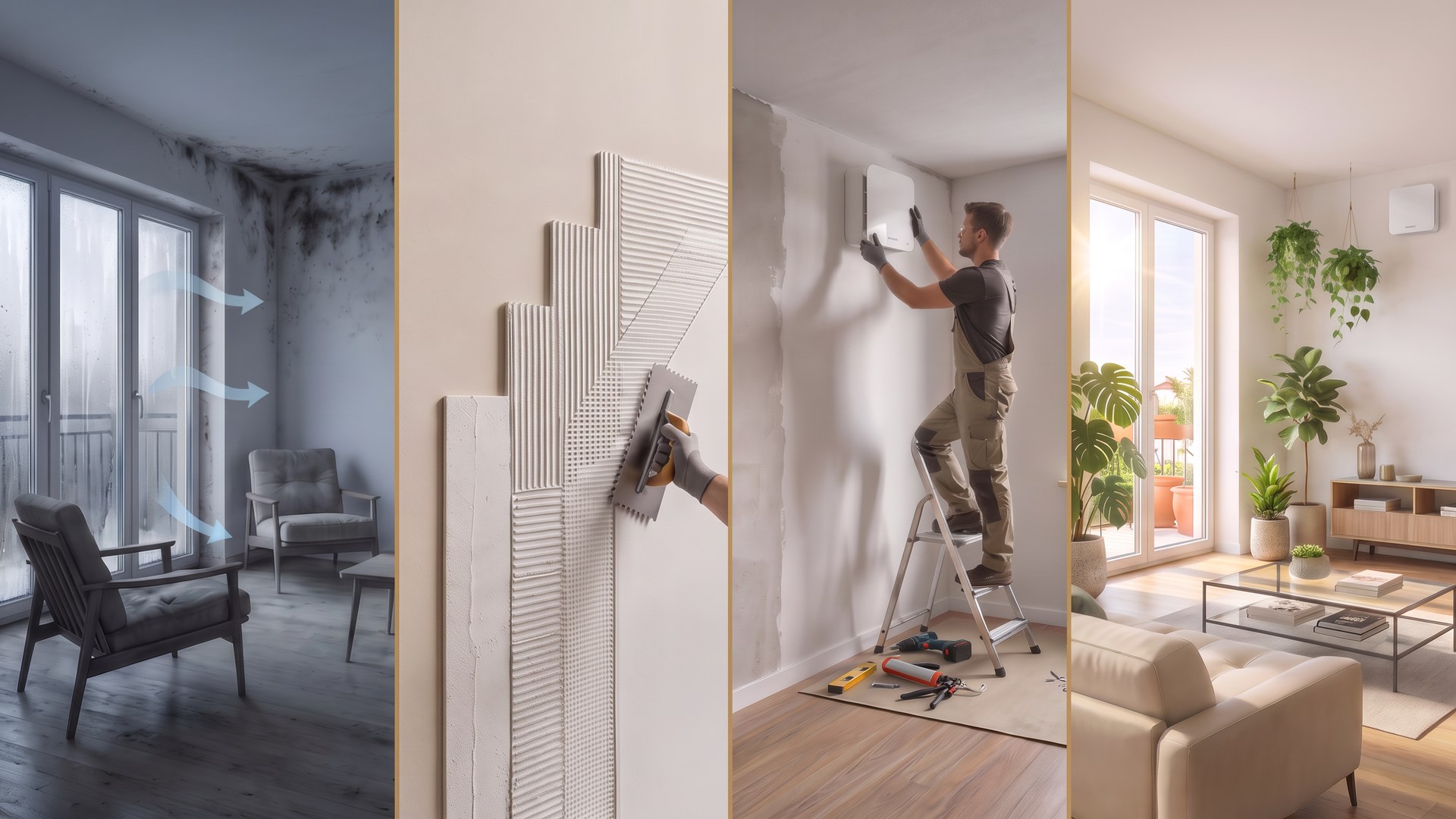
A coat of a few millimeters that continues into the knots
A solution to the problem is Econanosil ECO 2, a nanotechnological thermal insulating coating in paste which is used as a coat for the entire casing. The manufacturer declares in the DoP a conductivity λ10,dry of 0.0019 W/(m·K) (EN 1745) and the reaction to fire A2-s1,d0.
The product is applied with a trowel from 2 to 10 mm: 2 mm in one coat without mesh, further with embedded mesh. Since it is a continuous layer, the same product insulates the facade and enters the nodes, without panels to shape or plugs to be considered as specific thermal bridges: whoever creates the coat with ECO 2 can also tackle the construction nodes with the same covering.
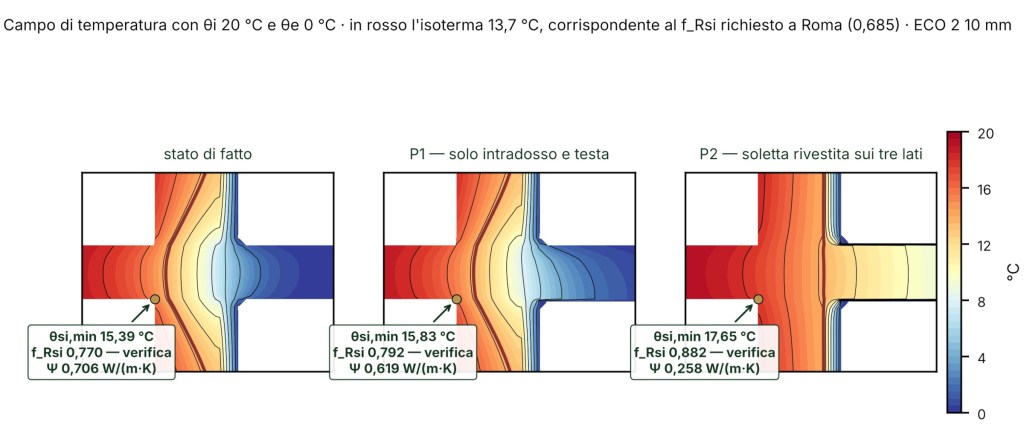
BRANDOLINI, ECONANOSIL authorized distributor, checked the finite elements on four recurring nodes and three walls typical of Lazio buildings. On a tuff deck with a paneled coat, where the deck remains uncovered, fRsi is worth 0.647; with ECO 2 continuing in the tile it rises to 0.758 already at 2 mm, and with the façade and tile continuously clad at 10 mm it reaches 0.830. On a brick box, 10 mm inside the box brings fRsi from 0.485 to 0.753; on the cantilevered balcony, covering the slab on three sides reduces Ψ from 0.706 to 0.258 W/(m·K).
And a rule emerges from the calculations: the covering goes where the cold enters, not where the mold can be seen. The calculations adopt the λ declared by the manufacturer in the DoP.
The other half of the test: indoor humidity
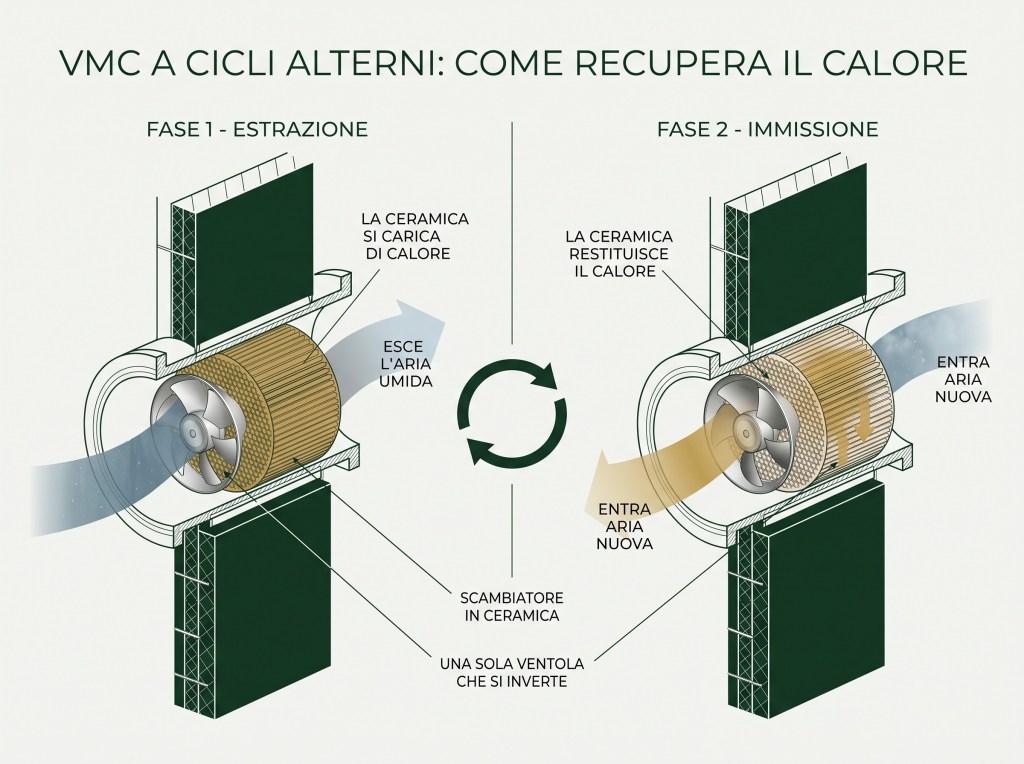
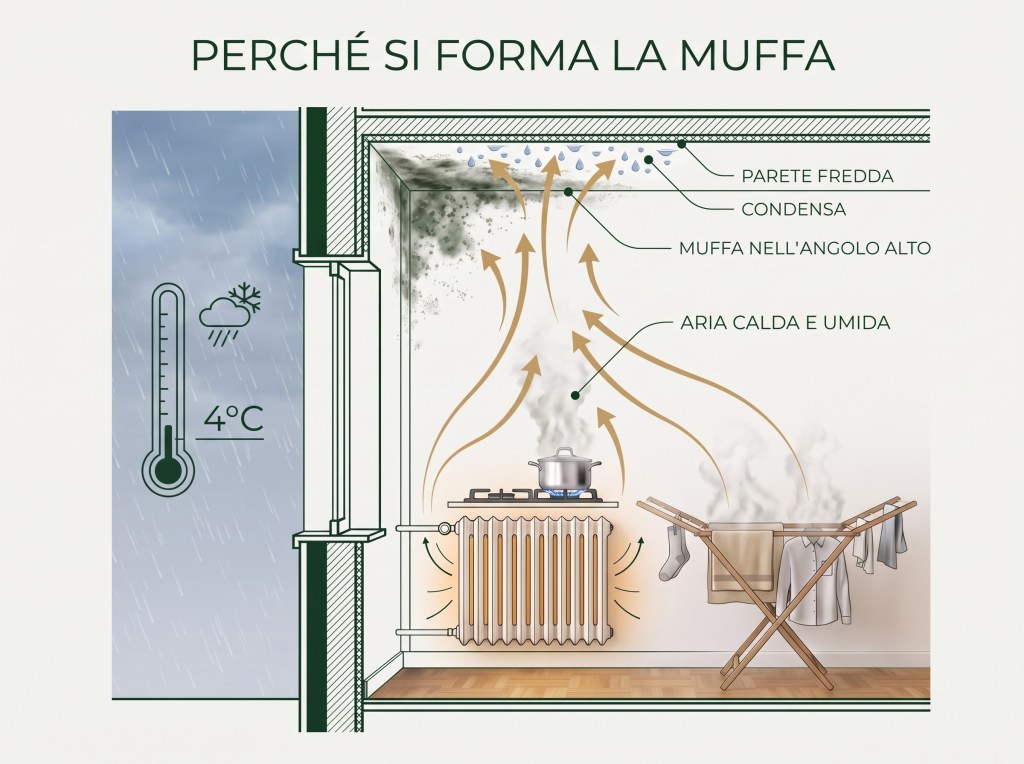
Raising the surface temperature is not enough if kitchens, bathrooms and closed rooms, perhaps behind new airtight windows, continue to take on steam. In these environments, the punctual VMC with heat recovery can intervene: a single-room unit in a 160 mm through hole, without ducts.
A single reversible fan works in alternating cycles: in extraction the regenerative ceramic exchanger retains the heat, in intake it returns it to new air. Humidity and temperature sensors regulate the flow rate; installation requires core drilling and connection with cable and plug to the nearest socket.
The Ministerial Decree of 28 October 2025 (Annex 1, art. 2.3) asks to verify the absence of risk of mold according to UNI EN ISO 13788, with particular attention to thermal bridges, and allows internal conditions different from those of reference when there is an internal humidity control system, to also be considered in the calculation of primary energy: the VMC is that system.
For designers, BRANDOLINI has collected on a single page the knot abacus with Ψ and fRsi calculated at 2, 5 and 10 mm, the calculator for intermediate thicknesses and the ready specifications >> are available on this page