

Faced with recruitment difficulties, the construction industry has a lever that is still under-exploited: workers undergoing professional retraining, as noted in a study carried out by the Observatory of Construction Professions

With nearly 1.5 million employees and persistent tensions on employment, the construction sector continues to seek new solutions to attract candidates. According to theObservatory of construction professions74% of recruitment was considered difficult in 2023, a level higher than that observed in many other economic sectors. In this context, the study devoted to professional transitions towards construction professions sheds new light on retraining paths and the expectations of candidates.
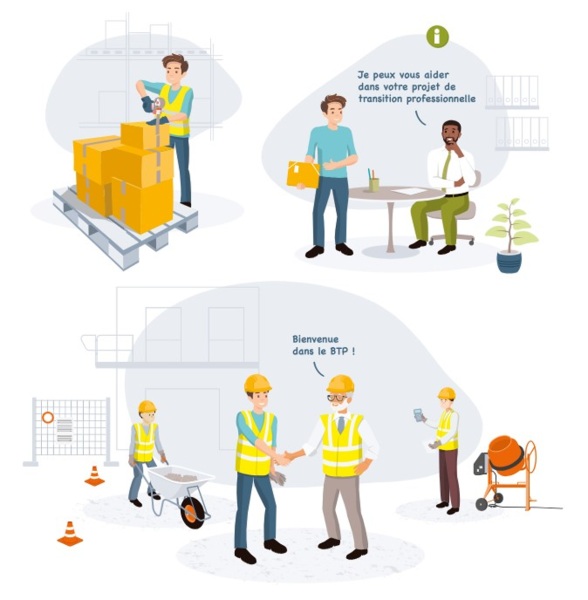
Carried out between May and December 2024 by the firm KYU Associés on behalf of the Observatory, the survey is based on 50 qualitative interviews, a consultation which collected 289 responses as well as statistical analysis of professional flows towards technical professions in building and public works. © Bing
A quest for meaning that benefits the construction professions
The study identifies two recurring triggers among people who join the construction industry : dissatisfaction with their original profession, often associated with a search for meaning, as well as a lack of prospects for professional development. These motivations then translate into three main reconversion logic :
– the first corresponds to a vocational reconversioncarried by workers who wish to exercise a concrete, manual or artisanal profession;
– The second is more of a geographical repositioningparticularly for employees seeking local employment after having endured long travel times;
– Finally, the third is similar to a social requalificationconstruction being seen as a sector offering prospects for entrepreneurship or achieving independence.
This diversity of motivations confirms that construction professions no longer only attract profiles from traditional technical sectors, but also candidates from very distant professional backgrounds.
Three particularly attractive job families
The works of theObservatory of construction professions show that retraining is mainly concentrated around three categories of professions.
The construction professions that most attract candidates for retraining
| Category | Professions concerned | Mainly targeted profiles |
|---|---|---|
| Qualified secondary workers | Electricians, plumbers, carpenters, carpenters, painters | Workers, employees, technicians and executives in search of meaning or better employment conditions |
| Technical supervision | Work managers, construction engineers | Managers and technicians with transferable skills |
| First qualification levels | Masons, formworkers, road workers, network fitters | People in integration or employees looking for a new professional direction |
THE finishing trades appear to be the most transversal since they attract workers from industry as well as employees from commerce, logistics and even transport. For executives, the opportunities lie more in management functions, particularly for profiles coming from industry, maintenance, design offices and technical purchasing.
The ecological transition strengthens the attractiveness of the sector
The study also highlights a factor that is increasingly present in retraining pathways: the desire to contribute to the ecological transition.
For engineers and technical managers, the Construction appears to be a concrete field of application of skills acquired in other industrial sectors. Energy renovation, low-carbon infrastructure or even improving the environmental performance of buildings are all professional prospects likely to attract experienced candidates.
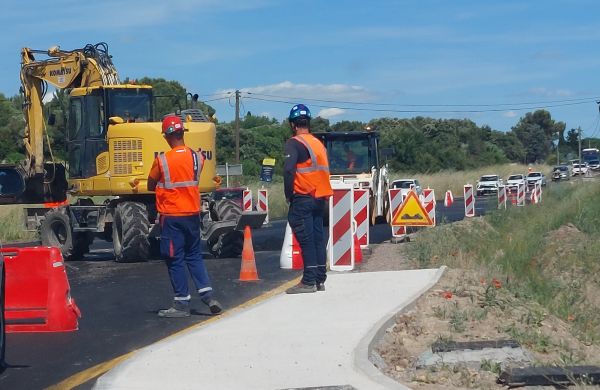
A development which contributes to modifying the historical image of the sector, long associated only with construction trades, by further highlighting its technological, environmental and innovation dimensions. © Laure Pophillat
Employers largely convinced by retraining profiles
One of the most striking lessons from the study concerns the perception of companies. Nearly a third of the companies surveyed already employ employees from professional retraining and 90% of managers or HR managers say they are satisfied with these recruitments. Better yet, some consider these employees as a source of enrichment for the company thanks to their previous experiences and the diversity of skills they bring.
This positive assessment contrasts with certain preconceived ideas which can still slow down candidates considering a transition to construction or public works. In fact, the Professional transitions appear to be a sustainable recruitment lever for construction companiesand all the more so sinceThe Observatory’s study perfectly underlines the fact that candidates undergoing retraining do not join the sector by default, quite the contrary. They are often driven by a thoughtful approach, motivated by the search for meaning, stability or entrepreneurial perspectives.
Four ways to accelerate transitions to construction
With the aim of convert more retraining projects into concrete recruitmentsthe Observatory considers it necessary to strengthen support for candidates throughout their journey. This involves in particular increased cooperation with the operators of the Professional Development Council (CEP), in order to better direct active people towards the opportunities offered by construction professions.
The study also highlights the importance of further promote successful retraining pathswhose testimonies constitute a powerful lever to change the image of the sector and reassure future candidates. At the same time, the provision of practical guides listing financing mechanisms such as the aid that can be mobilized would make it possible to remove certain administrative obstacles that are often perceived as complex.

The final avenue for accelerating transitions to construction, the development of tools for immersion and discovery of professions appears to be an essential condition for securing retraining projects, by giving candidates a more concrete vision of the realities on the ground before embarking on a new professional path. © Magnific
The study also highlights companies’ expectations in terms of HR support.
The main needs expressed by construction companies
| Need identified | Share of respondents |
|---|---|
| Information on funding and training schemes | 76% |
| Improvement of recruitment methods and channels | 59% |
| Adaptation of the skills of recruited employees | 55% |