Urban regeneration is taking on an increasingly central role in city transformation strategies, especially in a context in which the containment of land consumption and the redevelopment of the existing building stock have become priority objectives. Intervening on abandoned or underused buildings and areas means combining urban recovery, improving energy performance and quality of living, while at the same time limiting the use of new construction.
This is also what emerges from a recent analysis by BRB SpA Società Benefit, main shareholder and promoter of the development of the BRB Group, a company active in the construction, redevelopment and real estate investment sectors. The analysis links the potential of urban regeneration with the need to intervene on existing heritage and already urbanized areas.
>> Are you interested in articles like this? Receive them directly
Existing heritage and land consumption: some data
According to the European Commission, over 85% of the buildings that will be used in 2050 already exist today, making it strategic for the development of cities to intervene on buildings.
The latest available data from ISPRA highlights that in 2024 alone, almost 84 square kilometers of territory were artificialised, the highest figure in the last decade: our country lost soil at a rate of around 2.7 square meters per second. The new European EPBD Directive (Energy Performance of Buildings Directive) also aims to accelerate the energy requalification of the existing building stock.
In this scenario, the regeneration of buildings therefore takes on a value that not only concerns the real estate market, but directly involves strategies for limiting land consumption, energy efficiency and transformation of existing urban areas.
The potential of the areas to be redeveloped
As highlighted by the Second National Report on Urban Regeneration, published by Real Estate Scenarios in collaboration with Urban Upin Italy there are approximately 855 square kilometers of potentially recoverable areas, from which up to 320 million square meters of new real estate surfaces could arise, limiting the consumption of new land and enhancing the existing building stock.
These are numbers that highlight the potential dimension of the recovery and transformation interventions of the already urbanized fabric and the possibility of responding to part of the demand for new spaces without necessarily resorting to the expansion of cities.
The BRB case study: Arcadia Living in Rozzano
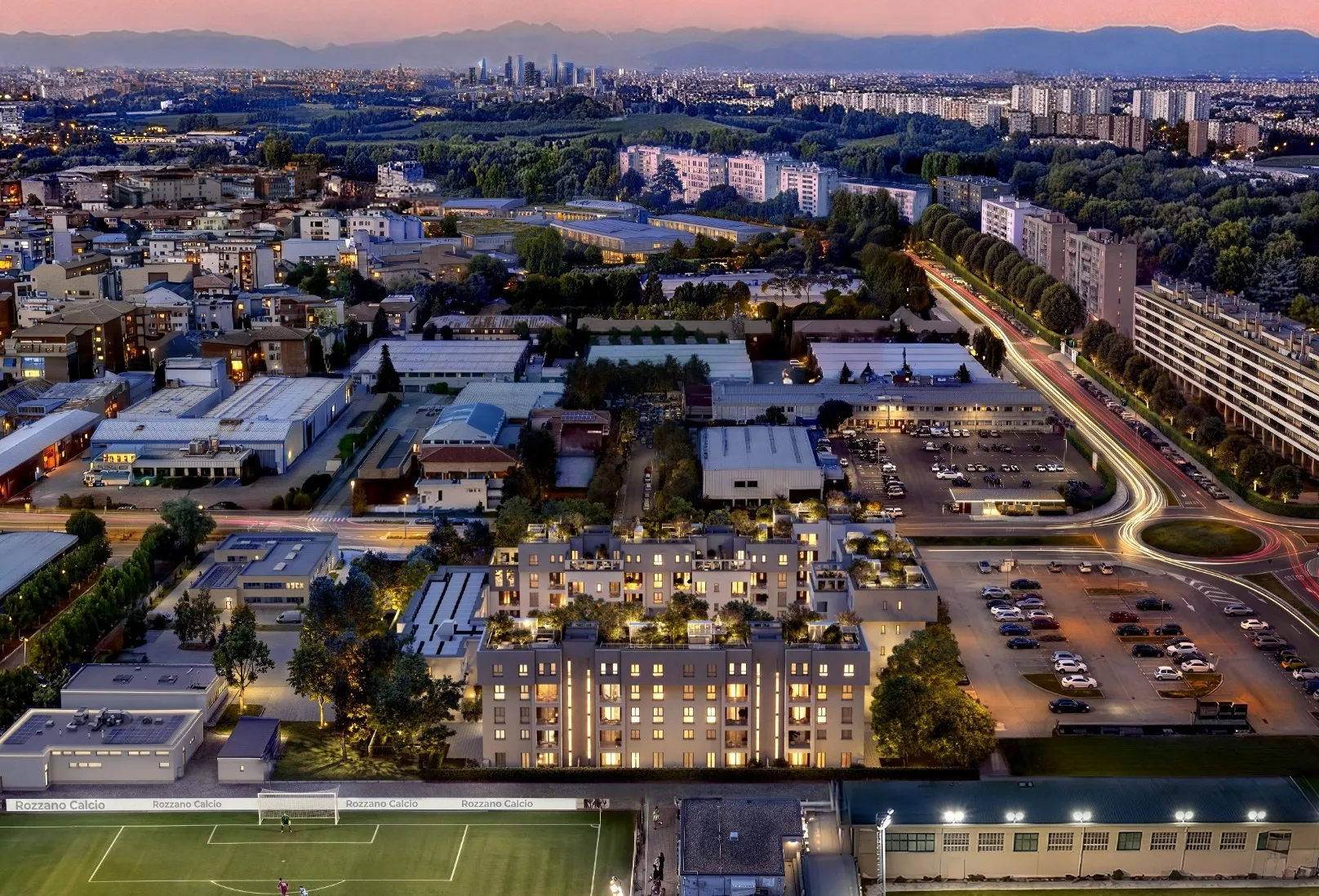
Among the interventions developed by the BRB Group in the context of urban regeneration and redevelopment is Arcadia Living, the residential complex under construction in Rozzano, a municipality on the outskirts of Milan, on an area previously occupied by an abandoned building, then demolished and reclaimed.
The project, worth 50 million euros, includes 77 apartments and adopts solutions aimed at the efficient use of resources, including heat pumps, underfloor heating and thermo-acoustic insulation.
The green system includes a central garden with tall trees and roofs with private hanging gardens, designed to retain up to 40% of rainwater, encouraging more sustainable management and contributing to environmental comfort.
The intervention allows us to observe on a concrete scale some of the central themes of urban regeneration: recovery of a previously unused area, reclamation, new housing, energy efficiency and integration of solutions for greenery and rainwater management.
Says Artan Bixi, CEO of BRB Group: “In recent years, urban regeneration has taken on an increasingly central role: if in the past real estate development was linked above all to the expansion of cities, today the challenge is to enhance the existing heritage, limiting the consumption of new land. This approach allows us to combine construction quality and energy efficiency with the ability to restore value to degraded or underused areas. Arcadia Living was born from this vision: transforming an abandoned area into a new residential complex, while contributing to the enhancement of the urban context.”
In the last five years the BRB Group has created over 500 apartments, more than 50 building redevelopment interventions and around 200 restorations, concentrating part of its activity on the recovery of abandoned or underused properties and areas.