
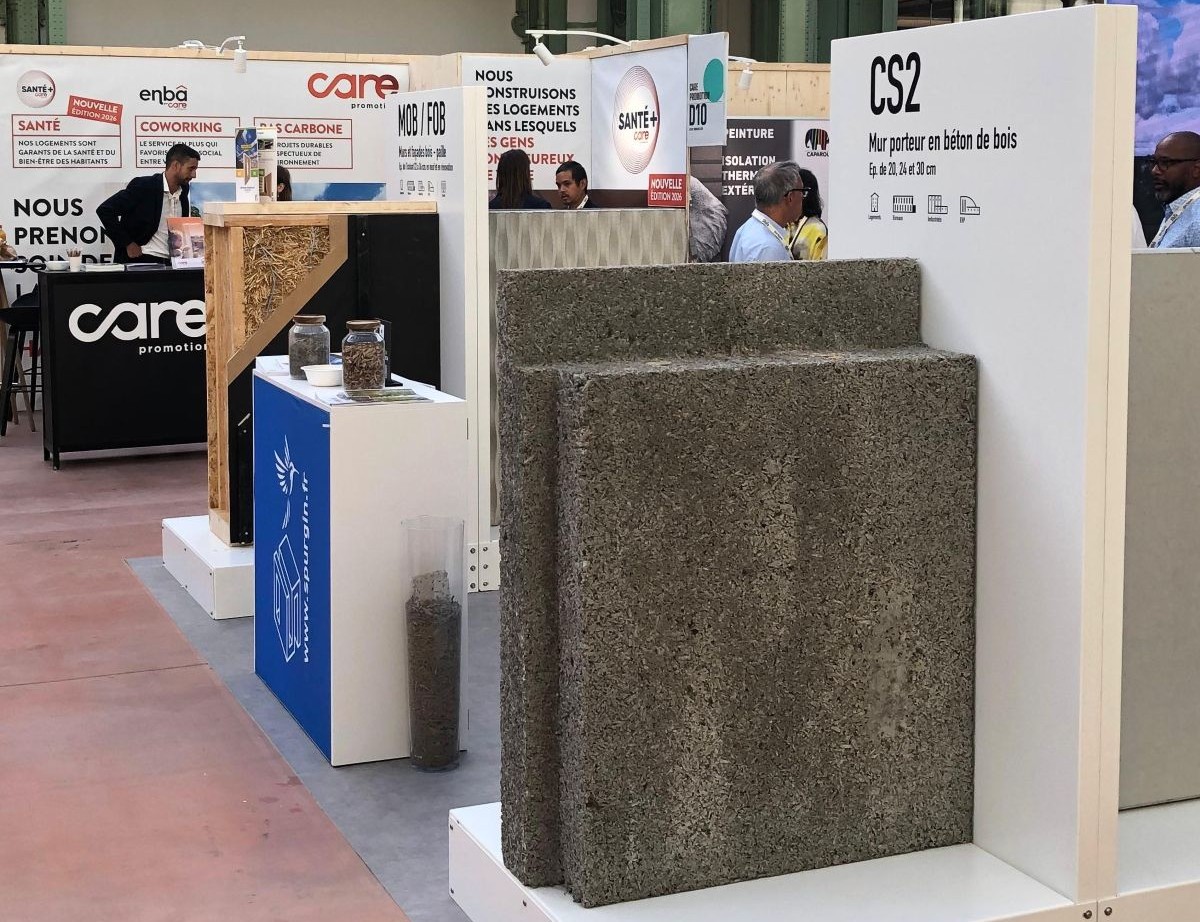
While at the International Wood Construction Forum, the emphasis is placed on the relationship between wood and bio- and geo-sourced materials, on the market, wood construction is often involved in forms of wood-concrete mixing.

Prices for wooden construction have fallen because BLC and CLT are selling for less. But the wooden construction with the minimum required concrete in the cores and foundations often remains considered as a luxury, particularly in the face of solutions in wood concretethemselves more expensive than traditional concrete. Even decarbonized, concrete reaches its limits in terms of compliance with regulations RE2028 and especially RE2031.
For RE2025, it is common to see “carbon-free” concrete structures with FOBs and possibly other subtleties to pass just within the regulations. On the other hand, for RE2031, it becomes important to decarbonize concrete in wooden constructions consequent.
The false debate of the prefa
Here are the very rough benchmarks reported from the 5th edition of SIBCA. In principle, the off-site approach does not change anything; for wood, it is an optimization of prefabrication when the design takes into account the specificities of wood and the demand for repeatability and standardization. But the off-site is above all a form of discursive appropriation of the wooden prefa by the concrete prefa. When we replace the term wood construction with off-site, we can avoid the use of wood while retaining the advantages of prefabrication. And we return to what was current fifty years ago in France, with the major advantage, compared to cast-in-place concrete, of better consideration of the extended setting time of carbon-free prefa concrete, even if the latter has the disadvantage of being less efficient, for the moment, in floors.
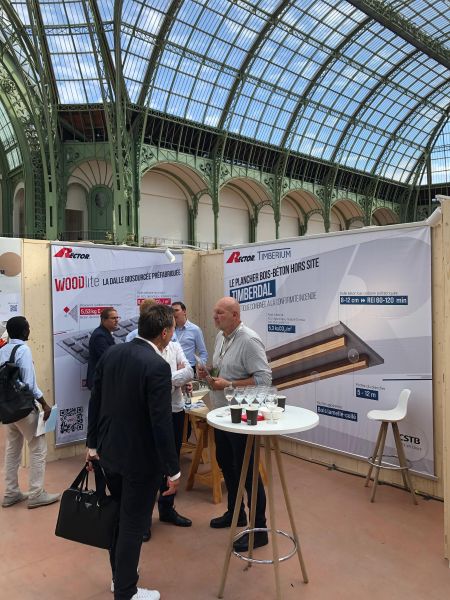
Rector: There is always a Rector factory nearby, and always a wood manufacturer, so Rector’s new mixed solution is also a local option. © Jonas Tophoven
Wood-concrete seeks its way
The benchmarks are moving at all levels and what is said today is probably no longer valid tomorrow. However, the France is currently the great carbon laboratory and explore the wood/concrete mixbut also the concrete/biosourced mix in addition to the virtuous trend in biogeosourced wood which makes the difference in terms of true low carbon, and compensates a little better for a general constructive reality which remains far too emissive despite the gradual transition to RE2025. There is the wood-concrete which is gaining momentum according to the AICB, the Association of Biosourced Construction Industrialists to which CCB Greentech (0.9 million m2 installed in 2025?), while Spurgin, present at SIBCA, is counting on dedicated units. However, the integration of wood does not replace clinker.
Worksite diversity facing the challenge of RE2031
Mixing genres is not new. At REI Habitat, the concept of a wooden post structure – and even glued beech –, associated with a BB prefa concrete slab whose biosourced dimension comes from the integration of wood fiber, was used for the Wood Up tower and for the Les Pierres Sauvages operation in Pantin.
Previously, in Champs-sur-Marne, Vinci with AIA tested the prefa concrete floor on wooden joists also in prefavia connectors, but this option does not seem to have become established, in particular because of the cost of the very numerous connectors.
At WOA, the architectural agency which refers directly to wood (Wood Oriented Architecture), the opposite of the option of the Wood Up tower, finally imposed for the neighboring Tour Commune, in the ZAC Bruneseau, combines CLT boards to a concrete structure for a 50 meter tower. We are here in configurations where the contribution of biosourced products compensates for carbon, in a context which authorizes this type of compensation and is satisfied with it by mocking the objective of carbon neutrality and the Paris Agreement, in a given market context, but before the five heat waves of the summer of 2026.
The AURA tower in Lyon is of the same order, but things are changing with the competition that WOA has just won in Bagneux for a RE2031 mixed structure with the use of Ecocem low-carbon concrete. in core.
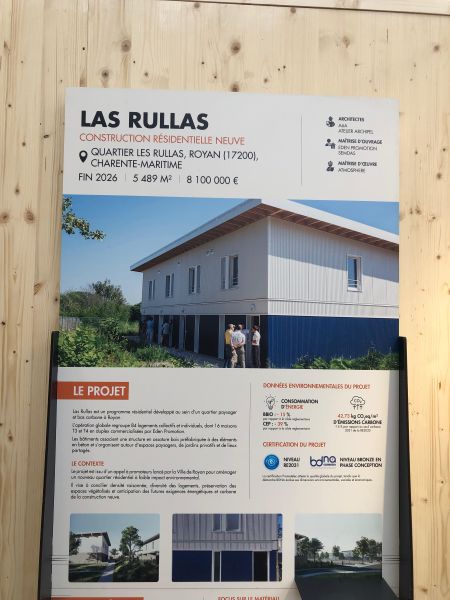
Sybois contributes to a mixed “RE2031 level” solution, exemplified on the Matériau.archi stand. © Jonas Tophoven
Deep nests in continuous motion
As everything is in motion, it is interesting to see how an evolution takes shape. First, at the level of the actors. The industrial supplier of the alternative to clinker offered by Ecocem becomes the owner of the laminate manufacturer Cosylva and the wood manufacturer James. After Vinci/Arbonis and Eiffage/Savare, Legendre CCB, Léon Grosse/Techniwood, Spurgin takes over Activ Home for wood-straw construction, GCC present at the last edition of SIBCA in 2025 has a wood division, nesting becomes almost the rule and Rector develops a concrete floor solution on joist after the failure of the formula combining its prefa floors with Techniwood facade solutions. One more step and a cement manufacturer will become a manufacturer of industrial wood. Holcim could have made an offer to take over Stora Enso’s timber construction activities, but preferred to take over Xella. However, Xella now offers protection solutions on the underside of CLT floor slabs, developed with Piveteau.
And we are still waiting for Saint-Gobain for whom wooden construction is a godsend in terms of the use of plasterboard, especially since the decree of February 19 on the fire protection of biosourced ERP buildings. Saint-Gobain left the wood industry in 1993, a strategic decision that dates back more than thirty years.
In the meantime, Bouygues is marketing for good a wooden frame partition wall, which ignores the galvanized steel solutions of plasterboard producers.
In the absence of Holcim, Saint-Gobain is one of the rare global players in the construction industry to be able to take over the activities of Stora Enso. In doing so, Saint-Gobain is working with Mathis on ribbed CLT floors protected on the underside by plasterboard. The match with the cellular concrete option depends, among other things, on whether or not the fire resistance of the wooden ribs is taken into account.
Formwork wooden facades, the return
Mathis has a head start with the delivery of the WOOD E project in Pantin, presented at the last International Bois Construction Forum, and on the French market, the Mathis school remains a crucible of inventiveness, direct or indirect. The Xella option is currently being tested by Léon Grosse on the Time housing project in Saint-Denis, never mind! Mathis applies a secret weapon that can now be communicated because an Atex case A approach is successful. This involves taking up the idea developed by Yves-Marie Ligot for Bouygues, fifteen years ago, of using the MOB facade as formwork for the concrete floor, an idea taken up by Vinci in Lormont but ultimately abandoned, but which returns with an option in BLC posts which make it possible to support descents of multi-storey construction loads. It will be necessary to avoid leaks and manage setting times and above all, at present, the low-carbon concrete floor is not efficient. We will undoubtedly return to an evolution of the Mathis formwork MOB option associated with mixed slabs which will ultimately allow faster assembly and a switch to something akin to wooden construction, pushed out through the door and back through the window.
Thirty years ago, the Dubosc and Landowski agency developed dry construction within the framework of a club, Architecture with Industry, and highlighted the extent to which it is problematic to mix two ultimately contradictory construction techniques, dry and wet. We sometimes have the impression that the French ship is moving back to jump better, absolutely wants to test all the mix formulas before making the winning leap towards the biogeosourced construction which requires a different approach in terms of fire protection and requires partitioning, but which constitutes the only response to heatwaves.
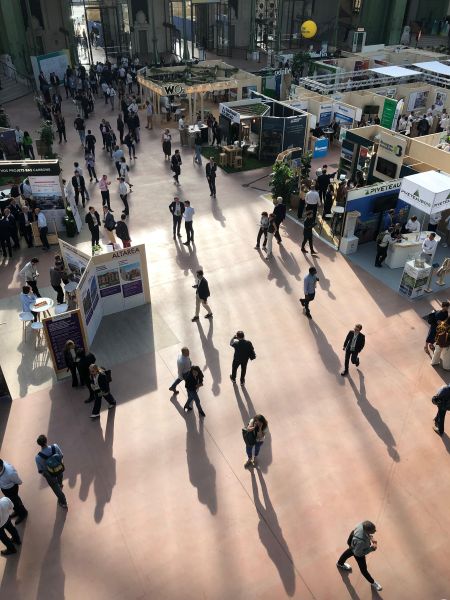
Diversity: the economic optimum must fit with the climatic optimum. © Jonas Tophoven
The essential wood
There are signs that are unmistakable. Simonin’s Dalfeu went from an average performance at Efectis to a magnificent performance of CF 4h at CERIB and the mixing of the sector is also reflected in the good press of the “concrete laboratory”, which is finally turning into a good competitor in a too monopolized market. Diversity is also found in Vicat’s efforts to support the development of miscanthus blocks. It was necessary to adapt the formula used for the hemp blocks with a finer miscanthus fiber. We find it on construction sites where WeWood advocates for Bouygues the versatility of teams, while Léon Grosse in Saint-Denis has wood installed by non-carpenters who are, however, well supervised. The great carpenters don’t necessarily like it, but when you ask them, they have enough work. Certainly, within two years… but who knows where the world is going in the next two years?
Jonas Tophoven / © Jonas Tophoven