
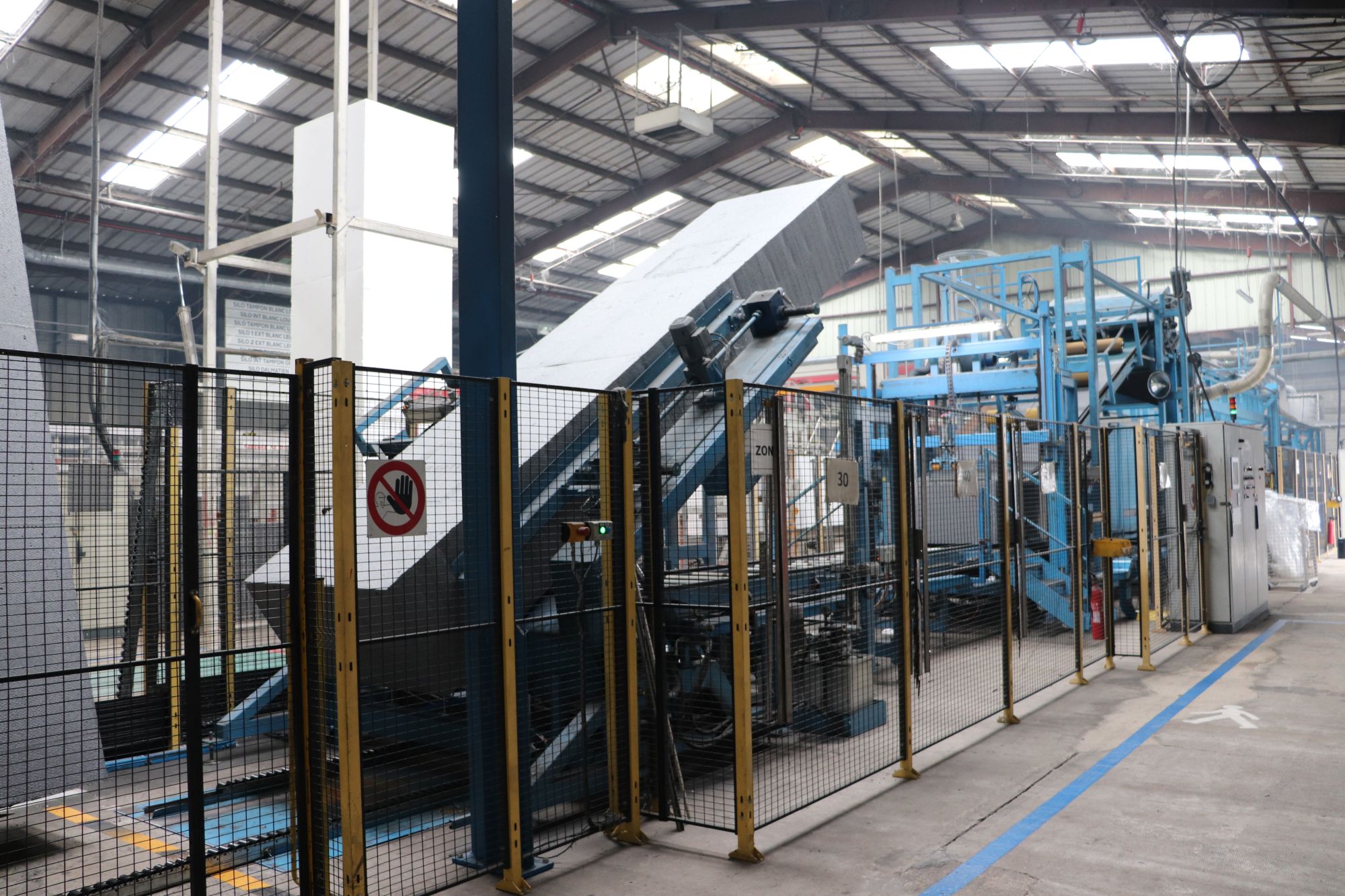
Manufactured in Guipry-Messac (35), the Hirsch Isolation Foundations range opens up new possibilities on the French market for buried and semi-buried walls.
Publi-Information 


Dedicated to theinsulation of buried and semi-buried wallsthere Foundations range from Hirsch Isolation has been completely redesigned to support the growth of this market, driven by reinforced requirements in terms of energy performance of buildings.
Insulation of foundations and semi-buried walls
Quite small, compared to that of floor insulation and ITE, this market represents 132,000 m2 installed per year in France – i.e. 10,000 m3 of panels. Hirsch Isolation, the second largest manufacturer in France, intends to gain market share thanks to a range of solutions covering all construction site scenarios and responding in particular to the constraints of mechanical resistance and burial depth. The industrialist is the only one to propose an EPS solution to cover burial depths greater than 6 meters and up to almost 10 m.
DTU 20.1 determines three categories of buried wallsfor which the professional recommendations of the CSFE refer to the calculation of maximum depth, which depends on the nature of the ground, the presence of adjacent parking lots or firefighter access, and the mechanical compressive strength of the insulation.
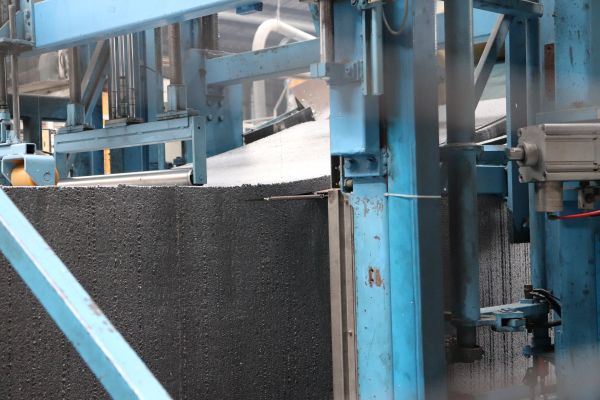
The size of the block is calculated to limit scraps when cutting the panels. © EJH
A better segmented range
With now seven references of 1200 x 600 mm insulating panels, the Foundations range offers specialized products, 100% recyclable and incorporating recycled material in varying proportions depending on the areas of application (20% on average).
For buried walls
There range of Cellomur Fondation insulation includes new products which will be integrated into the FDES HIRSCH Isolation configurator from next July.
– Ultra Foundation: graphitized EPS panel with high insulation performance – thermal resistance from 0.6 to 12.90 m2·K/W – allowing treat thermal bridges on the first buried rows (from 1.25 m to 2.30 m), limiting the thicknesses (the semi-buried panels must be visible to a minimum height of 15 cm before the departure of the ITE).
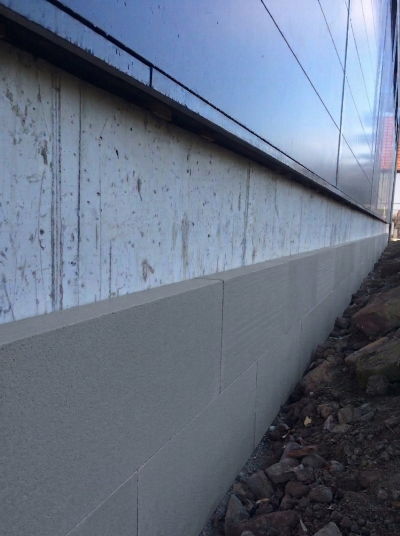
Cellomur Fondation Ultra allows continuity of thicknesses, for example with thermal insulation from the outside of the facade. © Hirsch
Great burial depths
For great burial depths, three white EPS, whose density increases with depth, are offered: Foundation (up to 3.8 m), Fondaplus (up to 6.80 m) and Fondamax (up to 9.50 m).
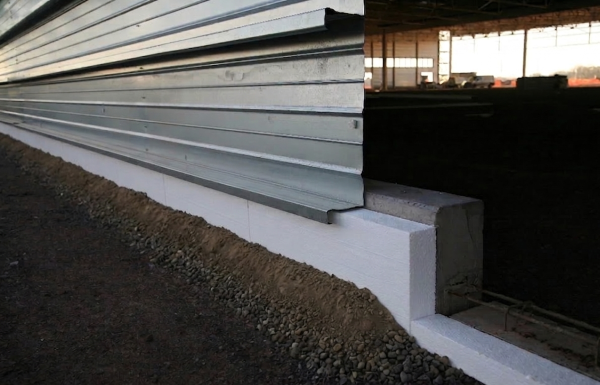
White EPS from Cellomur Foundation. © Hirsch
Specific solutions for technical sites
In addition to its primary function of insulation, theEPS insulation can provide drainage, mechanical protection and even an aesthetic finish. Hirsch has products already on the market in its offering to address these various issues.
Drainage
It is studied on a case-by-case basis because it depends on the nature of the terrain and not on the category of walls. Between 3.60 m and 5.70 m below the surface, the Cellodrain Ultra solution is recommended. This Molded graphite EPS gridded and covered with a geotextile ensures drainage and insulation – made in Germany, it is already marketed.
For semi-buried walls
Cellocem Ultralight BD – launched in 2023 – provides insulation and mechanical protection in a generally stressed area. Its 10 mm thick wood-cement cladding can be painted with a suitable paint.
Cellocem Ultra, its predecessor – it dates from 2018 – is used for the same functions, with 8 mm thick fiber cement cladding which provides a high-end finish.
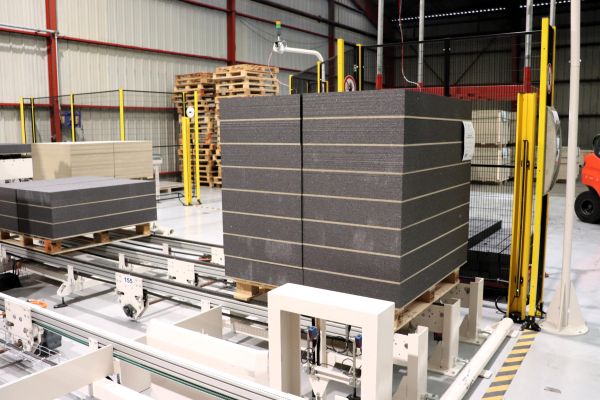
These two products respond to growing market demand. This year, Hirsch Isolation produced 20,000 m2doubling its production each year 3 years in a row. © EJH
A robotic line since January
To accompany the launch of its new Foundations range and the looming increase in volumes, Hirsch Isolation has invested in its Breton site in Guipry-Messac in a new assembly line dedicated to production of Cellocem Ultralight and Cellocem Ultra panels.
Since the beginning of the year, the two products for semi-buried walls are automatically assembled on this brand new tool, which allows both production capacity to be doubled and finishing quality to be increased.
Several hundred thousand euros have been invested in this line which achieves automatic gluing of the facing to the insulationthereby improving the working conditions of operators. The robot is responsible for handling the different elements but also the pallets.
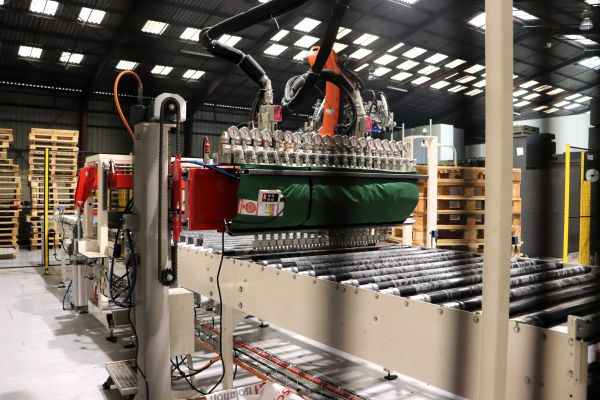
Installed by a French company, the line occupies a former block storage yard. © EJH
Hirsch Insulation and the virtuous circle
Number 2 in EPS insulation in France, Hirsch Isolation is a subsidiary of the Austrian Hirsch group, owned by the Herz foundation and the Bewi group, which manufactures, among other things, the raw material for EPS.
Transforming EPS since 1954 – first under the names Isobox, then Henry – Hirsch Isolation has developed a complete offer of building envelope insulation but also products for mobile homes, podiums, etc. Its five production sites employ 197 people in the region, for a turnover of €63.1 million in 2025/26.
Established in 11 European countries, this PES specialistwhich has grown quickly, is keen to limit its environmental impact. He received an Ecovadis silver medal for his actions – green electricity, recycling of all waste, etc.
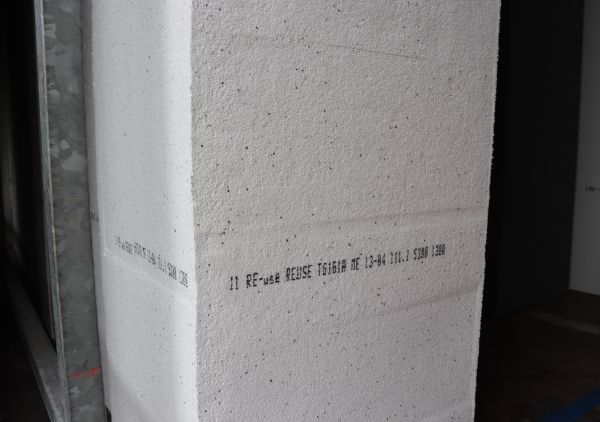
This 100% recycled EPS has a carbon weight halved (vs. virgin EPS). The REuse panel has been sold since 2023 to insulate floors (mechanical resistance and slightly degraded thermal performance). © EJH
Closing the loop
In Guipry-Messac as in the other Hirsch factoriesa compaction line has made it possible for two years to recycle EPS of all types, from construction sites in the Rennes region and from packaging. Factory scraps are reintegrated directly into the manufacturing line.
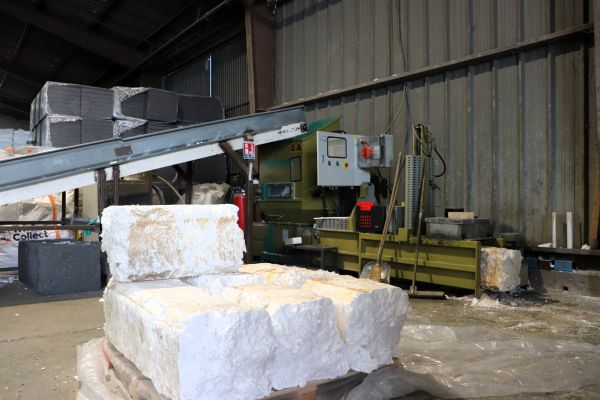
These blocks resulting from the sorting, crushing and compacting of EPS waste are sent to the Czech Republic, where Bewi remanufactures the raw material. © EJH
EPS from biomass
Since 2020, Hirsch produces an improved Carbon Footprint range from styrene obtained by pyrolysis of plant waste. More expensive by 15 to 20%, these products used for foundations or ITE, represent 1 to 2% of sales, but they could benefit from renewed interest, given the current geopolitical context.
Because the price of classic EPS is increasing: derived from naphtha, a co-product of oil refining, styrene has seen a sharp increase in its price in recent weeks, which is passed on to insulating panels – EPS can be stored for a maximum of two months before the expansion gas escapes from the balls.
Source: batirama.com / Emmanuelle Jeanson / © EJH