

The concept, moreover, is never truly free. Even when we don’t realize it, it is already the result of standards, dimensional relationships, client requests, economic objectives. Spacio starts from this evidence and changes perspective: instead of hiding these conditions behind a convincing form, it brings them to the foreground. The project is not born as a closed object, but as a system of relationships that can be questioned, modified, compared.
This explains why Spacio is designed above all for the initial phases of work. It is not a software for construction details nor a final representation tool. It is a space in which parameters are set, constraints are defined, and we observe how the volumes change when the starting conditions change. A particularly useful approach for feasibility studies, master plans, residential or complex interventions, where the central question is not yet “how a building appears”, but whether it works, whether it falls within the limits, whether it stands up to comparison between multiple hypotheses.
One of the most interesting aspects of Spacio is the presence of generative features that allow you to quickly explore multiple project alternatives. Starting from defined rules and parameters, the tool produces different volumetric and distributional hypotheses, all consistent with the initial conditions. This allows you to compare different scenarios in a short time and orient the project with greater awareness, without having to redo the model from scratch every time.
But what does it mean, concretely, to use Spacio in an initial project phase?
The first contact is rather linear. After registration you access an essential environment. A new project is created and the context is chosen: the urban model is loaded automatically, with the related spatial data present in the system.
The work starts from the ground. The lot is traced directly in three-dimensional space, drawing its perimeter and verifying distances, alignments and relationships with the context.
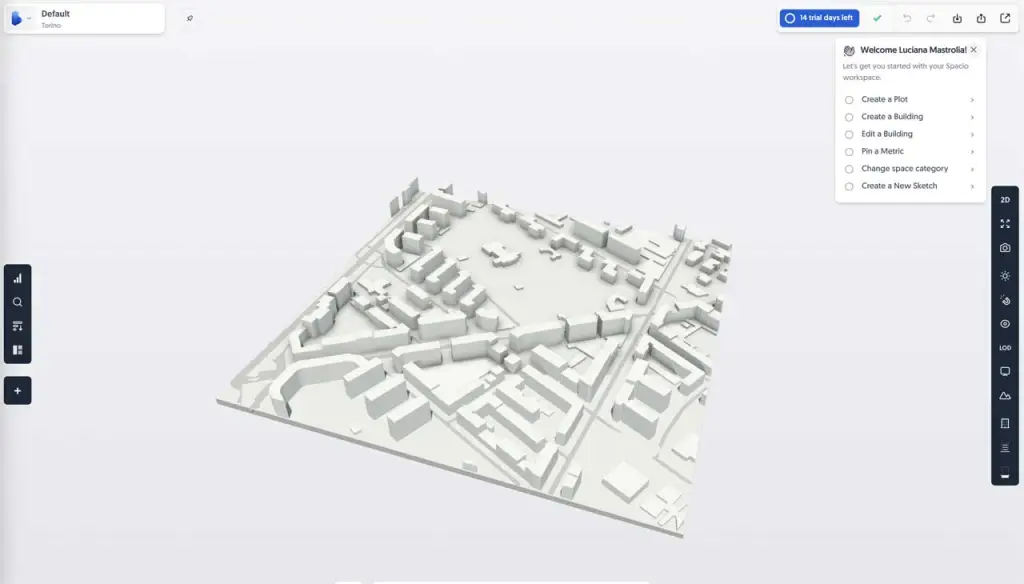
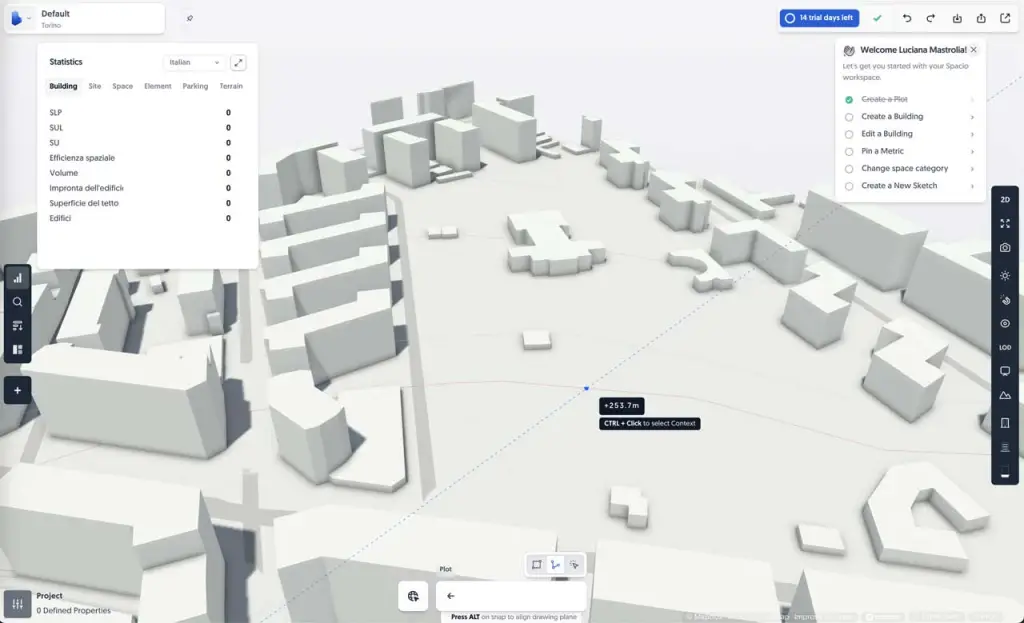
Once the lot has been defined, we move on to the building. Here Spacio shows its parametric nature: the volume can not only be modeled manually, but also generated starting from rules. Number of floors, inter-storey heights, depth, articulation of the building body. Each value is editable and each change has an immediate effect on the model. At the same time, surfaces, volumes and other indicators update in real time.
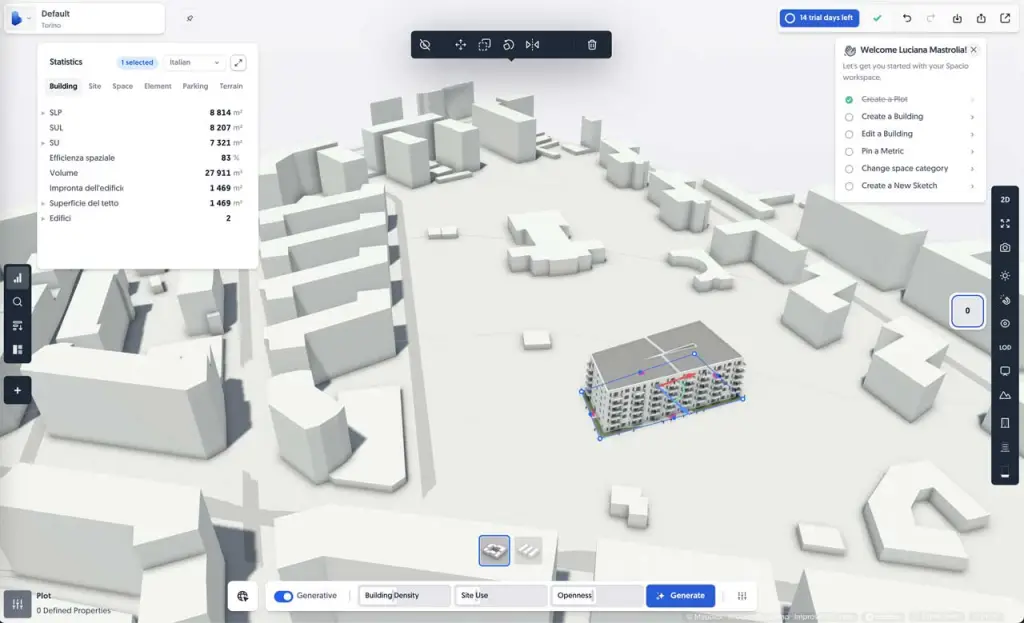
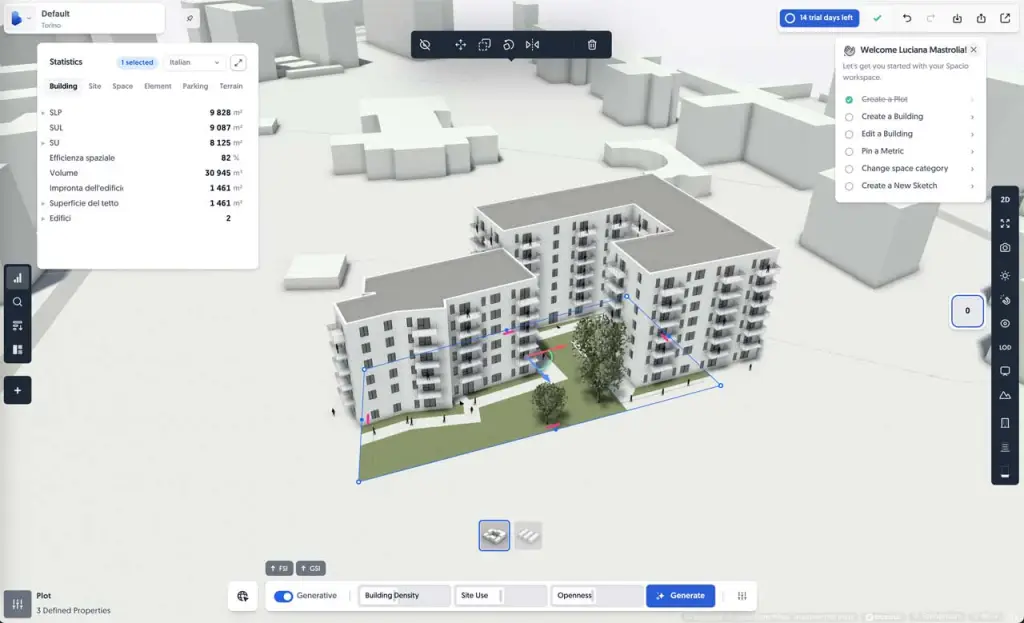
The most significant step comes when you start comparing alternatives. By changing a parameter – a distance, a density, a distribution of bodies – the system produces a new configuration while keeping the entire system coherent.
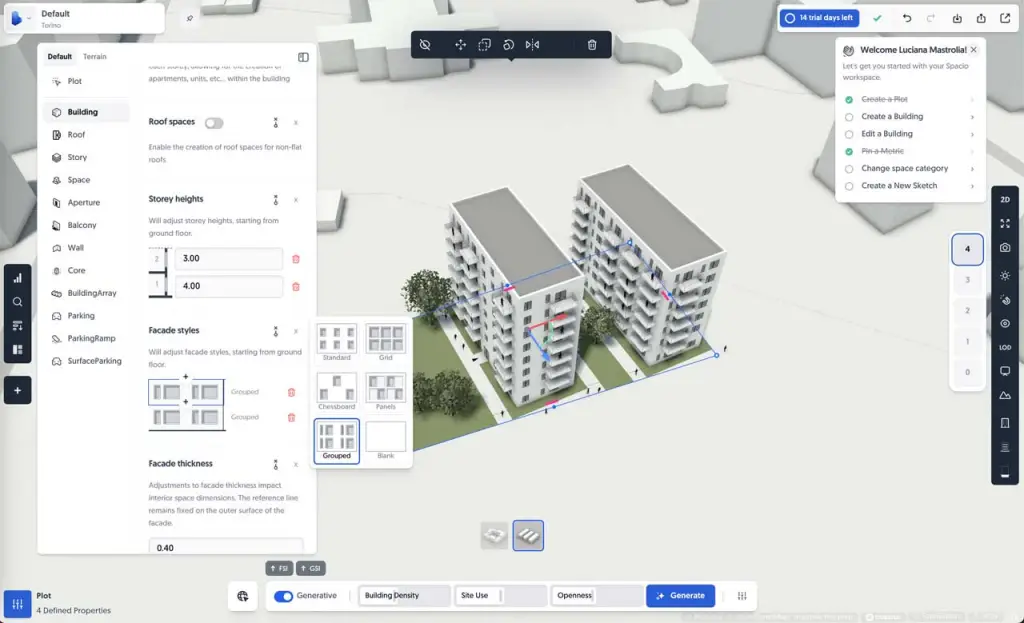
At this point the work can continue in different directions: the project can be refined, discussed within the studio or with the client, or exported to other work environments.
Like many tools designed for professional practice, Spacio also adopts a subscription-based access model. In summary:
- access via subscription
- trial period (currently 14 days)
- differentiated plans for individual professionals and teams
A field experiment
Spacio.ai (as well as x Figura, which we talked about previously) will also be used within a design laboratory to be held in Turin at the end of March, organized by me and the architect. Riccardo Piazzai, as a working tool in the initial phases of the project. The platform will be used operationally to think about volumes, surfaces and design alternatives, testing its use within a real and shared process. The objective is not to present the tool in the abstract, but to verify its actual usefulness in daily work: understanding at which moments it helps to clarify decisions, compare different scenarios and make the project rules more explicit, and where instead it shows limitations or requires integrations with other tools. For more information on the laboratory, you can write to me at: [email protected]
The weekly column “Architectural Prompting” is edited by experts Luciana Mastrolia, Giovanna Panucci and Andrea Tinazzo
>> If you are interested in these topics, also sign up to the free Linkedin Newsletter AI & Design for Technicians, we’ll talk about it here!