
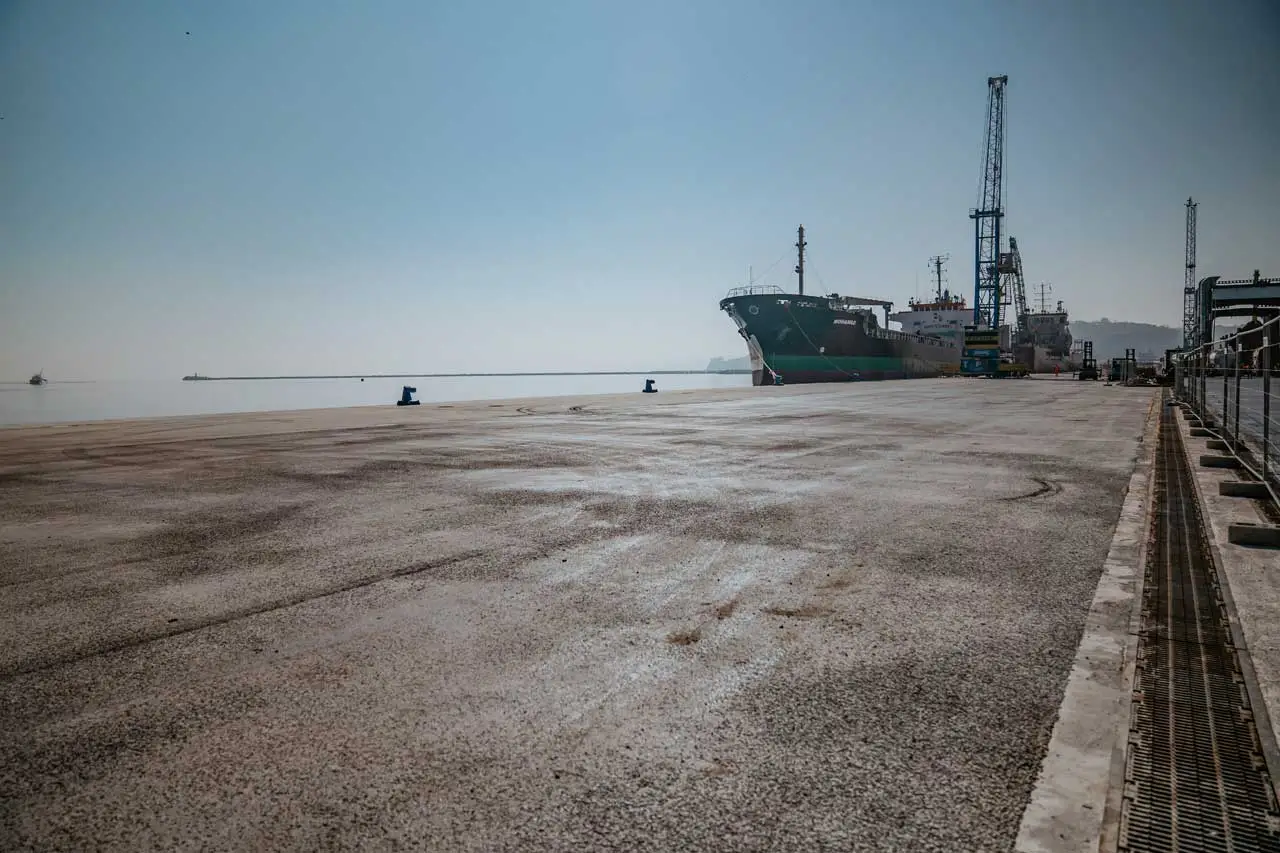
Structural consolidation of the quay
The first phase of the works involved approximately 230 meters of quay (out of a total of 560 metres), for a width of 30 meters and a total investment of 13 million euros financed by the PNRR (Mission M5C3, Investment 4 – ZES). The works, entrusted to the temporary group consisting of Mentucci Aldo Srl and Fincantieri Infrastructure Opere Marittime Spa, were completed 99 days ahead of schedule.
The consolidation was achieved by relining the existing structure with:
- sea side pile bulkhead;
- land side anchoring poles;
- reinforced concrete deck;
- slab and crowning beam.
For the piles, slab and dock beam, concrete from the ECO CAM line by Heidelberg Materials was used, made with TERMOCEM GREEN 42.5 N, RCK 45 cement, exposure class XS3 and consistency S4, suitable for highly aggressive marine environments.
The flooring was completed with a surface layer of fiber-reinforced concrete approximately 25 cm thick, laid by Ibuild Italia, a Heidelberg Materials Italia company specialized in the “turnkey” construction of concrete flooring.
ECO CAM concretes: performance and sustainability
The ECO CAM line concretes used in the project comply with the Minimum Environmental Criteria (CAM) and contain over 30% pre-consumer recycled material. The use of blast furnace CEM III/A cements allows for a significant reduction in CO₂ emissions, less than 550 kg/t compared to over 750 kg/t for a traditional CEM I.
In compliance with the provisions of the EN 197-1 standard, CEM III/A 42.5 N cement has a reduced environmental impact thanks to the partial replacement of the clinker with granulated blast furnace slag (approximately 40% slag and 60% clinker), satisfying the CAM obligation to incorporate at least 5% of recycled, recovered or by-product material.
“The use of slag not only improves the sustainability profile of the material, but also allows to optimize its mechanical performance and durability“, says Angelo Pelliccione, Ibuild Italia technical contact for Abruzzo and Marche. “The hydration reaction of the cements to the slag develops over time, favoring a progressive closure of the porosity of the concrete. This has a double advantage: on the one hand it limits the penetration of water and aggressive agents, on the other it slows down the natural carbonation process. Added to this are high mechanical strengths, good resistance to chemical attacks and a low heat of hydration, characteristics that make these concretes particularly suitable for works in a maritime environment.”.
Semi-flexible flooring for operational areas
Once the structural consolidation was completed, the works concentrated on the paving of the port square, designed to support intense traffic and high loads. Following checks on the subgrade, the initial project – which involved the use of a layer of Rolled-Compacted Concrete (RCC) resting on a layer of stabilized granular mix (MGS) – was modified by adopting a multi-layer solution consisting of:
- stabilized granular mix (MGS);
- three layers of cemented mix with decreasing stiffness obtained using calibrated mixtures with TERMOCEM III/A 42.5 N cement at differentiated dosages (from 70 to 150 kg/m3);
- SAMI waterproofing membrane;
- bituminous binder;
- surface layer in grouted macadam filled with i.tech CARGO (which helps to guarantee high mechanical performance and durability in operation).
The installation of the CARGO was carried out by Ibuild Italia, which employed qualified operators from Coedisol-Mageste for the intervention, guaranteeing compliance with the application standards and control of the execution phases. The intervention involved a total of approximately 8,000 m² of operational surface area.
What is i.tech CARGO
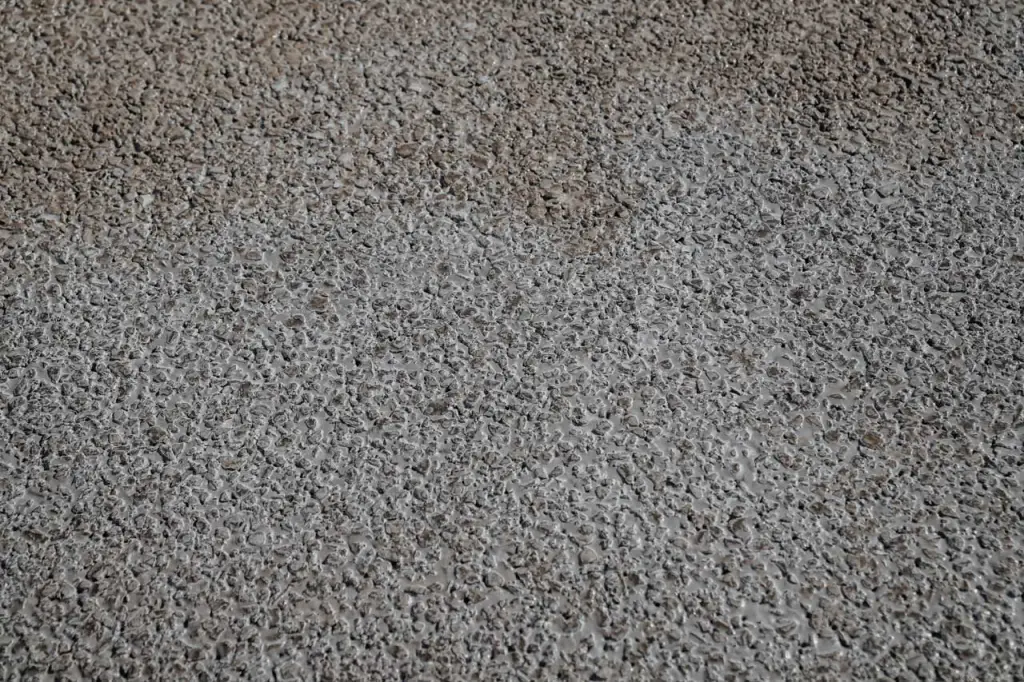
i.tech CARGO is a self-percolating cement mixture in the form of a fluid grout, developed for the complete clogging of open graded bituminous conglomerates with a high content of communicating voids. Once infiltrated into the porous structure of the asphalt, this allows the creation of monolithic semi-flexible pavements, combining the load-bearing capacity and chemical-mechanical resistance of the cement matrix with the flexibility of the bituminous conglomerate.
The result is a surface with high performance in terms of resistance to compression, puncture and the action of aggressive agents such as hydrocarbons and solvents, with a significant reduction in cracking, rutting and settlement phenomena. In terms of performance, this technology allows for greater durability than traditional bituminous paving, reaching resistance values up to four times greater, with benefits also in terms of maintenance and the environment.
As Marco Sandri, i.tech CARGO product manager and technical director of ibuild Italia, underlines, “i.tech CARGO combines speed, flexibility of intervention and high performance, representing a particularly suitable solution for high-traffic logistics and port areas, where reliability and operational continuity are essential requirements”.
Installation times and operational performance
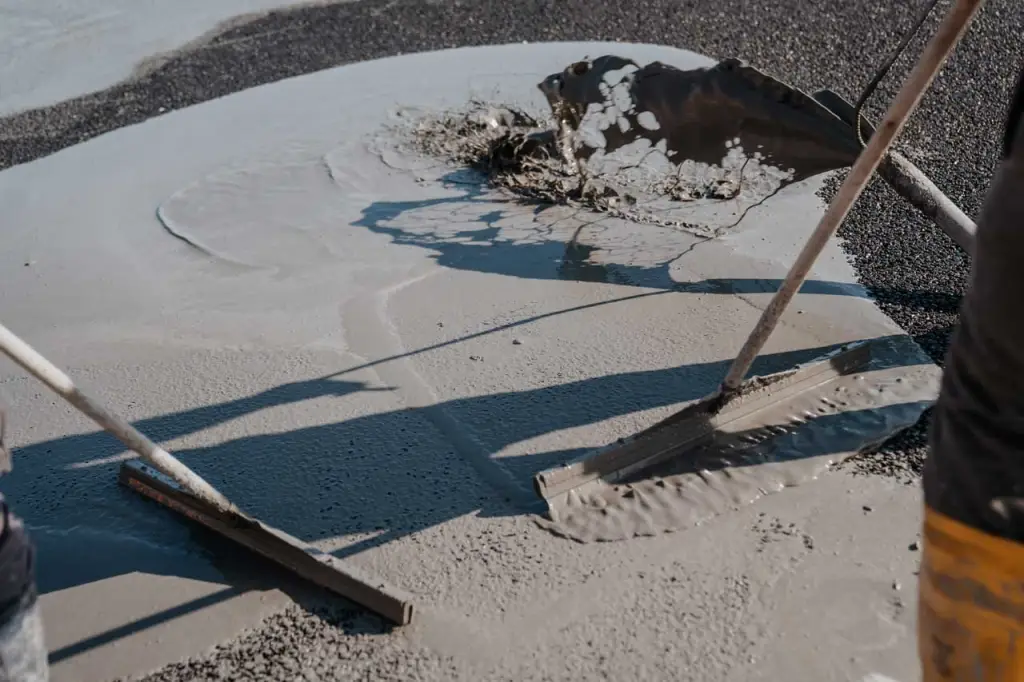
The installation of i.tech CARGO took place upon completion of the open graded bituminous layer, once the thermal conditions suitable for clogging had been reached. The cement grout, developed as part of a collaboration between i.build Italia/Heidelberg Materials Italia and Mapei and produced by the latter for the exclusive use of Heidelberg Materials, was packaged using a mixer on an articulated lorry, pumped onto the surface and distributed using manual squeegees, with subsequent mechanical finishing, favoring the expulsion of the air and the complete penetration of the grout along the entire thickness of the conglomerate.
The intervention allowed two strips of approximately 4,000 m² each to be completed in 4–5 days with a team of five operators, making the flooring operational in less than 24 hours from installation. Among the advantages of the solution:
- greater stability at high temperatures;
- reduction of surface deformations;
- less use of bitumen;
- albedo increase and heat island mitigation.
An intervention for port infrastructures with high intensity of use
The intervention at the port of Ortona represents an example of integration between structural consolidation, high-performance flooring and environmental sustainability. The combined use of ECO CAM concretes and i.tech CARGO technology confirms the evolution of cement solutions for port and logistics infrastructures, where durability, speed of execution and operational continuity constitute fundamental requirements, and is part of Heidelberg Materials’ path towards the development of increasingly reliable, sustainable technical solutions capable of responding to high performance requirements in complex operational contexts.
For further information
heidelbergmaterials.it