
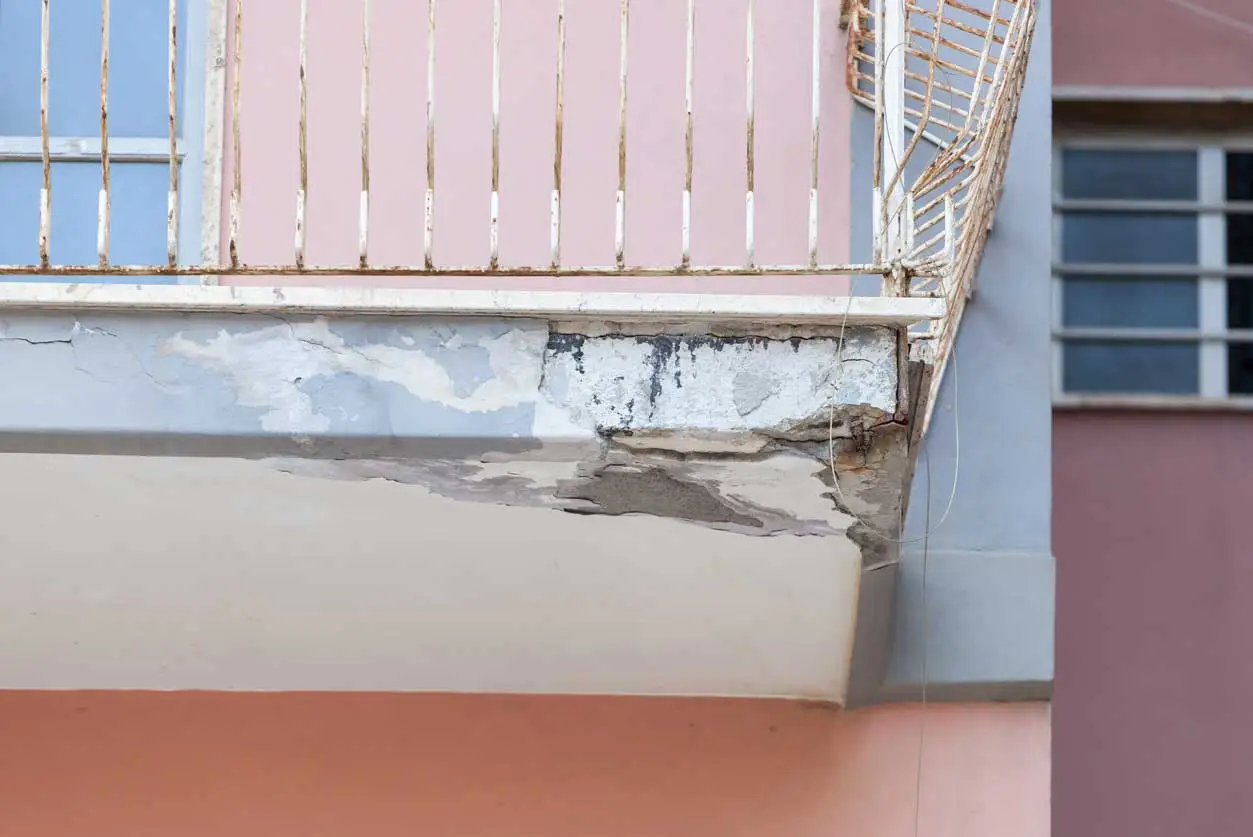
In the context of condominium life, overhanging balconies represent one of the most delicate issues in terms of responsibility, maintenance and safety protection. Their particular conformation, autonomous protrusions with respect to the facade, supported by their own brackets or beams, clearly distinguishes them from built-in balconies and inter-storey floors, generating significant consequences both in terms of ownership and in terms of maintenance obligations.
Jurisprudence has long clarified that the structure of the overhanging balconies constitutes the exclusive property of the individual condominium owner, since it is an extension of the real estate unit.
These structures, exposed to atmospheric agents and subject to progressive deterioration, can become a source of risk for the underlying units and common areas. In this regard, it must be considered that when the sub-balcony does not perform any decorative function of the façade, but presents a structural deterioration that compromises its safety, it must be qualified as an exclusive part of the overhanging balcony, with consequent responsibility of the sole owner of the unit above.
The story
The matter originates from the appeal brought pursuant to art. 1172 cc by a condominium owner, who reported the serious state of deterioration of the underbalconies of the apartment above, the exclusive property of the defendant. The appellant reported that the underlying parts of the balconies, both on the side of the public road and on the internal courtyard, were in conditions such as to raise fears of an imminent collapse, despite the presence of containment nets already installed. These protections, however, were insufficient to retain the detached material, with a real and serious risk of collapse for the building below and for the safety of the inhabitants.
The defendant contested the existence of a current danger, arguing that the nets installed (in double layer) were suitable for containing the rubble and that the situation was attributable to the lack of maintenance of the common parts and to infiltrations coming from the building.
The Court’s decision
On the merits, the Judge classified the application as an action for feared damage pursuant to art. 1172 cc, recalling the prerequisites required by the law: the danger of future damage, the seriousness of the danger and its spatio-temporal proximity. The official technical consultancy fully confirmed the appellants’ allegations. The CTU ascertained that the balconies above were in a state of deterioration, with plaster and concrete cover almost absent, exposed and oxidized reinforcing iron, detachments of material “barely held” by the fall protection nets. The causes of the deterioration have been identified as infiltrations, wear and insufficient maintenance, with a situation of degradation dating back at least a decade.
The consultant also noted that, despite the presence of the nets, a concrete risk remained: the weight of the rubble already detached had caused the protections to loosen, with the possibility of further failures and compromise of their sealing capacity. This framework led the Court to consider the serious and imminent danger required by the art. 1172 cc
As for the remedies, the CTU indicated urgent and temporary interventions suitable for eliminating the danger: removal of the rubble that has already fallen, revision of the protection nets and application of a transparent liquid sheath on the flooring of the balconies, in order to limit infiltrations. For the balcony overlooking the internal courtyard, which is not accessible to mechanical vehicles due to the unusability of the area, intervention via acrobatic construction was suggested, a solution deemed technically feasible.
The Court endorsed these conclusions, ordering the defendant to carry out the interventions indicated by the CTU (Trib. Siracusa 26 May 2026).
Safety nets: a temporary solution
In the event of deterioration of overhanging balconies, the owners’ first response is often to install protective nets to contain detachments of plaster or concrete. However, this is a merely temporary remedy: the nets, by their nature, do not guarantee a stable hold over time and are not designed to withstand the growing weight of the materials that continue to detach from the structure. Leaving it in place for an excessively long period, as happened in the specific case, drastically reduces its effectiveness and can transform it into a further risk factor.
The net, therefore, is not a structural remedy and does not exempt the owner of the overhanging balcony from the responsibility of maintenance and custody pursuant to art. 2051 cc (Trib. Palermo 20 March 2026 n. 1944).
>> If you want to receive news like this directly on your smartphone, subscribe to our new Telegram channel!
Thank you for subscribing to the newsletter.