
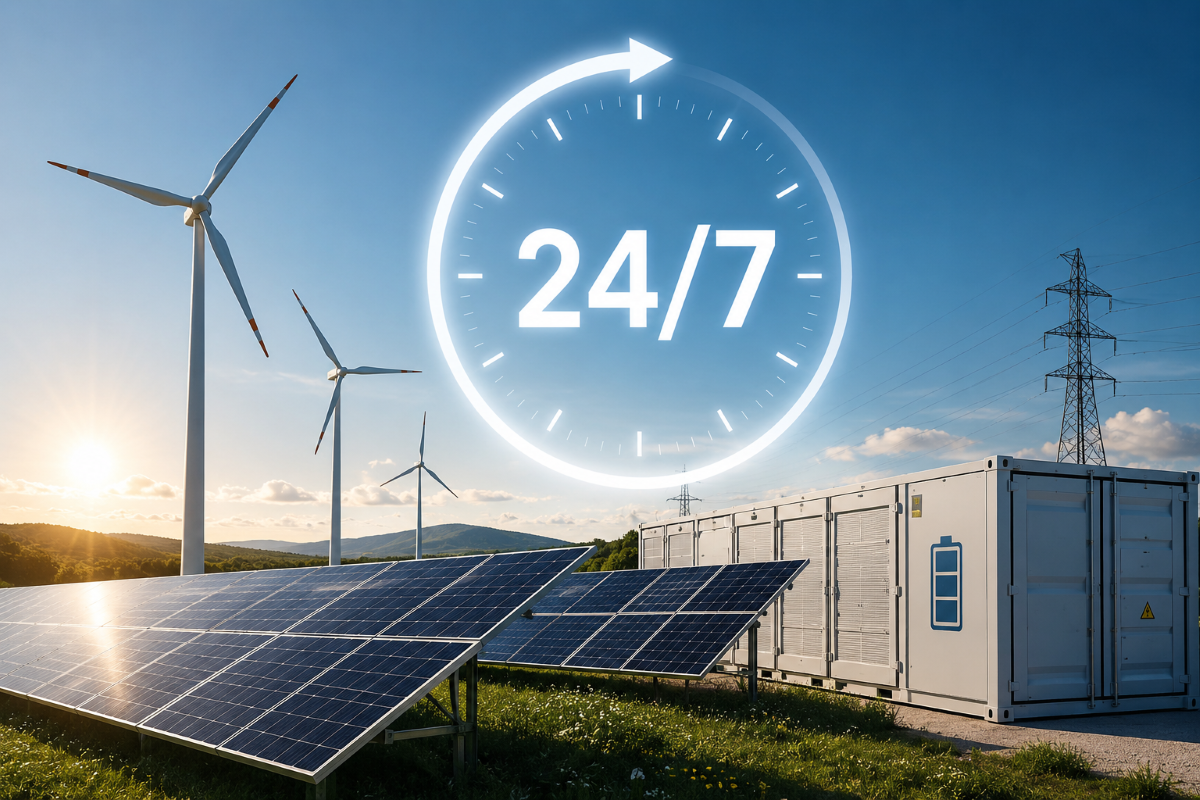
Engie and Legrand are launching the first “24/7” renewable electricity contract in France, with green production adjusted to consumption hour by hour.

Engie and Legrand switch to renewable electricity “24/7”. The two groups signed a supply contract covering the period 2029-2031 and intended to supplying all of Legrand’s activities in France with renewable electricity.
The principle is simple since it involves match, hour by hour, the production of renewable electricity with the customer’s consumption. A logic very different from that of traditional green electricity contractswhich generally operate on an annual basis.
Green electricity, but not necessarily at the same time
With a classic green electricity contractthe company buys each year a volume of renewable electricity corresponding to its consumption. But this does not mean that the electricity consumed at a given moment actually comes from a renewable source. The electricity network operates in real time: the electricity injected and that consumed must constantly balance each other, whatever their origin. According to Engie, this annual model now makes it possible to achieve around 40 to 50% correspondence between renewable production and actual electricity consumption.
THE “24/7” contract therefore pushes the reasoning much further. The objective is to bring renewable production and consumption as close as possible, hour after hourout of the 8,760 hours in a year. Legrand thus becomes the first French customer of Engie to adopt this type of contract. The system will make it possible to cover its entire activity in France with a supply of renewable electricity according to this logic of time correspondence.
Today, Engie estimates that it can achieve around 70% correspondence between renewable production and consumption with a 24/7 contract, with the ambition of going up to 100%. To achieve this, the supplier relies on the complementarity of several production sources: solar, wind and hydraulic, to which storage batteries can be added. Because the main challenge of 24/7 is precisely that of intermittency. A photovoltaic installation produces during the day, but not at night. Wind power depends on the wind. Hydraulics can provide more flexibility. Storage then makes it possible to move part of the electricity produced to periods when it is needed.
A contract still discreet about its amount
THE contract between Engie and Legrand will cover the years 2029 to 2031. The two groups, however, have not communicated either the volume of electricity concerned nor the financial amount of the agreement. This lack of data therefore does not yet make it possible to precisely measure the economic weight of the operation.
Its interest lies elsewhere: it marks the arrival in France of a supply model which seeks to go beyond the logic of certificates and guarantees of origin calculated on a yearly scale, to bring real consumption closer to renewable production.
Engie already has international experience in this field, with 24/7 contracts currently running in the United States, Brazil, United Kingdom and Belgium. Legrand, however, becomes the first French group to sign such a contract with Engie.
For the industrialist, this development should make its decarbonization approach more concrete. For Engie, it constitutes above all a new stage in the evolution of renewable electricity contracts towards much finer management of the balance between production and consumption.