
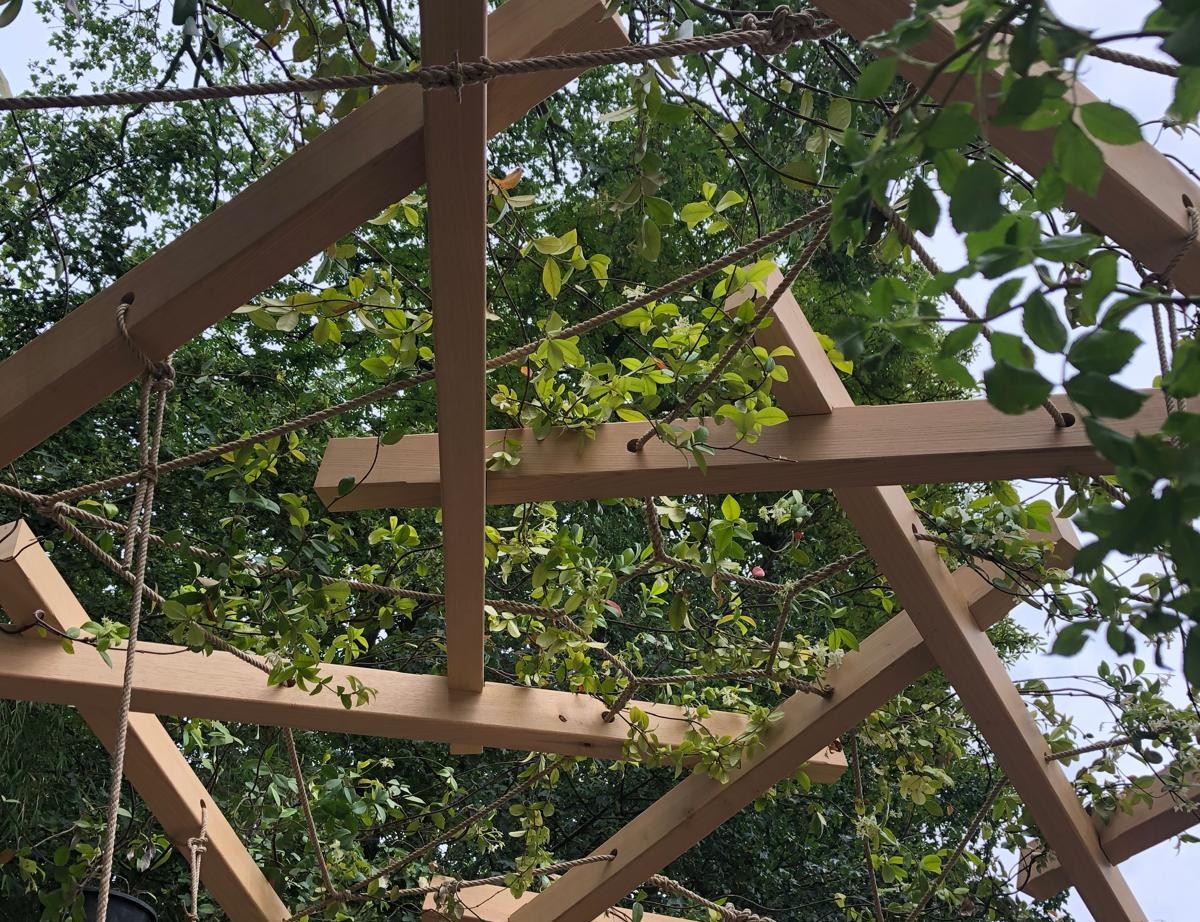
At the end of May, the Jardins jardin event was held at Villa Windsor in Paris, a point of convergence between plant architecture and new climatic construction.


The annual show, founded in 2003 notably by members of La Ferme de Gailly, influential Ile-de-France nurserymencelebrates its 20th edition and its 4th at the Villa Windsor from the Parisian Bois de Boulogne. Gradually, the boundaries between the world of construction and the world of gardens intersect.
Thus, in the gardens of the Villa, we come across the Bouquets of Douglas from the agency Chomette and Lupiinitially designed in 2018 in Douglas, as a totem of the 8th edition of the International Wood Construction Forumthen as the decoration of the “paddock” of the Grand Palais, with the magnificent banana leaf flowers of Bloomboom (which was obviously missing in this exterior configuration).
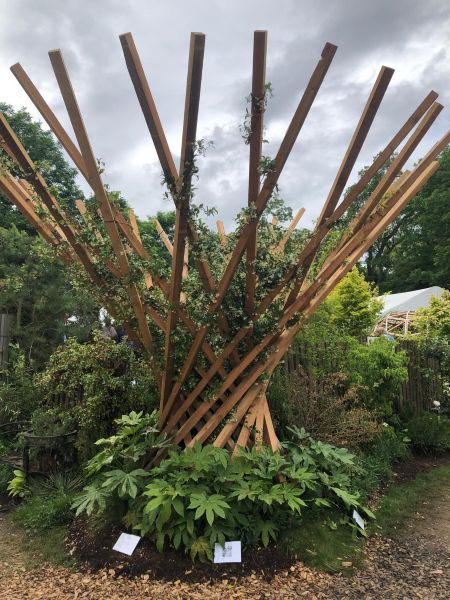
Douglas bouquets from the Chomette-Lupi agency. © Jonas Tophoven
Bioclimatic architecture and new climatic architecture
There are approximately 140,000 individual houses in the Greater Paris Metropolis, the garden is therefore very present in the urban area, with always the temptation to create an extra room. There new climatic architecture, inspired by bioclimatic architecture from the beginning of the millennium, needs plants to unfold on several levels. On the one hand because of biosourced materials, which is on the right track. But also by the protection of the building offered by plants. THE hardwood facing south which prevents the facade from heating up or on the contrary lets the sun’s rays through in winter, that’s the textbook case. If it is only the construction world has neither solved the question of the urban garden, nor found the way to plant developed trees so that they have their effect immediately because the heat waves are now and not in twenty years.
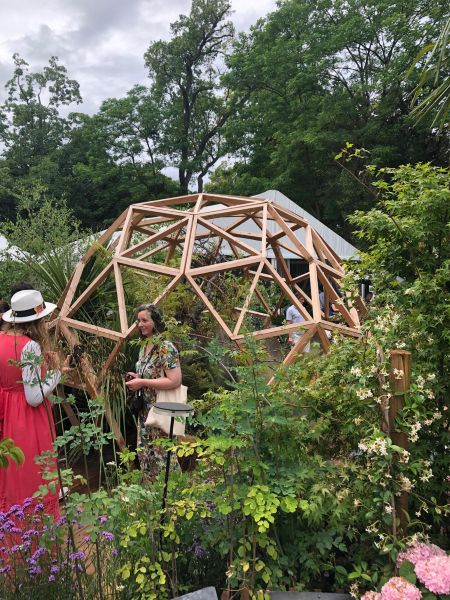
Zome by Michaël Feneux at Villa Windsor at the end of May. At the same time, Michaël Feneux and his team completed the assembly of the Belajò zome in the port of Gennevilliers at Balas. © Jonas Tophoven
Building with plants
Building with plants is a potential theme of the International Wood Construction Forum, hampered for the moment by the smallness of the market. There Ferme du Rail, in Paris, shows, among other things, a plant facade growing on the surface in front of a wood-straw building. The Virginia creeper is a treasure of biodiversity and grows quickly.
L’Stream building by PCA-StreamPorte de Clichy, leaves pushing harvested hops to produce beer in the building’s cellar. Building with a wooden structure and using bricks that are sometimes raw and unstabilized, sometimes cooked, to solve fire protection problems, is also the possibility ofaccommodate climbing plants that regulate the structure. But in the case of Jardins jardin, it is not a question of asking a builder to become a gardener, rather the opposite.
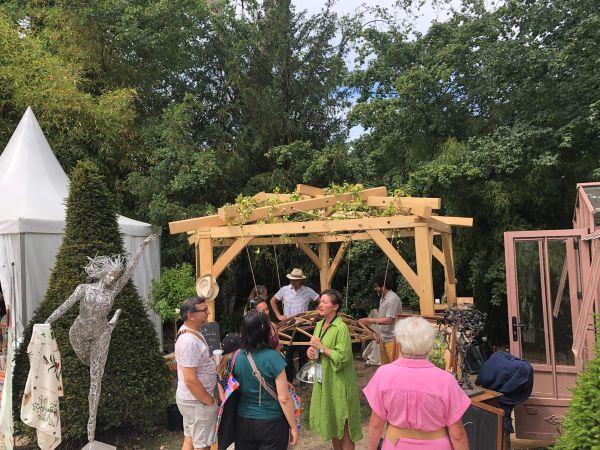
Ombrière de Sinallagma at the 20th Jardins jardin exhibition. © Jonas Tophoven
The terrace without an umbrella
The zome of Michaël Feneux which rises above the plants in the exhibition has above all a decorative function. THE biomimicry of these wooden structures fits well with gardens. Nothing prevents it from being combined with more or less lasting coverage, or from let plants climb, ensuring that the wood used also resists the tensions of tropisms. While the presence of a zome at Villa Windsor is fortuitous, that of L’Sinallagma shade house fits with part of the project developed by Vincent Bechtel: the renaissance of private shade houses, where the shade comes from the plants which also allow air to circulate and create incomparable cooling.
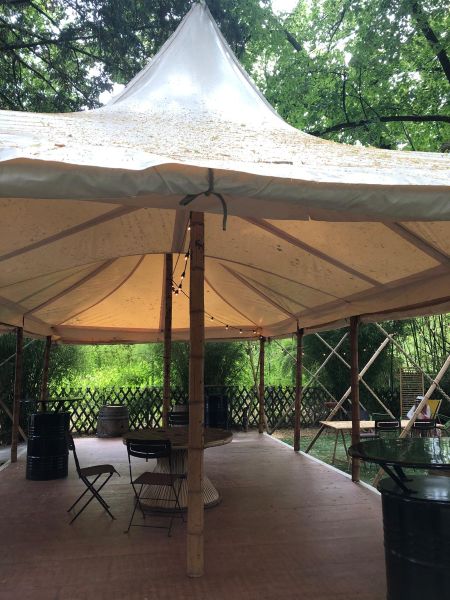
Superb bamboo pole shed proposed by Bambouctou. © Jonas Tophoven
Listen to the tropism
Vincent Bechtel aims, among other things, at the high end with biomimetic reciprocal constructions that a solvent buyer can equip without delay with jasmines or other long plants, knowing that very long climbing plants also have a price. We return here to one of the key problems of the plant constructionthere temporal difference between plant growth and construction of a structure.
Moreover, Vincent Bechtel captures the music of growing plants and proposes, at the Forum International Bois Construction as well as at Villa Windsor, to retransmit it in human musical mode. In outdoor classroom mode, we imagine that the teacher or natural sciences professor pinches a jasmine leaf and shows the permanent electrical liveliness of the plants which react to their surroundings.
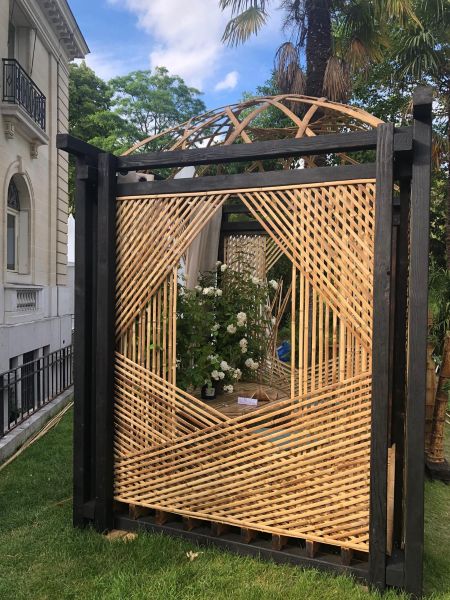
Bambouctou shows how the bamboo blade is not just about reeds. © Jonas Tophoven
Bamboo, myth and termites
Wood and plants are one thing, but there is also this mixture that bamboo represents, always fascinating with its speed of growth, its resistance, its persistence. THE construction plant strictly speaking is well represented Villa Windsor by Bambouctouwhich offers a magnificent barnum, whose bamboo posts still exceed the sections produced in France. According to François Rosenzweig, a specialist in bamboo and in particular French bamboo for a long time, French production is minimal to the point that the subject becomes anecdotal, except for imports. What is currently emerging in the North with Fiboo is the production of insulating fibers. As for Bamboothe focus is now on bamboo blades and their specific performance, without gluing. Thus, French bamboo could serve as a support for cob walls, but why not for sprayed hemp?
Biomass to survive
There plant construction is only reborn and like Paris, cities today are only discovering the boundaries between buildings and plantsthe public and the private. In this context, we must not forget the contribution of plants to carbon captureto the urban maintenance of biodiversity destroyed by agriculture, and also to remember the injunction of certain climatologists to counterbalance as quickly as possible the current development, according to which the weight of processed products has exceeded that of natural products on earth and in particular of biomass. Thus, according to the eminent German climatologist Hans Joachim Schellnhuber, the accumulation of biomass in urban spaces is the key to allowing humanity to emerge as quickly as possible from the climatic hell into which it is currently entering.
Jonas Tophoven / © Jonas Tophoven