
The apparent advantages of synthetic turf
Today, synthetic grass is viewed with great favor in many sports facilities, in municipal and parish football fields, but also in many private gardens. The main reason for its success is its resistance to time and the apparent absence of maintenance. The basic component materials of synthetic grass are Polyethylene (PE) and Polypropylene (PP), sometimes combined, or separated for the same function.
Polyethylene gives the blades of grass characteristics of softness, resistance to abrasion and bad weather, drainage capacity and synthetic memory, which is the characteristic with which each blade of grass tends to regain its original position, even after multiple crushing actions. Polypropylene, on the other hand, has opposite characteristics, obtaining greater rigidity which contrasts and balances the excessive softness of Polyethylene, as well as giving a more stable color over time.
The executive procedure for a synthetic turf includes an excavation, a filling of silica sand and the laying of a layer of recycled plastic (ELT type), derived from the crushing of discarded tyres, which – in sports fields – has the purpose of improving the bounce of the playing ball and absorbing the shocks of the players’ falls.
From a performance point of view, polyethylene and polypropylene are excellent resistant materials which, as mentioned, apparently allow for limited maintenance over time. Unfortunately, however, the favorable characteristics end here, if we take into account the countless controversial elements that are rarely shown.
The hidden environmental costs of synthetic turf
The permanence of the synthetic grass on the ground, the exposure to bad weather over time, the wear from trampling and the presence of the underlying loose layer of plastic material, in direct contact with the ground, can in fact determine a massive dispersion of micro and nano plastics in the ground, as well as PFAS, also called eternal pollutants, perfluoroalkyd and polyfluoroalkyd substances with which more than ten thousand water-repellent and oil-repellent synthetic chemical compounds are produced, and which they risk polluting aquifers, thanks to the transport of surface rainwater into the depths of the ground. It has been estimated that the release of microplastics from synthetic lawns in Europe is in the order of 45,000 tonnes per year on average (1).
Although there is a belief that synthetic turf does not require any irrigation, the opposite is actually true. In fact, it must be frequently wetted to keep its durability intact. In contact with UV, most plastic products, even the most resistant ones, tend to reduce their technical characteristics over time, especially due to the action of heat and temperature changes.
Likewise, it is necessary to dispel the myth that synthetic turf is easily draining. In fact, with the compaction of the underlying layers, integrated with shock-absorbing plastic materials, drainage is more difficult than a natural lawn, which better promotes the percolation of rainwater into the ground. This “water brake” unfortunately determines a certain predisposition to surface flooding, slowing down water absorption in the underlying layers.
Another flaw of artificial lawns is the ease with which they overheat in hot seasons, thus significantly contributing to the formation of heat islands, compared to a natural lawn which keeps the underlying substrate cool. Furthermore, in this condition, any animal excrement (dogs, cats, passing birds, etc.) persists on the surface, creating a major hygiene problem and the obligation to frequently use special disinfectants to sanitize the surfaces of the playing fields.
The superficial maintenance of synthetic grass, in fact, prevents the oxygenation of the soil, reducing its resistance, due to the absence of the stabilizing root systems of the grasses. In fact, it has been established that in the presence of a synthetic lawn there is an erosion of the substrate, where the fertile part, which reaches up to about 50 cm in depth, dries up and becomes sterilized.
A further negative detail concerns the progressive loss of its resistance characteristic due to the sun’s rays, which cause the soil to suffer persistent high temperatures. For this reason, continuous stress over time produces a progressive weakening of the blades of grass, causing progressive cracking and detachment, as well as the loss of colour.
While a vegetal lawn releases oxygen and captures carbon dioxide, also contributing to the abatement of various types of dust, synthetic lawn acts the opposite, preventing soil evaporation and transpiration. The presence of a fake lawn, especially on large extensions of sports fields, then determines the absence of the biodiversity that is normally present in a natural grass lawn, including insects, earthworms, hymenoptera, small reptiles, amphibians, hedgehogs, birds, thus missing an entire ecosystem.
Last but not least, the high cost of disposing of synthetic turf at the end of its life must be considered. When the lawn is worn and has lost a good part of its resistance and color characteristics, disposal involves the intervention of specialized personnel, who must cut the entire surface into pieces, avoiding the environmental dispersion of the individual constituent elements, to then transfer the waste to a landfill that can accept it, after paying the disposal charges, or to an incinerator for its waste-to-energy treatment.
When synthetic grass can make sense
In conclusion, there is a big difference between maintaining a lawn in its natural state and a synthetic one where, in the second case, the disadvantages seem to outweigh the advantages, despite apparently the opposite appearing to be the case.
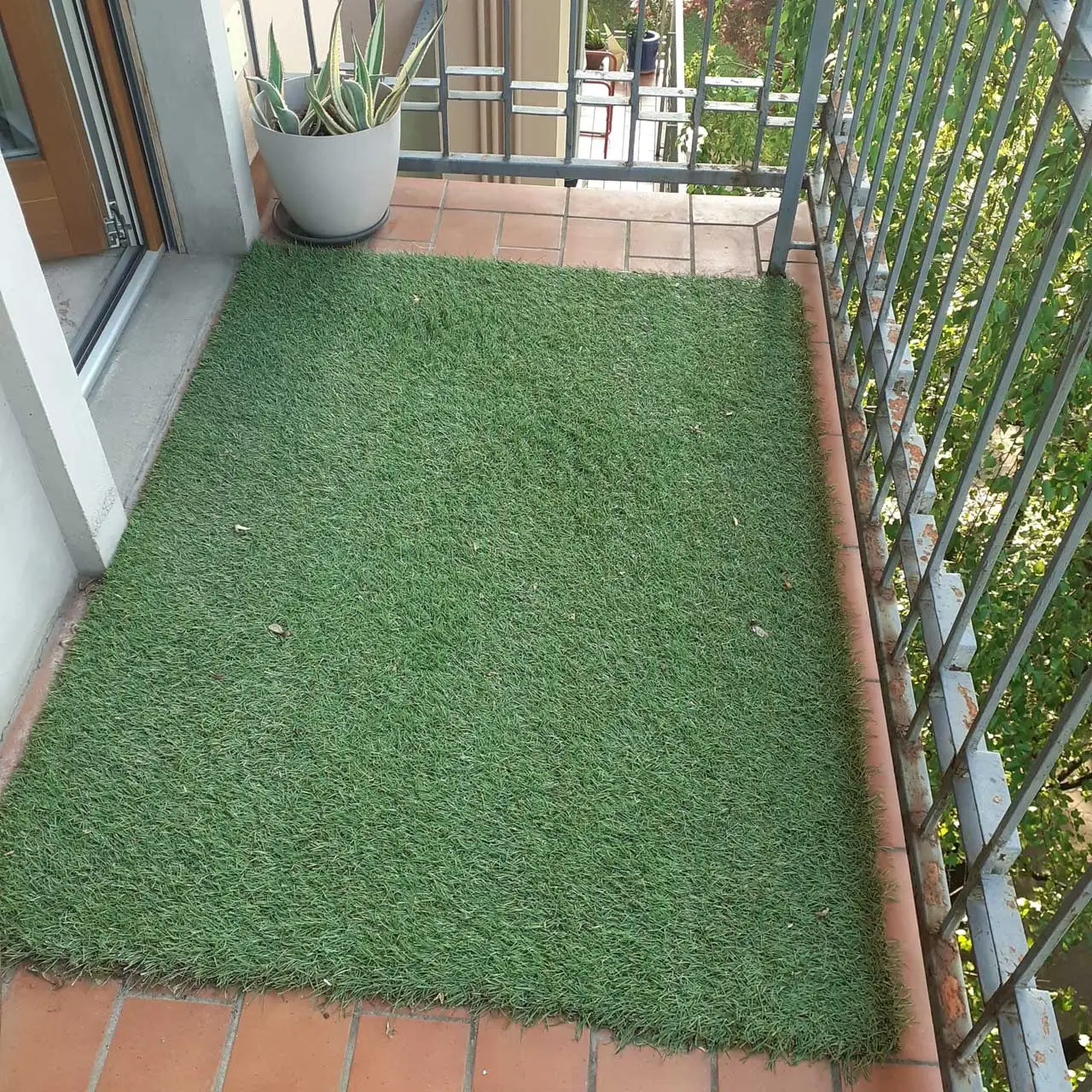
A practical piece of advice that I personally would like to give to anyone interested in experimenting with its use is to place it where you want to simulate a lawn effect in impossible physical conditions, such as for example on the terrace of a condominium or on the flat roof of a flat roof, taking care, in these cases, to check that no dispersions of plastic fragments are created and that the rainwater drains are kept clean and unobstructed. Only in these cases will it be possible to benefit from simulated greenery, without environmental risks and, probably, with fewer wear and tear problems over time.
Notes
(1) The European Chemicals Agency (ECHA) estimates that every year, in Europe, between 18,000 and 72,000 tonnes of microplastics from artificial lawns are released into the environment.