
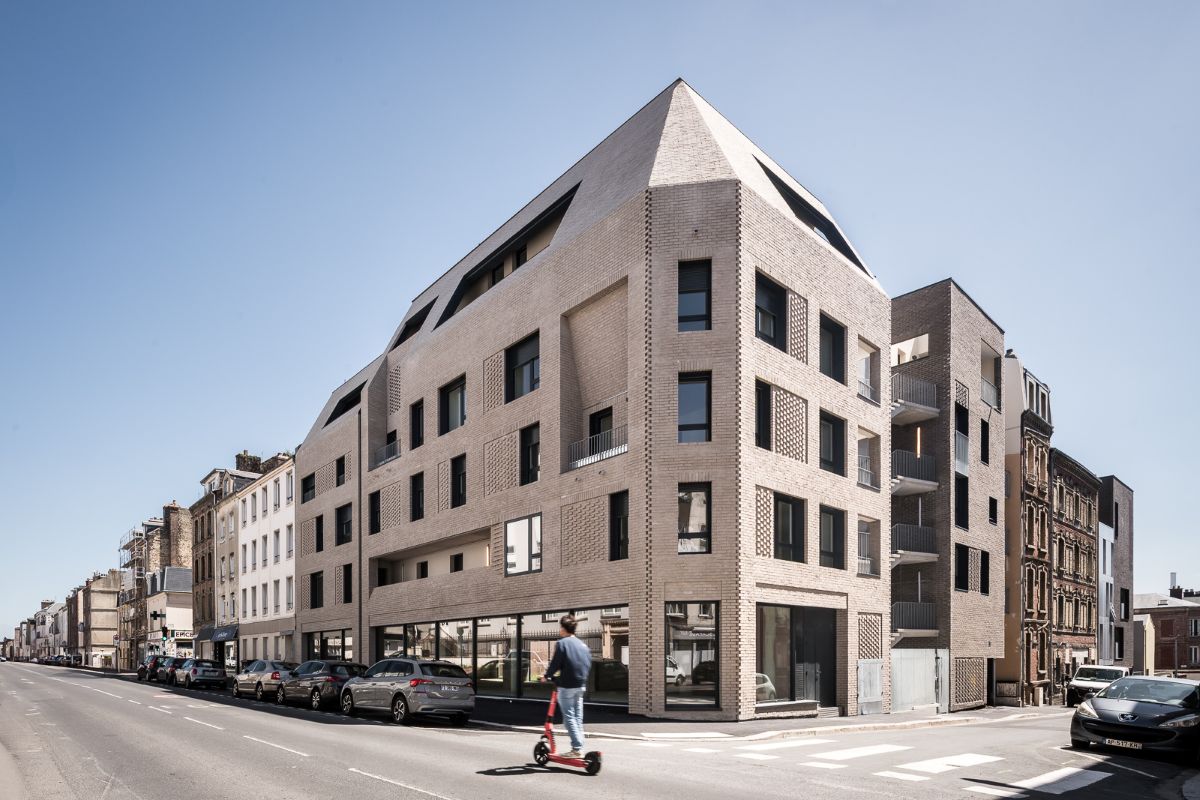
The Limmat residence, clad in hand-molded bricks, is part of an urban renewal process by combining contemporary architecture and industrial heritage.

At Havre, the Limmat residence is part of an architectural approach that combines memory of the territory and contemporary expression. Designed by Sterenn Architectes as part of an urban renewal operation, the project is based on a emblematic material of local history: brick.
Provided by wienerberger, the brick covers the entire building, from the facades to the roof, giving birth to a monolithic architecture whose reliefs and interplay of materials shape a singular identity.
Contemporary architecture anchored in Le Havre history
Located in a district expected to undergo significant transformations, the Limmat residence constitutes the first achievement of a larger urban renewal program. In this context, the designers sought to establish a dialogue between the Le Havre industrial heritage and contemporary uses. To achieve this, Sterenn Architectes has adopted certain historic building codesnotably their proportions and volumes, while developing a resolutely current style.
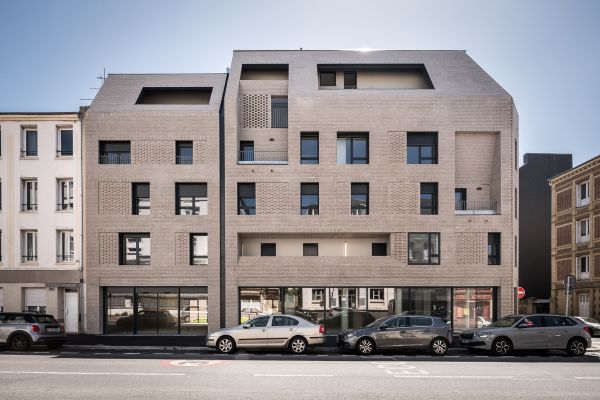
Brick quickly established itself as a central element. Long omnipresent in the Le Havre landscape before the post-war reconstructions, it offers here a direct link with the constructive history of the city while responding to the aesthetic ambitions of the project. © Sandro Carlo di Darsa
A monolithic envelope shaped by brick work
On the Limmat residence, terracotta is not limited to simple facade cladding. There brick covers the entire building and extends to the roof, following the inclined lines of the terraces and passageways. This architectural choice gives the building a particularly strong monolithic reading. The skin of the building is distinguished by significant compositional work where recesses, reliefs, patterns and variations in depth alternate.
The openings take place within rectangular frames dug into the facade, creating a regular rhythm while varying the dimensions. To this are added relief decorations inspired by moucharabiehswhose geometric patterns evolve throughout the day under the effect of natural light. The whole produces a living facade where the play of shadow and material permanently modifies the perception of the building.
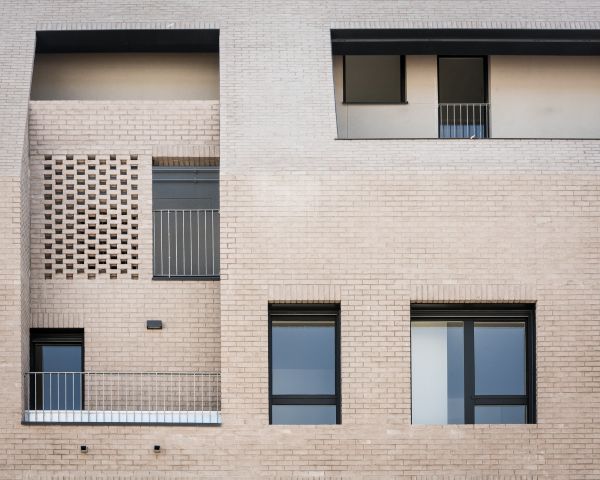
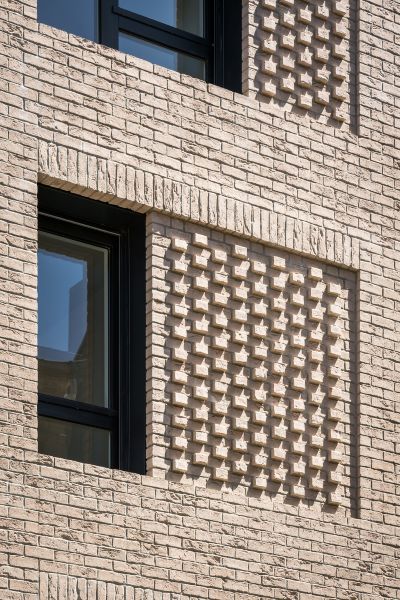
The facades are distinguished by the subtle work of the reliefs and openings, which enlivens the building with the light. The variations in depth and the patterns integrated into the brick create evolving shadow plays, giving the whole thing a changing appearance throughout the day. © Sandro Carlo di Darsa
Two shades of terracotta to distinguish volumes
The residence is made up of two buildings separated by a large central gap accommodating common circulation areas, in particular the main staircase. If the two volumes share the same architectural language, they are distinguished by the choice of their brick colors.
The main building is clad in beige-gray terracotta with slightly pink undertones, the brick Forum color Prata. This color echoes the tones of the concrete which characterize a large part of the Le Havre architecture reconstructed after the Second World War. The second volume, narrower and more vertical, is covered with a darker brick, the Prague Gray color. A choice which makes it possible to differentiate the constructions while making reference to another achievement designed by the agency in the same street.
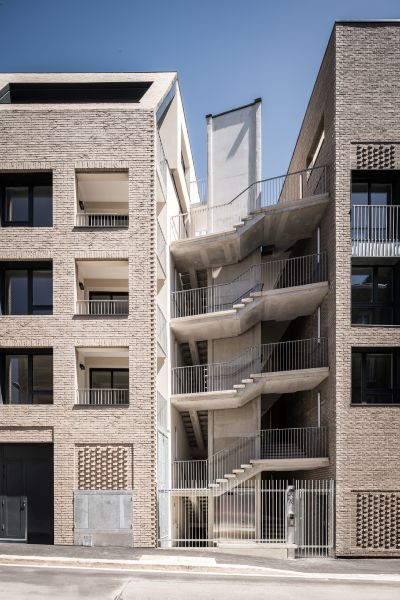
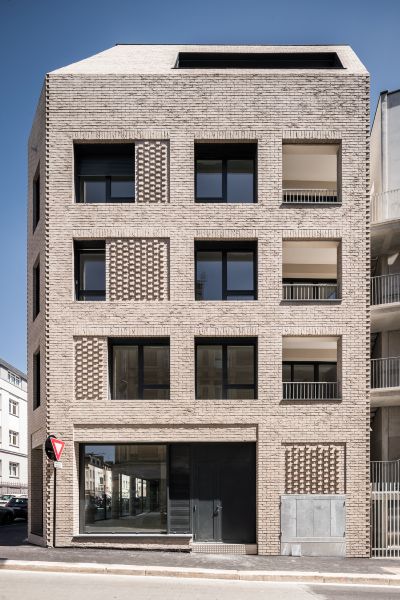
Two rooms, two atmospheres. © Sandro Carlo di Darsa
A material serving sustainability and constructive innovation
For Benoît Andrier, associate architect of Sterenn Architectes, the brick became obvious both for its heritage qualities and for its possibilities of implementation. According to him, the material offers great creative freedom thanks to the diversity of decorations, reliefs and assembly methods that it allows. On the Limmat residencethe architectural writing is based precisely on this meticulous work of recesses, inclinations and patterns which give rhythm to the facade.
The agency also favored a hand molded finish in order to bring more nuances and singularity to the whole. Each element presenting slight variations, the architecture gains in softness and warmth compared to more standardized production.
Beyond its aesthetic qualities, the terracotta was also chosen for its durability. “The advantage of terracotta is also that it is a durable material that ages well and can last 150 years without needing to be touched up. For this project, we were able to count on the support of Wienerberger from the design phase on the technical part, in particular for the reversal of the brick on the roof which goes beyond the usual construction rules and for which we had to carry out an Atex. We are very happy with the end result” testifies Benoît Andrier, associate architect of Sterenn Architectes.
© Sandro Carlo di Darsa