
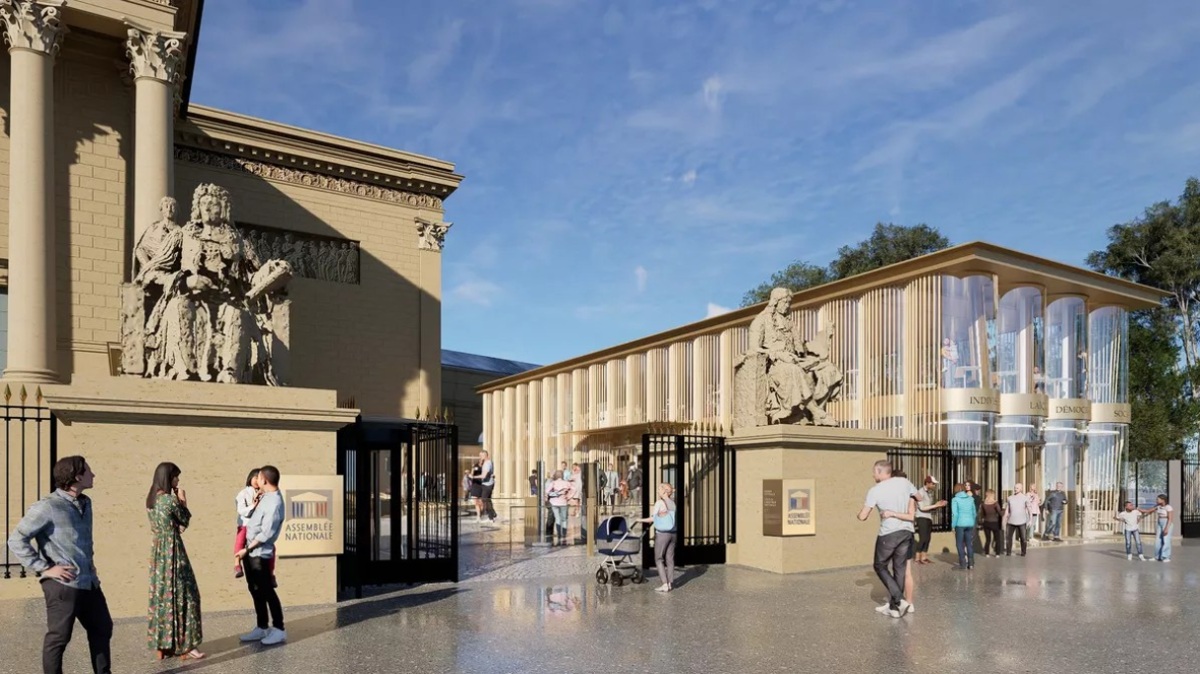
Despite a favorable opinion from the City of Paris, the 53 million euro building remains subject to numerous authorizations and continues to arouse strong opposition.

He had to modernize the reception of visitors to the National Assembly. Above all, he became one of the most controversial architectural projects of the Parisian summer. THE future reception pavilion of the Palais-Bourbonbaptized “L’A-venir” and designed by the Moatti-Rivière agencyis back on track after several months of suspension.
In July, the Paris Council issued a favorable opinion on the modification of the town planning regulations necessary for its implementation. An important step, but not a building permit: the City of Paris takes care to specify that this is neither a planning authorization nor a definitive validation of the architectural project. The file will still have to go through several stages before a new permit can be filed.
A glass building in place of an 1888 pavilion
The project plans to demolish the current public reception pavilion, built in 1888 by architect Edmond de Jolyto build a contemporary building of approximately 4,000 m2. Its largely glazed facade, composed in particular of four large cylinders and vertical lines evoking the colonnade of the Palais-Bourbon, must accommodate a larger entrance space, a shop, a cafeteria, exhibition spaces as well as an auditorium and an educational trail in the basement.
The stated objective is to better absorb the growing number of visitors, which reaches around 200,000 people per year.
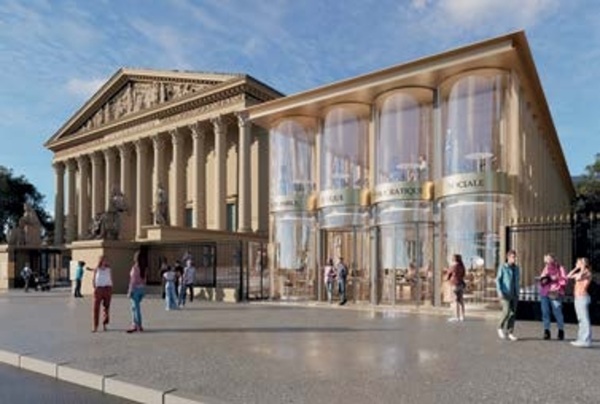
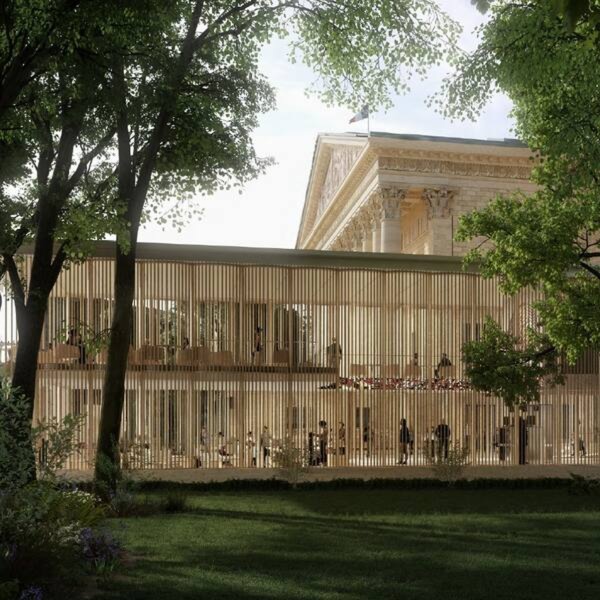
The future facade, largely glazed, will be structured around four large cylinders and vertical lines recalling the colonnade of the Palais-Bourbon. The building will accommodate a large entrance area, a shop, a cafeteria, exhibition spaces, an auditorium and an educational trail in the basement. © Moatti-Rivière
The contrast with theneoclassical architecture of the Palais-Bourbon is precisely what fuels the protest. For the Sites & Monuments association, which is leading the heritage movement, the future building would disrupt the harmony of the site and distort the surroundings of a emblematic monument of Paris. The association also recalls that the pavilion doomed to disappear itself constitutes a historic element of the architectural ensemble.
53 million euros going badly
The other point of tension is the amount of the operation: 52.8 million euros, or almost 53 million. L’National Assembly assumes this expense and ensures that the project will be self-financed thanks to the institution’s reserves, without recourse to additional funding from the State. She also emphasizes that certain studies already underway, particularly on accessibility, would have been necessary in any case and can be reused.
For his opponents, this argument is not enough. L’Sites & Monuments association judges the expense to be disproportionateparticularly in a context of budgetary constraints, and also challenges the environmental relevance of a largely glazed building.
A first license withdrawn
The project had already experienced a serious halt in February 2026. A first building permit was submitted in June 2025, but the Assembly finally decided to suspend the procedure. The site is in fact subject to particularly strict property ruleswithin the perimeter of protection and development plan (PSMV) of the 7th arrondissement.
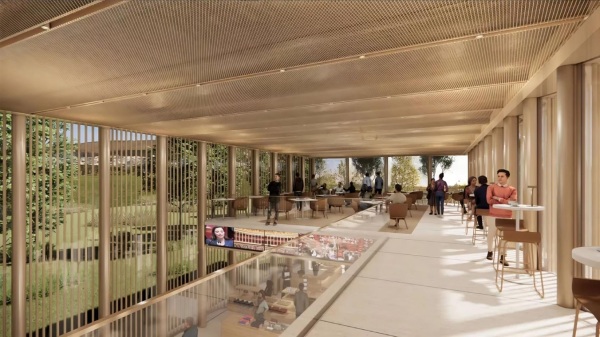
The cafeteria on the first floor of the future reception pavilion of the National Assembly, in which the Sites & Monuments in 2025 association sees a “Dubaïsation” of the parliamentary institution. © Moatti & Rivière.
The problem concerned in particular the possibility of creating the underground spaces planned by the project and its compatibility with the rules applicable to the site. Rather than risk rejection, the Assembly preferred to temporarily withdraw its permit. After the favorable opinion of the Council of Paris, the procedure must still continue with consultations of the competent services, in particular the Architect of Buildings of France and the local commission of the remarkable heritage site, before a public inquiry and possible final approval of the modification by the prefect.
The protest does not weaken
Launched by Sites & Monuments in 2025the petition denouncing a “ugliness of Paris“exceeded 90,000 signatures at the beginning of August. The controversy has also gained political ground. In fact, RN deputies Sébastien Chenu and Hélène Laporte are asking that the Bureau of the Assembly decide again on the project, which they judge “questionable and irrelevant“.
A request that Yaël Braun-Pivet’s entourage rejects: all political groups were represented in the Bureau when the project was unanimously approved in September 2024. The President of the Assembly also defended the project in the face of controversyconsidering in particular that certain criticisms focused on a building still little known to the general public. The institution above all ensures that it will adapt the project to the requirements of the State and the City, whether heritage, aesthetic or climatic.